










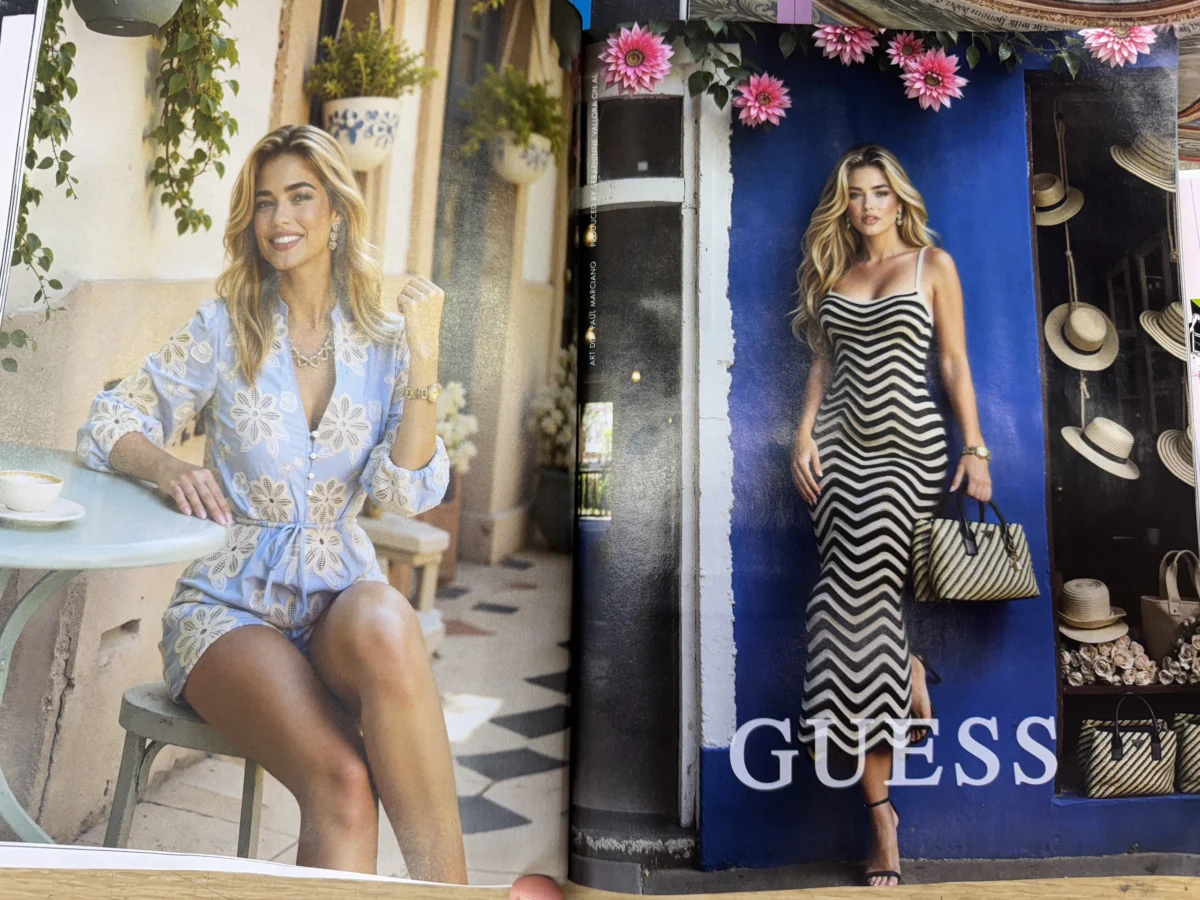
The global fashion industry stands at a critical technological crossroads, grappling with the rapid integration of artificial intelligence into advertising, e-commerce, and editorial content. What began as experimental digital styling and computer-generated imagery has rapidly evolved into a disruptive force capable of replacing human talent entirely. The debate intensified following the publication of Vogue’s July print edition, which featured an advertisement by Guess utilizing an entirely AI-generated model. This milestone moment within a publication historically tasked with setting industry standards has accelerated urgent conversations regarding copyright law, labor economics, and the future of human creativity.
A Chronological Shift: From Digital Mannequins to Generative Avatars
The integration of computer technology into retail and fashion marketing is not entirely novel. Retailers have experimented with digital visualization tools for over a decade. In 2013, the French retail giant Veepee began deploying virtual mannequins to display apparel online. However, the technological leap occurred around 2023, marking a watershed moment for generative artificial intelligence in commercial media.

In March 2023, iconic denim manufacturer Levi Strauss & Co. announced a partnership with AI digital studio Lalaland.ai. The initiative aimed to generate hyper-realistic, diverse digital models to showcase products online, ostensibly to increase representation and inclusivity across e-commerce platforms. The reaction from the fashion community was immediate and severe. Critics and industry insiders pointed out the paradox of using artificial algorithms to simulate human diversity instead of hiring diverse human talent, coining the term artificial diversity. Commercial models, including Sarah Murray, spoke out against the normalization of digital perfection, highlighting the psychological and professional toll such software inflicts on working professionals.
Over the subsequent two years, experimentation accelerated across global brands. Major retailers including H&M, Mango, and Calvin Klein began deploying AI-generated models for promotional campaigns, driven by commercial pressures to scale visual output. The threshold was crossed when the Guess advertisement appeared in the July print edition of Vogue. Unlike previous e-commerce experiments, the placement within a premier publication signaled a mainstream commercial endorsement, sparking fierce debate across social media and digital platforms.
Economic Realities and the Scaling Crisis
To understand the rapid adoption of AI modeling, industry analysts point to fundamental shifts in marketing demands and production economics. Traditional fashion advertising operated on a predictable seasonal cycle, requiring a limited number of high-production campaigns per year. The rise of social media, digital-first retail, and fast-fashion cycles completely restructured these requirements. Brands now need hundreds, thousands, or even hundreds of thousands of distinct visual assets to populate TikTok feeds, Instagram accounts, and targeted e-commerce portals.

According to PJ Pereira, co-founder of AI advertising firm Silverside AI, scaling content production from four major campaigns a year to hundreds of thousands is economically impossible through traditional photographic workflows. Hiring live models, securing studio space, booking photographers, makeup artists, stylists, and managing international travel incurs substantial capital expenditure.
Art technologist Paul Mouginot explains that generative AI enables brands to bypass traditional studio logistics entirely. By starting with a flat-lay product photograph, software can map garments onto photorealistic virtual avatars placed within coherent, digitally rendered environments. For brands operating on tight margins or attempting to satisfy algorithmic content demands, the cost savings are profound.
However, this financial efficiency directly threatens the foundational income source for commercial models. While high-fashion runway models achieve prestige and global recognition, the vast majority of working models rely on e-commerce and commercial catalog shoots for financial stability. Sinead Bovell, a model and founder of the digital literacy organization WAYE, notes that e-commerce is the bedrock of financial security for the profession. As brands automate these routine shoots, the economic pipeline supporting emerging and mid-tier talent is systematically constricted.
Ethical Dilemmas, Homogeneity, and the Threat of Robot Cultural Appropriation

Beyond the direct displacement of labor, the proliferation of generative AI introduces complex ethical considerations regarding representation, consent, and cultural ownership. When brands utilize generative AI to produce diverse models rather than employing historically underrepresented human professionals, critics label the practice robot cultural appropriation. This occurs when corporations synthesize identities to project inclusivity without providing economic benefits or authentic representation to the communities being portrayed.
Furthermore, models express deep concern regarding contractual clauses designed to secure rights for synthetic replication. Talents are increasingly asked to sign agreements containing ambiguous language that may grant brands the legal right to use their facial structures, body proportions, and recognizable characteristics to train proprietary AI systems. While organizations like the Model Alliance, led by former model Sara Ziff, are actively championing legislative efforts such as the Fashion Workers Act in New York to mandate explicit consent and financial compensation for digital replicas, the regulatory landscape remains largely unstandardized.
Technical homogeneity presents another major hurdle for the technology. Sandrine Decorde, CEO and co-founder of creative studio Artcare, points out that early generative models frequently suffer from a lack of distinctive character. Algorithms tend to output idealized, highly symmetrical facial features, uniform jawlines, and standardized beauty metrics that fail to capture the compelling imperfections characteristic of successful human models. Without deliberate, highly sophisticated prompt engineering and carefully curated training datasets, AI models risk amplifying existing societal biases rather than fostering genuine inclusivity.
The Children’s Wear Sector and Specialized Applications

While adult commercial modeling faces immediate automation, specialized sectors of the industry are finding distinct operational justifications for synthetic imagery. Artcare focuses heavily on generating digital representations of babies and children for apparel marketing. The employment of minors in the commercial fashion industry has historically represented a heavily regulated, logistically complex, and ethically sensitive arena susceptible to exploitation. By utilizing advanced image-generation tools powered by foundational models like Black Forest Labs’ Flux, companies can bypass the ethical complications associated with child labor while meeting intense market demand for children’s clothing imagery.
Industry Reception and the Divide Between Public Backlash and Sales Metrics
Despite technological advancements, consumer reception remains deeply polarized. Industry booking platforms, such as Ubooker founded by Claudia Wagner, view current AI ad campaigns primarily as experimental marketing ploys designed to capture temporary media visibility rather than foundational shifts in brand storytelling. Luxury heritage houses, which rely heavily on long-term brand narrative, exclusivity, and emotional connection, have largely maintained cautious distance from fully synthetic human campaigns.
Conversely, quantitative performance metrics tell a different story regarding commercial efficacy. Advertising firms utilizing AI-generated video and imagery on platforms like TikTok report significant friction in comment sections, accompanied by overwhelming engagement rates, dramatically higher click-through proportions, and measurable spikes in product sales. This data reveals a stark divergence between vocal public critics and the quiet majority of digital consumers who engage with and purchase products regardless of their digital origin.

The Future of Human Creativity in a Digital Economy
As the fashion industry navigates this technological paradigm shift, the consensus among technologists and creatives is that generative AI will ultimately integrate into standard creative workflows rather than completely eradicating human presence. However, the nature of modeling and creative professions is permanently altered.
Experts suggest that human talent must increasingly pivot toward personal branding, authenticity, and narrative differentiation. As Bovell observes, algorithms can synthesize physical perfection, but they cannot replicate a genuine human story, lived experience, or idiosyncratic charm. Whether prestigious publications like Vogue will fully embrace editorial spreads featuring artificial models remains an open question, but the commercial momentum behind synthetic imagery ensures that the debate over authenticity, labor rights, and the value of human artifice will define the fashion landscape for years to come.