









The German watchmaking industry, centered in the town of Glashütte, has long been defined by a philosophy of understated elegance, mechanical integrity, and historical continuity. Among the notable participants in this tradition is Tutima Glashütte, a brand with origins dating back to 1927. While historically recognized for its robust pilot’s chronographs and military-grade instrumentation, the company has spent the better part of the last fifteen years recalibrating its identity to compete within the high-end, in-house movement segment. The latest manifestation of this strategic evolution is the Tutima Patria 6612, a timepiece that attempts to bridge the gap between historical German horological aesthetics and contemporary material science through the use of a Grade 5 titanium case and a refined, in-house caliber.

The Evolution of the Patria Line: A Chronology of Strategic Realignment
The current iteration of the Patria 6612 represents the culmination of a decade-long shift in Tutima’s brand positioning. The trajectory of this evolution can be traced through several critical milestones that demonstrate the brand’s pivot toward the luxury sector.
In 2011, Tutima signaled its intent to enter the upper echelons of watchmaking by unveiling the Hommage Minute Repeater. This release was not intended for mass-market consumption; rather, it served as a technical proof-of-concept, establishing that the brand possessed the capacity to manufacture high-complication, in-house movements. The project resulted in a limited run of only 20 pieces, with price points exceeding $100,000 USD. This move was pivotal, as it forced a recalibration of the brand’s image among collectors and industry analysts.

By 2013, the brand introduced the foundational Patria collection. At launch, these models were exclusively 18k gold, 43mm in diameter, and powered by the newly developed Caliber 617. Despite the technical prowess of the movement, the market response to the collection was muted. Industry observers noted that the 43mm size felt discordant with the refined, dress-watch aesthetic, and the high entry price created a barrier to adoption.
The company spent the ensuing years refining its approach. A significant update arrived in 2019, when Tutima released a stainless steel version of the 43mm Patria, priced at approximately €4,900, aimed at making the platform more accessible. Following a period of corporate restructuring and leadership changes, the brand eventually arrived at the current 6612 generation, which debuted in 2025. This latest iteration reflects a concerted effort to optimize the case dimensions and material composition for the modern collector.

Technical Specifications and Material Innovations
The Tutima Patria 6612, specifically the 6612-09 reference, marks a departure from traditional precious metals in favor of Grade 5 titanium. This choice of material addresses a common criticism of the earlier gold models: the weight-to-wearability ratio. Grade 5 titanium is known for its high strength-to-weight ratio and its hypoallergenic properties, making it an increasingly popular choice for luxury timepieces intended for daily use.
Case and Dial Architecture
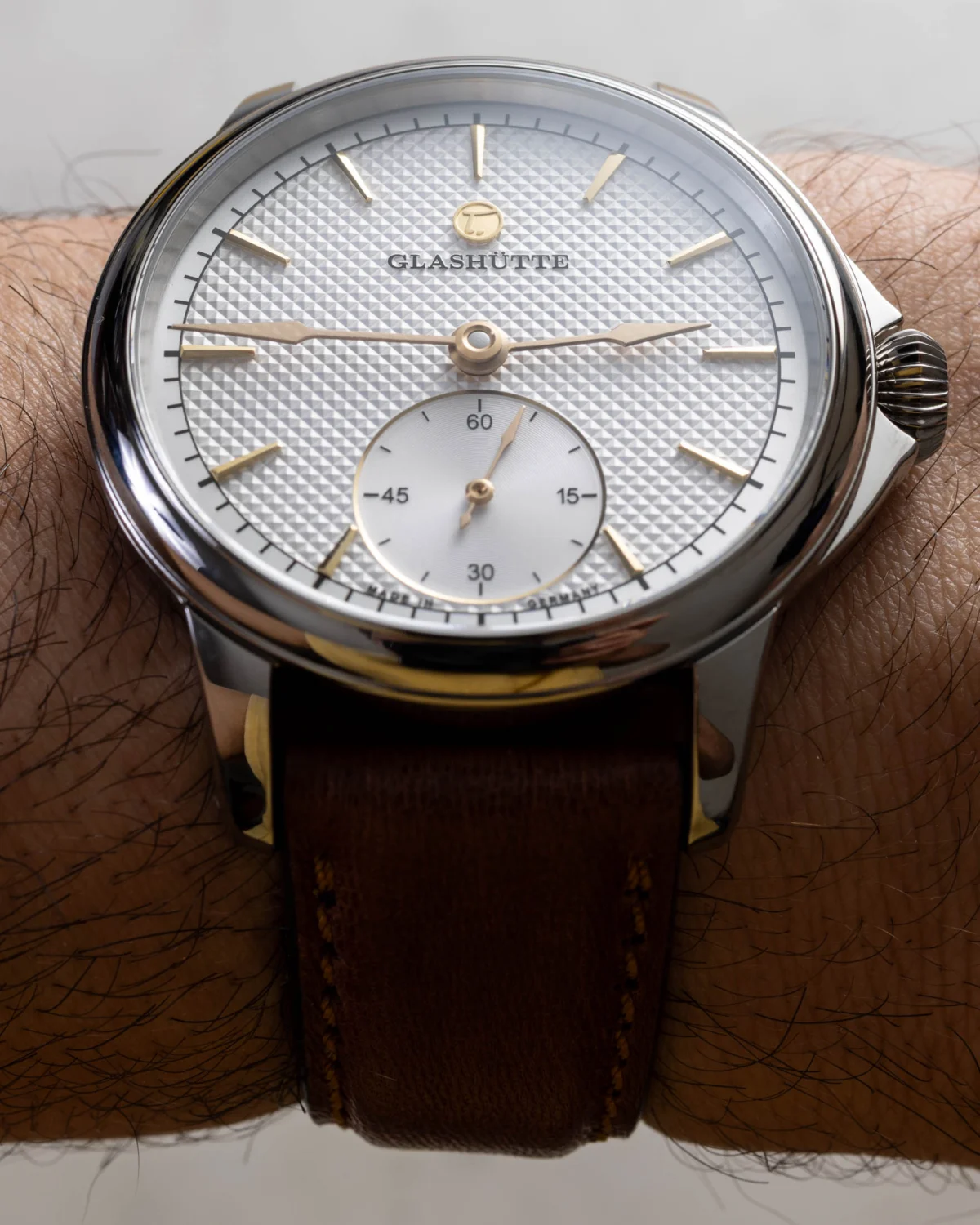
The case has been reduced from the original 43mm to 41mm, a modification that aligns with broader industry trends favoring more conservative, ergonomic proportions. The watch features a thickness of approximately 12mm and a lug-to-lug distance of 48mm, dimensions that facilitate a balanced presence on the wrist. The case is finished with a combination of polished surfaces, while the dial—a silver-white, machine-engraved textured surface—provides a depth that contrasts with the minimalist design language of the hands and hour markers. These markers and hands are crafted from 18k yellow gold, adding a layer of warmth to the industrial cool of the titanium housing.

The In-House Caliber 617
At the heart of the timepiece is the manual-wind Caliber 617. This movement is a testament to the Glashütte tradition, featuring the characteristic three-quarter plate that provides structural rigidity and protects the gear train. Operating at a frequency of 3Hz (21,600 vibrations per hour), the movement is designed for longevity and ease of service.
The finishing includes traditional elements such as real gold chatons and specific Glashütte-style decorative patterns. The power reserve is rated at 65 hours, which is competitive for a time-only manual movement. While the caliber does not utilize blued screws—a common stylistic choice in the region—this decision appears to be a deliberate effort by Tutima to maintain a distinct aesthetic identity separate from its local contemporaries, such as A. Lange & Söhne.

Market Analysis and Strategic Implications
The introduction of the titanium Patria 6612 at a price point of €8,600 carries several implications for the mid-to-high-end watch market. First, it highlights the increasing demand for "casual luxury"—timepieces that offer high-level finishing and in-house mechanics but are constructed from materials suitable for everyday, non-formal environments.
Historically, German watchmakers in Glashütte have been bifurcated into two categories: high-volume, entry-level luxury manufacturers and ultra-high-end maisons. Tutima is currently attempting to occupy a middle ground, leveraging its heritage as a tool-watch manufacturer to justify the durability and utility of its dressier models. By transitioning from 18k gold to titanium, the brand has effectively lowered the weight of the watch while maintaining the prestige associated with the "Made in Germany" designation.

Furthermore, the decision to return to a historic graphical "T" logo on the dial indicates a strategy of heritage-based branding. In an era where consumers are increasingly looking for brand authenticity, referencing the company’s 1927 roots serves to ground the modern, tech-forward movement in a long-standing historical narrative.
Consumer Reception and Future Outlook
Early feedback from the horological community suggests that the reduction in case size and the shift to titanium have been well-received. The Patria 6612 is perceived as a "sweet spot" product, offering the prestige of an in-house Glashütte caliber without the fragility often associated with delicate, precious-metal dress watches.

The versatility of the 6612-09, paired with a mahogany sheepskin strap, suggests a target demographic of collectors who value both technical substance and understated daily wearability. While the brand has yet to implement a power reserve indicator—a feature frequently requested by enthusiasts—the current iteration of the Caliber 617 remains a stable and reliable foundation.
Looking forward, the success of the 6612 series may determine whether Tutima expands the collection further. With seven existing variations already in production, the brand has demonstrated a willingness to experiment with dial textures and material finishes. If the current trajectory holds, the Patria line is likely to become the primary vehicle through which Tutima maintains its competitive standing against other established German horological houses.

Conclusion
The Tutima Patria 6612 is a product of significant internal refinement. By reconciling the technical expectations of a Glashütte-made watch with the modern demand for material innovation and ergonomic comfort, the brand has successfully repositioned one of its flagship models. The watch does not attempt to reinvent the wheel, but rather focuses on executing a classic design with high-quality, in-house engineering. For the collector, it offers a compelling alternative to the more conventional options currently dominating the market, blending the legacy of a near-century-old brand with the practical demands of contemporary life. As Tutima continues to navigate the complexities of the luxury watch industry, the Patria 6612 serves as a clear indicator that the brand has found its groove, emphasizing a balanced approach to design, function, and heritage.