





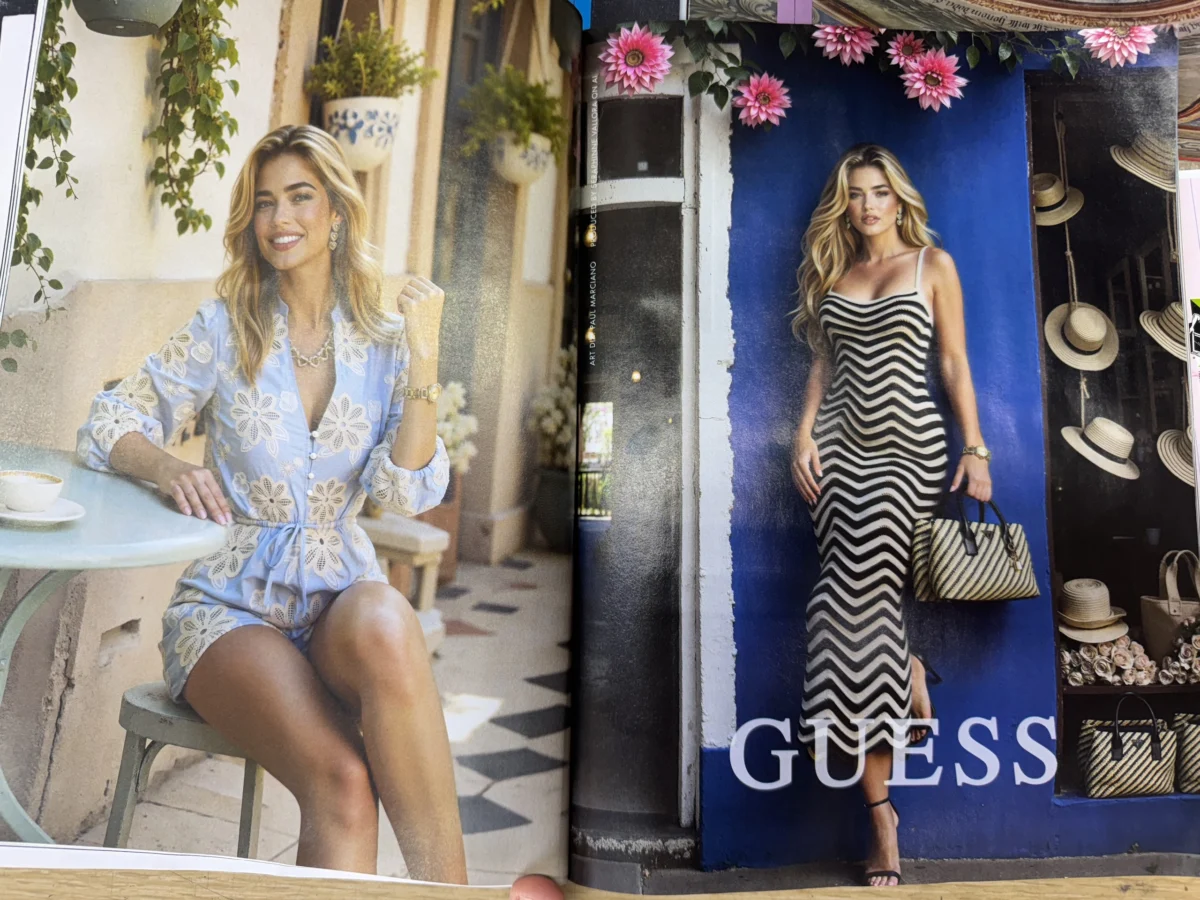
The fashion industry is currently navigating a profound technological shift as artificial intelligence moves from back-office logistics to the very face of global marketing campaigns. In July 2025, the industry reached a new inflection point when a print edition of Vogue featured a Guess advertisement showcasing a model who, despite embodying the brand’s signature aesthetic of glossy tresses and symmetrical features, was entirely AI-generated. This development has reignited a fierce debate over the displacement of human labor, the ethics of "artificial diversity," and the future of creative professions in an era of rapid automation.
The incident is not the first time the industry has faced backlash for substituting human talent with silicon-based alternatives. In 2023, the iconic denim brand Levi Strauss & Co. announced a partnership with Lalaland.ai, a digital studio specializing in hyper-realistic AI models. The stated goal was to promote inclusivity by generating diverse digital avatars. However, the move was met with immediate criticism from industry professionals and cultural critics, who labeled the initiative "artificial diversity." Critics argued that instead of hiring diverse human models who have historically been excluded from high-paying roles, the brand was choosing to simulate representation through software.
The Economic Imperative: Why Brands are Abandoning the Camera
The transition toward AI modeling is driven by a fundamental shift in how fashion content is consumed and produced. Traditionally, fashion houses operated on a seasonal cycle, producing a handful of high-impact campaigns per year. However, the rise of social media and e-commerce has necessitated a staggering volume of content. PJ Pereira, co-founder of the AI advertising firm Silverside AI, notes that the modern marketing landscape requires brands to scale from four major assets per year to potentially 400,000 unique pieces of content to satisfy algorithmic demands and personalized shopping experiences.

The financial disparity between traditional photography and AI generation is stark. A standard professional photoshoot involves a significant logistical apparatus: booking models, photographers, hair and makeup artists, stylists, and set designers. When factoring in studio rentals, travel, and catering, a single day of shooting can cost tens of thousands of dollars. In contrast, generative AI allows brands to take a "flat-lay" product image and project it onto a photorealistic virtual model in any setting imaginable within minutes.
Industry experts identify e-commerce modeling as the most vulnerable sector. While high-fashion "editorial" models—those who walk the runways of Paris and Milan—rely on their unique persona and celebrity status, e-commerce models provide the "bread and butter" of the industry. These professionals pose for the catalogs of retailers like H&M, Mango, and Calvin Klein. As these brands increasingly adopt virtual mannequins, the financial security of thousands of working models is at risk.
A Chronology of the Synthetic Face
The integration of non-human entities in fashion has a longer history than many realize, evolving through three distinct phases:
- The Virtual Mannequin Era (2013–2017): Companies like the French retailer Veepee began using basic CGI mannequins to display clothing. These were clearly digital and intended to provide a consistent look for online catalogs without the cost of human talent.
- The CGI Influencer Boom (2018–2022): The emergence of "Lil Miquela" and "Shudu" introduced the concept of digital supermodels. These characters, while computer-generated, built massive social media followings and landed major brand deals, proving that audiences could form emotional connections with synthetic personas.
- The Generative AI Explosion (2023–Present): The current phase utilizes Large Language Models (LLMs) and diffusion models like Black Forest Labs’ Flux. This technology allows for the creation of hyper-realistic imagery that is often indistinguishable from reality, moving beyond pre-designed CGI characters to infinitely variable, on-demand human likenesses.
The Ethics of "Robot Cultural Appropriation"
One of the most contentious aspects of AI modeling is its impact on diversity and representation. Sarah Murray, a commercial model, expressed to TechCrunch the exhaustion felt by many in the industry who now have to compete with "digital standards of perfection." The concern is twofold: first, that AI will set unattainable beauty standards by removing all human "imperfections"; and second, that brands will use AI to bypass the need to hire people of color, plus-size models, or older models.

Sinead Bovell, a model and founder of the WAYE organization, coined the term "robot cultural appropriation" to describe the phenomenon where brands generate diverse identities to tell a story without actually providing economic opportunities to the communities they are simulating. This creates a paradox where the digital world appears more inclusive than ever, while the physical world of professional modeling becomes increasingly homogenous and economically restricted.
Furthermore, there are growing concerns regarding the "homogeneity of the prompt." Current AI models often default to a narrow range of beauty standards—perfectly symmetrical lips, high cheekbones, and specific jawlines—unless specifically prompted otherwise. Without intentional intervention by "AI artisans," the technology risks amplifying existing biases in its training data, leading to a digital landscape that lacks the "charming imperfections" that have historically defined iconic human models.
Legal Frontiers: The Fight for Likeness Rights
In response to these technological threats, advocacy groups are pushing for legislative safeguards. Sara Ziff, a former model and founder of the Model Alliance, is currently championing the Fashion Workers Act in New York. This landmark legislation seeks to regulate management agencies and require brands to obtain clear, written consent and provide fair compensation when using a model’s digital replica.
The legal battle is intensifying as models report new clauses in their contracts. These terms often grant brands the right to use a model’s "recognizable features" to train future AI systems. Without legal protection, a model could effectively be signing away their career, as a brand could use their digital twin for decades without ever hiring the human original again.

Paul Mouginot, an art technologist, suggests that while this technology replaces labor, it also offers a new revenue stream for "sought-after" models who can license their avatars to appear in multiple shoots simultaneously across the globe. However, he warns that this "winner-takes-all" dynamic will likely benefit a small elite while further marginalizing the majority of the workforce.
The Role of the AI Artisan
As the technology matures, a new professional class is emerging: the AI Artisan. Firms like Artcare are positioning themselves as intermediaries who use tools like Black Forest Labs’ Kontext AI to fine-tune digital models with a "touch of unique humanity." Sandrine Decorde, CEO of Artcare, argues that AI can be used ethically to address "gray areas" in the industry, such as children’s fashion. By using AI-generated children, brands can fulfill market demands without the risks of exploitation or the logistical difficulties associated with employing minors.
These artisans emphasize that "imagery needs to make an impact." They argue that the future of fashion AI is not about mass-producing generic faces, but about creating distinctive digital personas that embody a brand’s specific heritage. This requires a deep understanding of datasets and image refinement to ensure the digital models possess the "gaze" and "attitude" necessary to move product.
The "Vogue Effect" and the Path Forward
The inclusion of an AI-generated model in Vogue represents a significant cultural endorsement. Fashion historian Amy Odell suggests that Vogue acts as the industry’s ultimate arbiter of taste. Much like the magazine’s eventual embrace of reality television stars paved the way for their mainstream acceptance in high fashion, the "Vogue stamp of approval" on AI may signal to luxury heritage brands that the technology is now acceptable for high-stakes editorial work.

However, the data suggests a complex consumer reaction. While social media comments are often overwhelmingly negative—focusing on the "uncanny valley" effect or the loss of human jobs—the underlying business metrics tell a different story. PJ Pereira noted that in recent tests, AI-generated product videos saw engagement rates 20 times higher than traditional content, with click-through rates and sales seeing a "steep hike" despite vocal criticism in the comments section.
Ultimately, the fashion industry appears to be moving toward a hybrid future. Luxury brands may continue to prioritize the "sensual reality" of human connection and the prestige of high-profile human models to maintain their aura of exclusivity. Meanwhile, the fast-fashion and e-commerce sectors are likely to become almost entirely automated.
For human models, the advice from veterans like Sinead Bovell is to lean into "unique human stories." As AI becomes the standard for generic beauty, the value of a model’s personal brand, their voice, and their lived experience may become their most valuable assets. In a world of infinite digital perfection, the "touch of imperfection" and the authentic human narrative may become the ultimate luxury.