







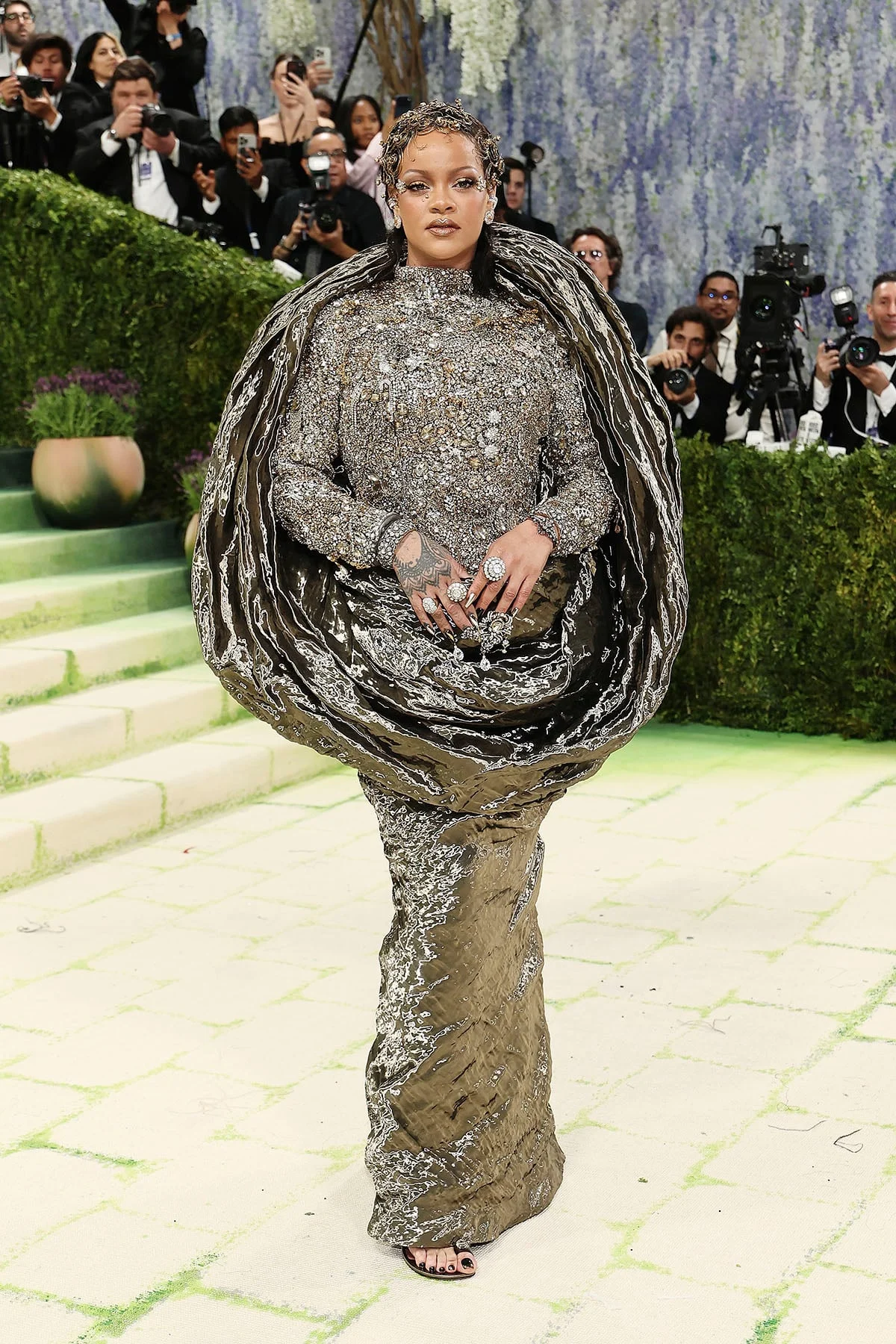
The Metropolitan Museum of Art’s annual Costume Institute Benefit, colloquially known as the Met Gala, remains the preeminent intersection of global celebrity and high-concept fashion design. For the 2026 iteration, the theme "Costume Art" challenged attendees to bridge the gap between historical garment construction and the conceptual boundaries of fine art. Rihanna, an attendee whose presence has become synonymous with the event’s most transformative moments, arrived in an ensemble that served as a technical and aesthetic masterclass in the evening’s directive. Dressed in a custom creation by Maison Margiela Artisanal, designed under the creative direction of John Galliano, the artist and entrepreneur presented a look that synthesized medieval architectural influences with avant-garde material experimentation.
Technical Mastery and Material Innovation
The centerpiece of Rihanna’s 2026 appearance was a draped column silhouette that functioned as a structural homage to the medieval architecture of Flanders. The gown’s construction relied on a complex interplay of rigidity and fluid movement, reflecting the atmospheric qualities found in 15th-century Flemish primitive painting. This stylistic choice linked the look to Maison Margiela’s 2025 exploration of historical forms, where the house focused on the intersection of surface texture and anatomical volume.
The material composition of the gown represented a significant departure from traditional couture textiles. In a continuation of Maison Margiela’s commitment to "Recicla" philosophies and the use of unexpected materials, the dress was crafted from duchesse woven with fine metal recycled threads. These threads, typically utilized in computer wiring and industrial electronics, were repurposed to provide the fabric with a memory-like quality, allowing the drapes to be sculpted entirely by hand into permanent, architectural folds.
Beneath the metallic-woven exterior lay a corseted bodice that served as the garment’s structural anchor. The embellishment of this bodice was a feat of high-jewelry integration and labor-intensive craftsmanship. It featured over 115,000 crystal beads, interspersed with antique jewels and intricate chains. According to reports from the Maison Margiela atelier, the embroidery process alone required 1,380 hours of manual labor. Each element was hand-sewn to ensure that the weight of the crystals and antique components did not compromise the integrity of the underlying structure, creating a surface that reacted dynamically to the camera flashes of the red carpet.
Artistic and Historical Context: The Flemish Influence
The "Costume Art" theme necessitated more than mere aesthetic appeal; it required a deep engagement with the history of visual culture. The Maison Margiela ensemble for Rihanna drew heavily from the visual language of the Northern Renaissance. The "Flemish primitive" influence is characterized by a meticulous attention to detail, the depiction of light on varied surfaces, and a specific type of heavy, angular drapery.
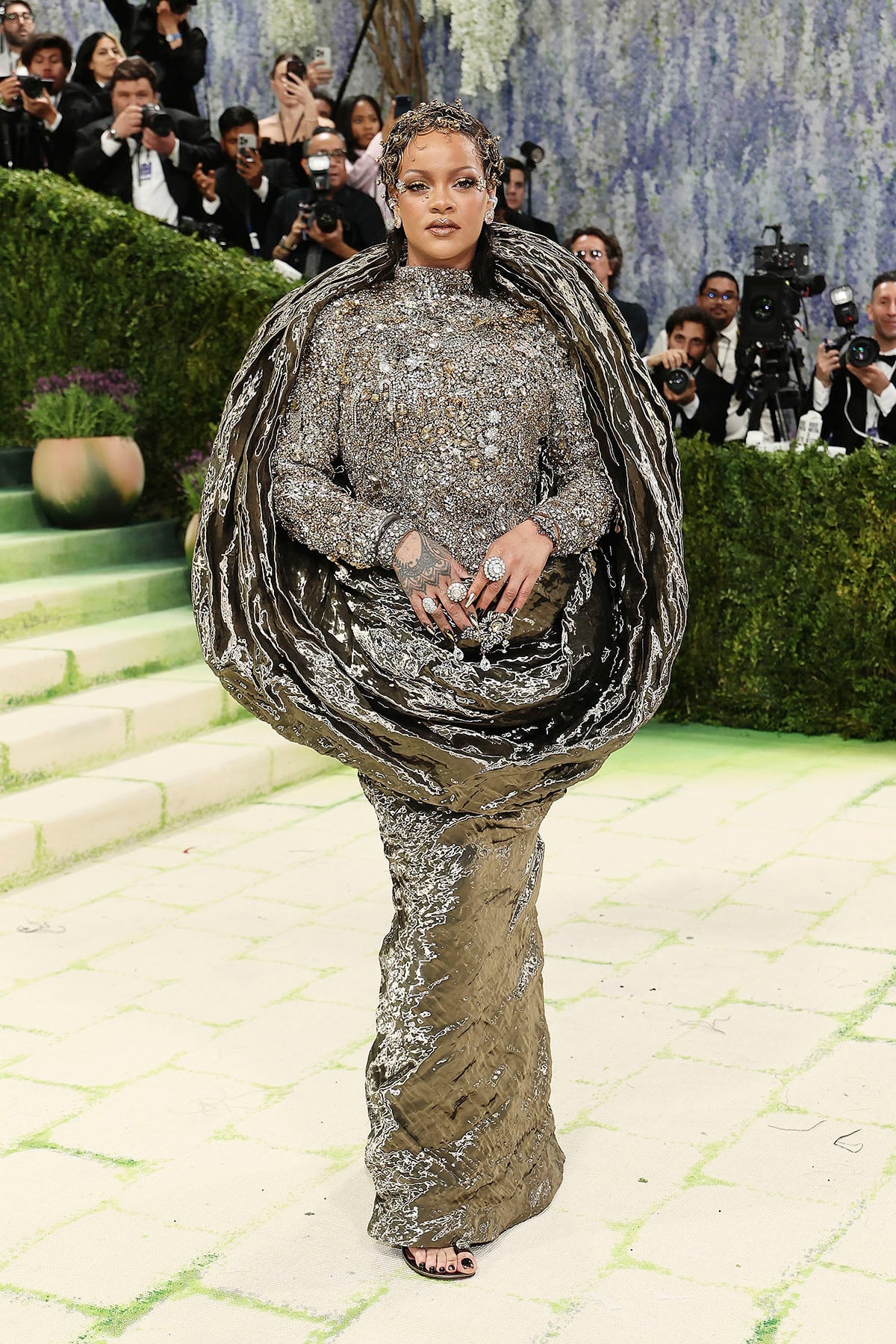
By referencing the medieval architecture of Flanders—a region known for its Gothic cathedrals and intricate civic buildings—Galliano and Rihanna’s stylist, Jahleel Weaver, positioned the garment as a piece of "soft architecture." The way the fabric pooled and caught the light mirrored the oil painting techniques of Jan van Eyck or Rogier van der Weyden, where the depiction of cloth was often used to convey status and transcendental beauty. In the context of the 2026 Met Gala, this read as a clear interpretation of fashion as a legitimate art form, where the garment does not merely clothe the body but transforms it into a sculptural entity.
Jewelry and Accessory Architecture
To complement the dense materiality of the Maison Margiela gown, the styling utilized a curated selection of high jewelry that spanned several eras of design history. The ensemble was topped with an Art Deco–inspired headpiece, fashioned from gold wire and set with precision-cut crystals. This piece acted as a bridge between the medieval themes of the dress and the modern industrial nature of the recycled wiring used in the textile.
The selection of jewelry was equally deliberate. Rihanna wore "Old Mine" pear-shaped diamond earrings by Glenn Spiro, a jeweler known for his technical prowess and use of rare stones. These were paired with a 1930s ring by Suzanne Belperron, one of the most influential jewelry designers of the 20th century, whose work was characterized by a departure from traditional settings in favor of bold, sculptural forms. The inclusion of Briony Raymond ear cuffs added a contemporary edge to the look, ensuring that while the references were historical, the execution remained firmly rooted in the present.
The Role of Jahleel Weaver and the Creative Process
The execution of such a complex look is the result of a long-term collaboration between Rihanna and her creative director and stylist, Jahleel Weaver. Weaver has been instrumental in navigating Rihanna’s fashion trajectory, moving her away from standard red-carpet glamour toward a more curated, archival, and concept-driven aesthetic.
The process for the 2026 Met Gala look likely began months in advance, involving multiple consultations with the Margiela atelier in Paris. For a custom "Artisanal" piece—the equivalent of Haute Couture at the house—the fitting process is notoriously rigorous. The use of recycled computer wiring necessitated specialized handling to ensure the garment was wearable while maintaining its sculpted shape. The 1,380 hours of embroidery suggest a timeline that began shortly after the theme was announced, involving dozens of specialized artisans.
Chronology of Rihanna’s Met Gala Influence
To understand the impact of the 2026 appearance, it is necessary to view it within the chronology of Rihanna’s history at the event. Over the past two decades, she has consistently been one of the few attendees to strictly adhere to the Costume Institute’s themes, often setting the standard for the evening.
- 2015 ("China: Through the Looking Glass"): Rihanna wore a yellow empress cape by Chinese couturier Guo Pei, a move that was credited with bringing global attention to Chinese high fashion and shifting the Met Gala toward a more theatrical scale.
- 2017 ("Rei Kawakubo/Comme des Garçons: Art of the In-Between"): She was one of the few celebrities to wear the honored designer’s avant-garde, structural pieces, solidifying her reputation as a "risk-taker" who respects the museum’s curatorial intent.
- 2018 ("Heavenly Bodies: Fashion and the Catholic Imagination"): Wearing a papal-inspired Maison Margiela look, she began her high-profile collaborative relationship with John Galliano for this specific event.
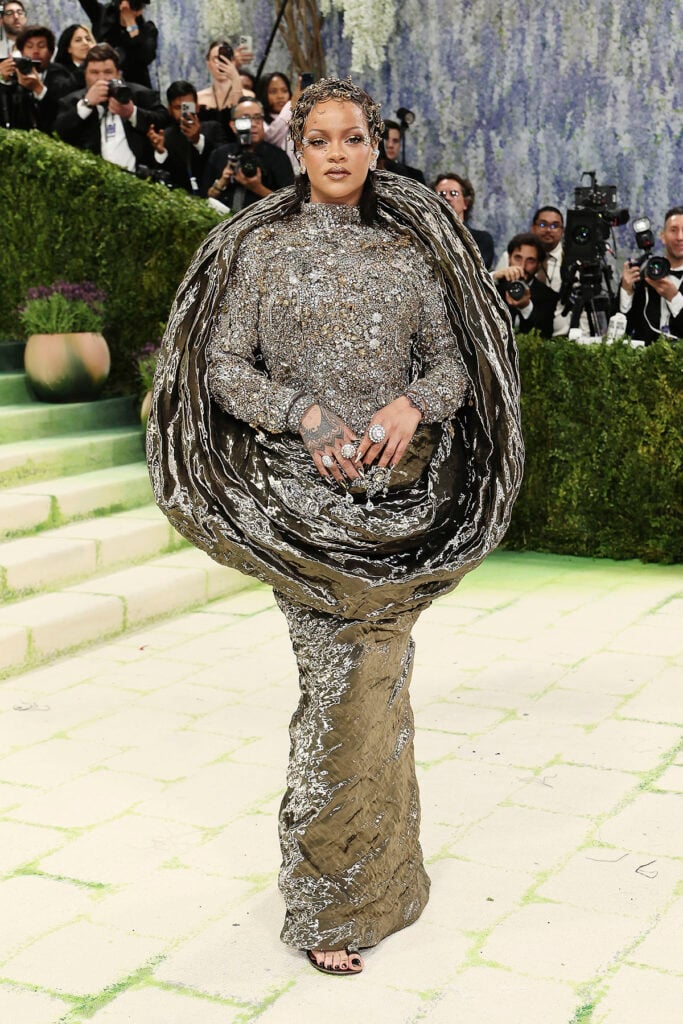
- 2026 ("Costume Art"): This latest appearance marks a return to the sculptural rigor of her 2017 and 2018 looks but with a heightened focus on the materiality of the future (recycled metals) and the art of the past (Flemish painting).
Implications for Sustainable Couture
The use of recycled computer wiring in a high-profile couture gown carries implications beyond the red carpet. As the fashion industry faces increasing pressure to address environmental concerns, the integration of industrial waste into "Artisanal" fashion serves as a proof-of-concept for luxury upcycling.
Maison Margiela has been at the forefront of this movement with its "Recicla" line, but applying these principles to a custom Met Gala gown for a global icon like Rihanna amplifies the message. It suggests that the future of "Costume Art" lies not just in the aesthetic beauty of the past, but in the resourceful repurposing of the present’s technological debris. The 115,000 crystal beads and antique jewels provide the "luxury" context, while the computer wiring provides the "innovation" context, creating a hybrid form of sustainability that does not sacrifice the opulence expected of the Met Gala.
Broader Impact on the 2026 Fashion Landscape
The 2026 Met Gala theme, "Costume Art," arrived at a time when the distinction between the gallery and the runway is increasingly blurred. Curators at the Metropolitan Museum of Art have noted that the exhibition aims to explore how garments function as independent art objects once they are removed from the context of daily wear.
Rihanna’s Maison Margiela gown is a definitive example of this philosophy. The structure, surface, and materiality come together to create a piece that is considered from every angle, rather than relying on a single "viral" detail. While distinct from the cocooned silhouettes seen on the Maison Margiela Fall 2025 runway, Rihanna’s gown built on that same language of sculptural drape and architectural volume, translating those runway ideas into an elevated format suitable for one of the world’s most photographed events.
Industry analysts suggest that this look will likely trigger a resurgence of interest in Flemish-inspired silhouettes—characterized by high necklines, heavy draping, and metallic textures—within the luxury ready-to-wear market. Furthermore, the emphasis on "hand-sculpted" garments highlights a growing consumer desire for artisanal craftsmanship in an era dominated by mass-produced digital fashion.
Conclusion
Rihanna’s attendance at the 2026 Met Gala in custom Maison Margiela Artisanal reinforces her status as a primary conduit for high-concept fashion. By merging 15th-century Flemish artistry with 21st-century industrial recycling, the ensemble met the "Costume Art" theme with technical precision and intellectual depth. The collaboration between Rihanna, Jahleel Weaver, and John Galliano continues to set the benchmark for how celebrity influence can be leveraged to highlight the rigorous craft of couture and the evolving definition of wearable art. As the 1,380 hours of embroidery and the 115,000 hand-sewn beads suggest, the garment was not merely an outfit for an evening, but a temporary installation of the highest order.