








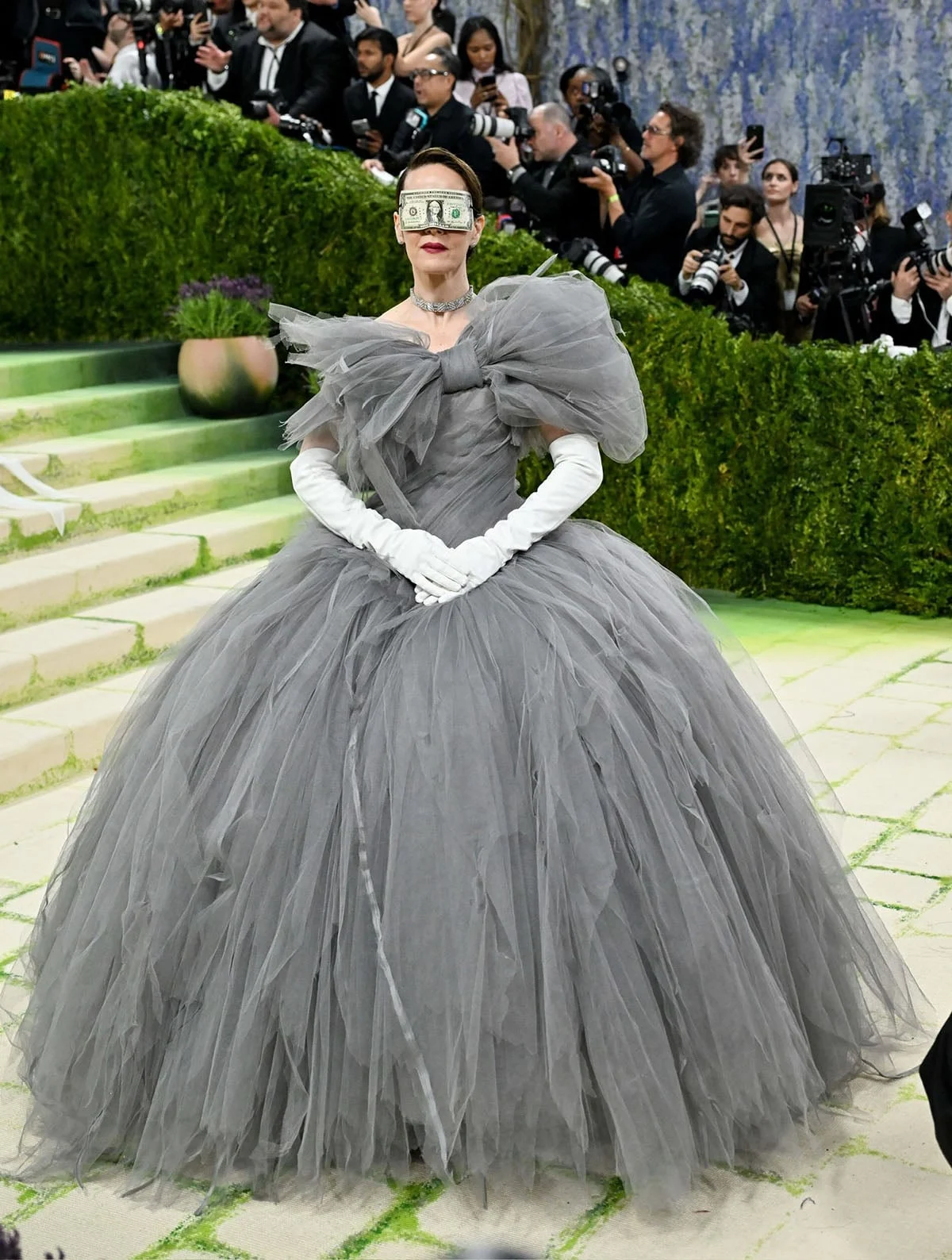
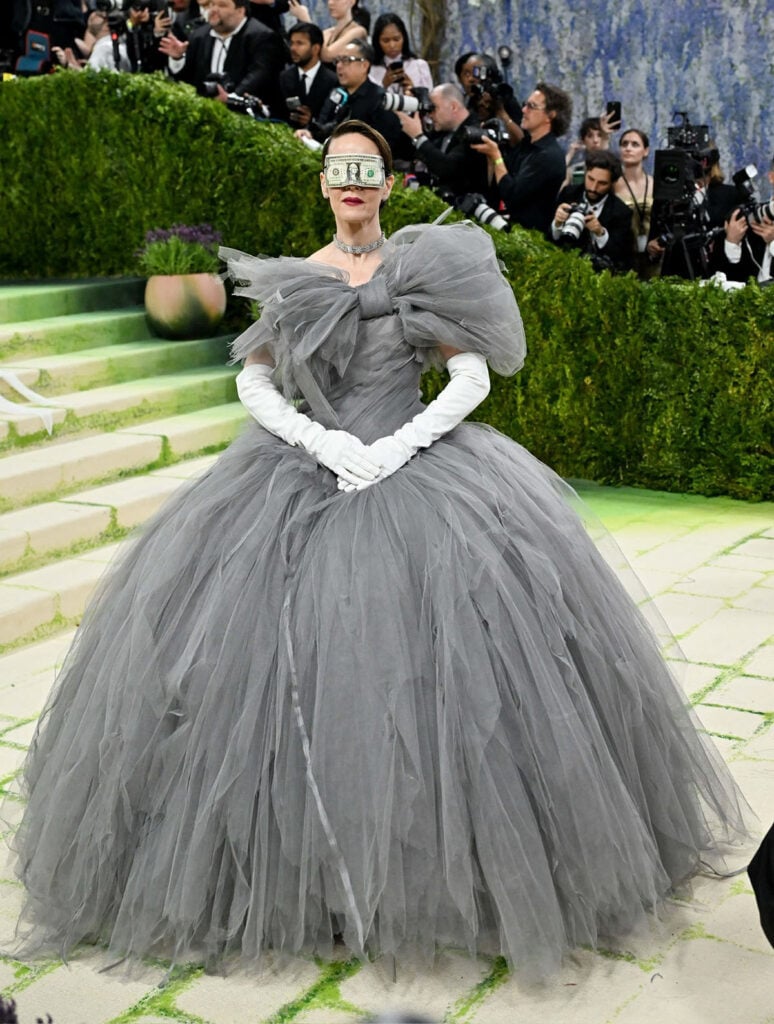
Sarah Paulson arrived at the 2026 Met Gala on the first Monday in May, delivering what critics are already describing as one of the most conceptually rigorous appearances in the history of the Costume Institute Benefit. Wearing a voluminous red-grey tulle ball gown from the Matières Fécales Fall 2026 collection, Paulson transcended traditional red-carpet glamour to engage in a piece of performance art that directly addressed the event’s theme, "Costume Art." The ensemble, characterized by its exaggerated proportions and a provocative dollar bill eye mask, served as a sharp commentary on income inequality and the performative nature of the global elite, staged at an event where individual tickets reportedly cost $75,000.
A Performance of Paradox on the Red Carpet
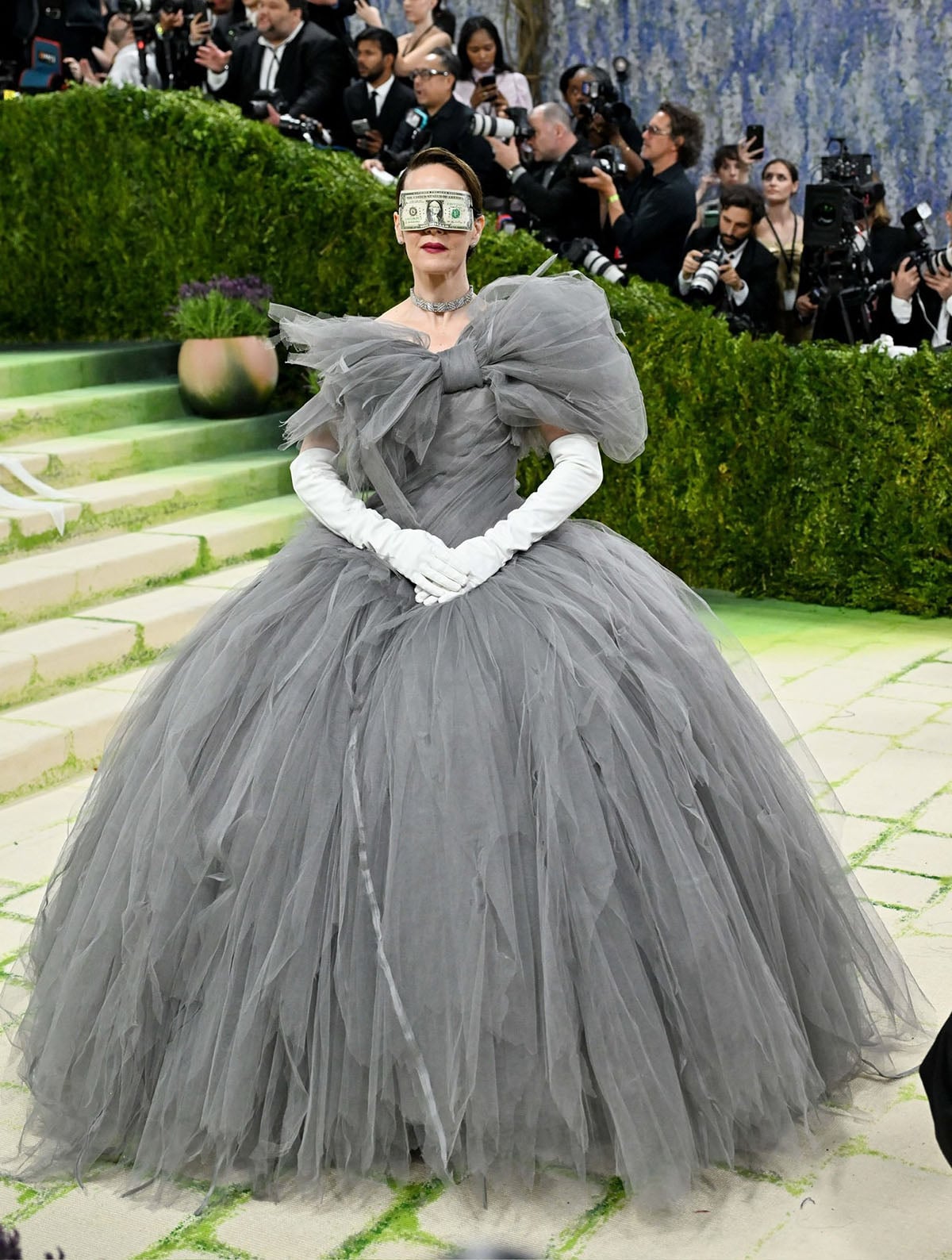
The 2026 Met Gala sought to explore the boundary between wearable clothing and conceptual sculpture. While many attendees opted for archival pieces or avant-garde silhouettes that emphasized aesthetic beauty, Paulson’s choice of Matières Fécales—the Montreal-based duo consisting of Hannah Rose Dalton and Steven Raj Bhaskaran—signaled a departure toward social satire. The gown featured a massive, structural bow and layers of tulle that created a silhouette of excessive, almost burdensome volume.
The most discussed element of the look was the dollar bill taped across Paulson’s eyes. This accessory functioned as a literal and figurative blindfold, suggesting a class of people blinded by capital. By wearing this on the steps of the Metropolitan Museum of Art, Paulson highlighted the inherent tension of the Met Gala itself: a fundraiser for the arts that is simultaneously one of the most exclusive and expensive social gatherings in the world.
Industry analysts noted that the look was not merely about the clothes but about the context. Standing within a system of extreme wealth while wearing a costume that parodies that very wealth created a meta-commentary that resonated across social media and fashion journalism. Paulson, a veteran of the Met Gala, has long been known for her willingness to take risks, but this collaboration with stylist Karla Welch pushed those boundaries into the realm of political and social critique.
The ‘ONE Percent’ Collection and Design Philosophy
The garment originated from Matières Fécales’ Fall 2026 collection, titled The ONE Percent. The collection was designed as a caricature of contemporary society’s most conspicuous winners. According to the designers, the collection was intended to hold a mirror up to the "absurdity of excess." The use of red and grey tulle in Paulson’s gown was a deliberate choice; the red symbolized power and vitality, while the grey muted the effect, suggesting the stagnation or "dust" of old money.
Matières Fécales has built a reputation on "provocation with a purpose." Known for their "alien" aesthetic, which often includes skin-textured footwear and prosthetic-heavy looks, the duo shifted their focus for Fall 2026 toward the aesthetics of the ultra-wealthy. In this collection, they utilized traditional "high-fashion" tropes—such as the ball gown and opera gloves—and distorted them. The proportions were scaled to a point of inconvenience, making the wearer a spectacle of their own consumption.
The inclusion of white opera gloves added a layer of historical irony. Traditionally a symbol of high-society etiquette and "clean hands," the gloves contrasted sharply with the dollar bill mask, implying that the hands of the elite remain pristine even as their vision is obscured by financial interests.
Technical Artistry and High Jewelry Integration
Despite the satirical nature of the outfit, the technical execution remained within the highest standards of couture. The gown required hundreds of yards of tulle, hand-pleated and layered to create a structure that could support the oversized bow without collapsing. The gradient from deep crimson to ash grey was achieved through a meticulous dyeing process intended to give the fabric a weathered, almost singed appearance.
To balance the avant-garde nature of the dress, Paulson wore a Boucheron Ruban Diamants choker from the Histoire de Style, Art Déco High Jewelry collection. The choice of Boucheron provided a necessary counterpoint to the Matières Fécales gown. The choker, a masterpiece of geometric precision and diamond work, represented the very pinnacle of the luxury industry that the dress sought to critique.
The Histoire de Style collection is known for revisiting the archives of the 1920s, an era defined by both immense wealth and the eventual economic collapse of the Great Depression. By pairing a 1920s-inspired diamond choker with a "One Percent" critique, the ensemble drew a historical parallel between the "Roaring Twenties" of the 20th century and the economic disparities of the 2020s. This layer of detail, orchestrated by Karla Welch, ensured that the look remained rooted in the history of fashion even as it looked toward a dystopian future.
The Economics of the 2026 Met Gala
To understand the impact of Paulson’s statement, one must consider the financial scale of the event. The 2026 Met Gala continued the trend of rising costs for attendance. With individual tickets priced at $75,000 and tables starting at $350,000, the evening is the primary source of funding for the Costume Institute. In 2025, the gala raised a record-breaking $26 million; early estimates for the 2026 event suggest that figure could be surpassed.

The "Costume Art" theme encouraged donors and celebrities to view fashion as a medium for profound expression rather than just a garment. However, the juxtaposition of a $75,000 entry fee with a dress critiquing the "One Percent" did not go unnoticed by cultural critics.
"The irony is built into the fabric," noted one fashion historian during the live broadcast. "Paulson is not pretending to be outside the system. She is acknowledging her place within it. By wearing a mask made of money, she is admitting that everyone in that room is part of the spectacle of wealth, whether they are conscious of it or not."
Chronology of the Appearance and Public Reaction
Paulson’s arrival occurred during the peak hour of the red carpet, typically reserved for A-list talent and museum chairs.
- 6:45 PM: Paulson departs her hotel in Manhattan. Images of the "dollar bill mask" begin to leak on social media, sparking immediate debate.
- 7:12 PM: Paulson arrives at the Metropolitan Museum of Art. She walks the carpet with a measured, theatrical pace, maintaining a neutral expression behind the mask.
- 7:20 PM: In a brief interview on the museum steps, Paulson declines to discuss the "beauty" of the look, instead directing reporters to the designers’ intent regarding social commentary.
- 7:45 PM: Stylist Karla Welch posts a high-definition close-up of the Boucheron jewelry and the Matières Fécales gown on Instagram, using the caption "The ONE Percent," confirming the conceptual nature of the look.
The reaction from the fashion community was polarized. While some praised Paulson for bringing "real intellectualism" back to the Met Gala, others argued that using a $75,000 ticketed event to critique wealth is a hollow gesture. However, supporters of the look argued that the Met Gala is the only stage where such a critique could carry weight, as it reaches a global audience of millions.

Broader Implications for Red Carpet Fashion
Sarah Paulson’s appearance at the 2026 Met Gala marks a significant moment in the evolution of the red carpet. For decades, the goal of the Met Gala was "the look"—finding the most beautiful, flattering, or "on-theme" garment. In recent years, led by figures like Paulson, there has been a shift toward "the statement."
As the gap between the ultra-wealthy and the general public continues to widen globally, the fashion industry faces increasing pressure to justify its excesses. By leaning into discomfort rather than decoration, Paulson and Matières Fécales have provided a blueprint for how celebrities can use their platform to reflect societal tensions.
The 2026 Met Gala will likely be remembered for this specific tension. In an era where "quiet luxury" and "old money aesthetics" have dominated the cultural zeitgeist, Paulson’s "loud critique" served as a reminder that fashion is not just a product of wealth, but a powerful tool for its interrogation. Whether this leads to a permanent shift in how celebrities approach high-profile events remains to be seen, but for one night in New York, the "Costume Art" theme was realized in its most provocative form.