








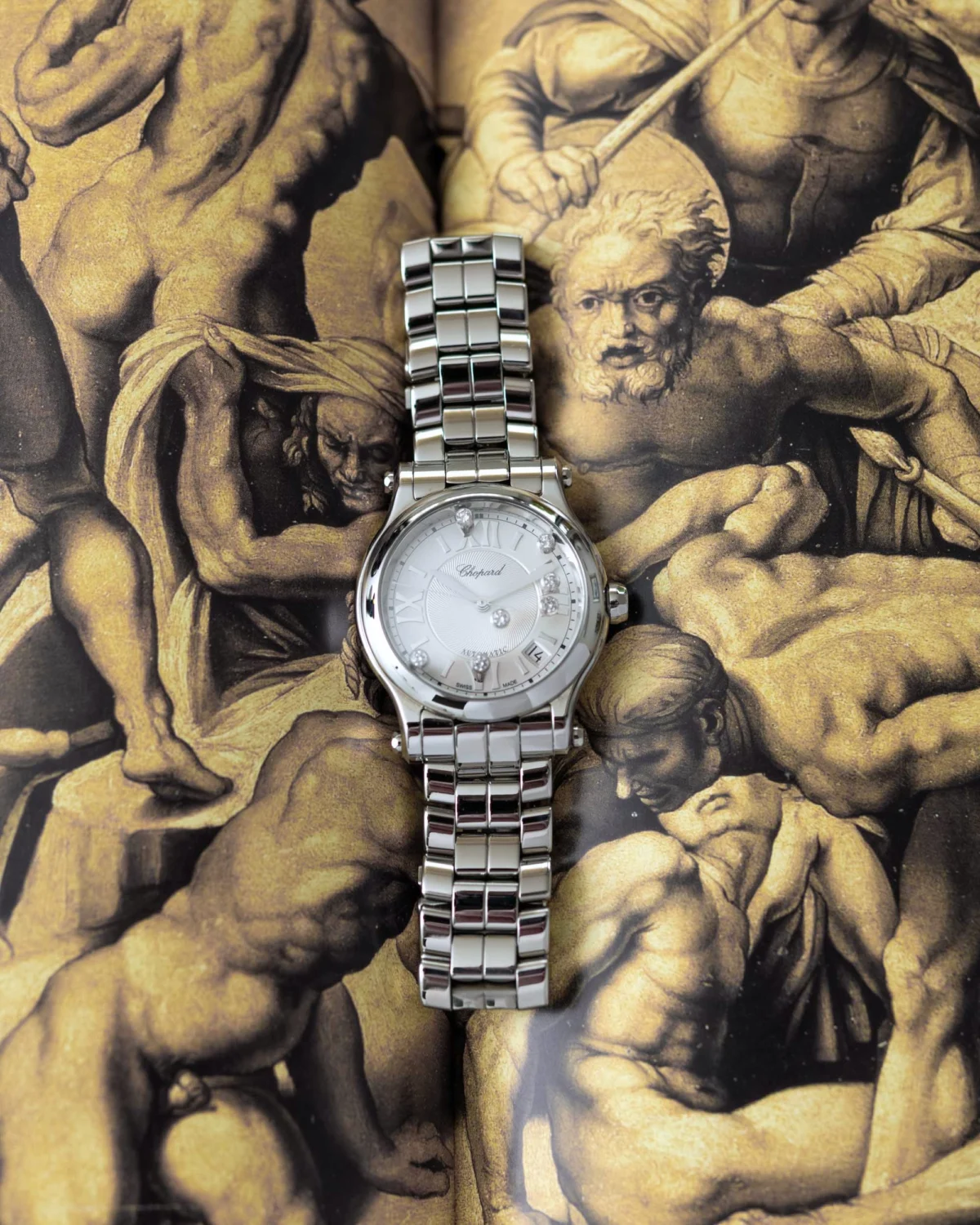
The Chopard Happy Sport 36mm in Lucent Steel, identified by reference number 278559-3002, represents a pivotal intersection of high-jewelry aesthetics and rigorous industrial engineering. By integrating proprietary metallurgical advancements with the brand’s historic "dancing diamonds" concept, Chopard has positioned this timepiece as a sophisticated alternative to traditional luxury sports watches. As the industry shifts toward higher levels of vertical integration and material science, the Happy Sport collection—originally debuted in 1993—serves as a case study in how heritage designs can be updated through modern technical specifications to maintain relevance in a competitive, high-end market.

Historical Context and Evolution of the Happy Sport Line
The lineage of the Happy Sport can be traced back to 1976, the year Chopard introduced the "Happy Diamonds" concept. This innovation, which involved diamonds moving freely between two sapphire crystals rather than being set into a fixed bezel or dial, fundamentally altered the perception of diamond-integrated horology. In 1993, Chopard expanded this concept into the sports watch segment, effectively merging the casual, durable nature of steel with the opulence of loose-floating diamonds.

This daring juxtaposition was reflective of the 1970s and 90s, eras characterized by a willingness to experiment with the traditional boundaries between jewelry and functional timekeeping. Over the past three decades, the collection has evolved from a niche aesthetic curiosity into a staple of Chopard’s catalog, currently overseen by co-presidents Caroline and Karl-Friedrich Scheufele. As a family-owned entity, Chopard has maintained a degree of strategic autonomy that allows for long-term investments in R&D, moving away from the quartz-reliant models of the past toward more robust, mechanical movements that align with the growing consumer demand for horological depth.

Metallurgical Advancements: The Significance of Lucent Steel A223
A defining feature of the current 278559-3002 model is the implementation of Lucent Steel A223. Introduced by Chopard in 2019 alongside the Alpine Eagle collection, this proprietary alloy represents a significant departure from the industry-standard 316L stainless steel.

Technically, Lucent Steel A223 is characterized by its composition, which utilizes 70% recycled steel. The material undergoes a double-forging process that removes impurities, resulting in a cleaner, more reflective surface that possesses a distinct, luminous quality often compared to gold. From a durability standpoint, the material is rated at 223 Vickers, providing a higher level of scratch resistance than the 150 Vickers typically found in standard 316L steel. This transition underscores a broader movement within the Swiss watch industry toward traceability and the use of "High Performance Metals." By sourcing this alloy from specialized partners like Voestalpine Böhler Edelstahl, Chopard has demonstrated that luxury watches can achieve superior performance metrics while simultaneously addressing sustainability objectives.

Mechanical Specifications and Performance
The transition to mechanical calibers in the women’s luxury segment is a trend that reflects changing consumer expectations. The Happy Sport 36mm is equipped with the ETA A32111 (based on the 2892 architecture), which has been refined to provide an extended 60-hour power reserve. This is an improvement over many entry-level mechanical movements, which typically hover around 38 to 42 hours.

Operating at a frequency of 4Hz (28,800 vibrations per hour), the movement provides a consistent level of accuracy and is decorated with traditional Geneva stripes and polished screw-heads. While some enthusiasts might prioritize in-house manufacture calibers, the decision to utilize a highly reliable, serviceable movement suggests a focus on long-term ownership and ease of maintenance. The inclusion of an exhibition caseback allows owners to observe these mechanical details, marking a clear departure from the battery-powered quartz movements that dominated this segment in the late 20th century.

Ergonomics and Design Considerations
The physical dimensions of the 36mm case, combined with a thickness of 12.15mm, place the watch in a versatile category suitable for various wrist sizes. However, the perceived size of the watch is larger than the 36mm specification suggests. This is attributed to several design elements:

- Integrated Lug Design: The prominent, screw-accented lugs extend the footprint of the watch head on the wrist, providing a more robust, "sporty" silhouette.
- Bracelet Construction: The four-piece link bracelet is manufactured in-house and features a complex geometry that aids in articulation. The weight distribution between the head and the bracelet is engineered to prevent the "wobble" often associated with thinner, less substantial bracelets.
- Bezel and Case Profile: The use of polished, concave surfaces maximizes the reflective properties of the Lucent Steel, drawing the eye and amplifying the watch’s visual presence.
While the butterfly clasp is designed for security, some users may find the friction-fit mechanism requires a firm hand to operate, a trade-off for its seamless aesthetic integration.

The Role of Dancing Diamonds in Contemporary Luxury
The "Happy Diamonds" are not merely aesthetic; they are an exercise in micro-engineering. The diamonds are encased in small gold or steel housings that glide between two panes of sapphire crystal. The tolerances required to ensure these elements move freely without becoming trapped, yet without being loose enough to rattle excessively, are significant.

In the 278559-3002, the inclusion of seven diamonds creates a dynamic, kinetic display that changes with the wearer’s movement. While the brand does not mandate uniformity in the UV-fluorescence of these stones, there is an ongoing discussion among collectors regarding the consistency of such details. Nevertheless, the charm of the movement remains the collection’s primary value proposition, effectively bridging the gap between functional timekeeping and kinetic jewelry.

Market Implications and Future Outlook
Priced at $12,100 USD, the Chopard Happy Sport 36mm exists in a segment where the competition includes iconic models from heritage brands such as Rolex and Omega. However, Chopard’s strategy focuses on differentiation through high-end finishing, the use of proprietary materials like Lucent Steel, and a commitment to vertical integration.

The industry’s reaction to such models has been one of appreciation for the "jewelry-first, watch-second" approach, provided that the underlying horology is of sufficient quality. The growing demand for mechanical movements in this category suggests that future iterations of the Happy Sport may continue to see upgrades in caliber specifications. As Chopard continues to scale its production of Lucent Steel across its collections, it is likely to influence the broader industry’s standards for what constitutes "luxury grade" stainless steel.

Summary of Key Features
- Model: Chopard Happy Sport 36mm
- Reference: 278559-3002
- Case Material: Lucent Steel A223 (Recycled content: 70%)
- Hardness: 223 Vickers
- Movement: ETA A32111 (Mechanical, automatic)
- Power Reserve: 60 hours
- Dimensions: 36mm diameter; 12.15mm thickness
- Distinguishing Feature: Seven free-moving "dancing" diamonds
- Price: $12,100 USD
Ultimately, the Chopard Happy Sport 36mm in Lucent Steel remains a testament to the brand’s ability to maintain a 50-year-old concept while modernizing its core components. By focusing on the interplay between metallurgical innovation and traditional Swiss watchmaking, Chopard has solidified the Happy Sport’s status not only as a piece of luxury jewelry but as a durable, precision-engineered timepiece. For the consumer, the value lies in the balance of these two worlds—a watch that is as reliable in its mechanical performance as it is visually captivating in its aesthetic expression.