









The Baume & Mercier Riviera 73 represents a strategic return to the origins of one of the watch industry’s most storied, yet historically underappreciated, integrated bracelet sports watches. Launched in 1973, the Riviera occupies a unique space in horological history, arriving in the market significantly earlier than many of its contemporaries that currently define the luxury sports watch category. By prioritizing a slim, minimalist aesthetic and embracing its quartz-powered roots, the brand is positioning the Riviera 73 as an entry-level luxury cornerstone designed to resonate with a modern demographic as the company transitions into a new chapter of its corporate evolution.
A Historical Perspective on the Integrated Bracelet Genre
To understand the significance of the Riviera 73, one must view it through the lens of the early 1970s watch market. The period was marked by the "Quartz Crisis," which forced traditional Swiss manufacturers to innovate or face obsolescence. In 1973, Baume & Mercier introduced the original Riviera, a timepiece characterized by its distinctive 12-sided dodecagonal bezel.

While the Audemars Piguet Royal Oak (1972) and the Patek Philippe Nautilus (1976) are often cited as the definitive benchmarks of the integrated sports watch category, the Riviera was a direct participant in this stylistic shift. However, whereas competitors largely leaned into industrial, high-horology mechanical movements, the original Riviera was conceived as a versatile, elegant, and accessible timepiece. By choosing to revisit the design language of the 1973 reference 5112, Baume & Mercier is attempting to reclaim a narrative that has, in recent decades, been overshadowed by the explosive secondary market hype surrounding other brands.
Technical Specifications and Design Philosophy
The 39mm stainless steel case of the Riviera 73 is engineered for versatility, measuring a remarkably slim 7.65mm in height. This profile allows the watch to maintain a low center of gravity on the wrist, a departure from the thicker, more aggressive proportions often seen in contemporary sports watches.
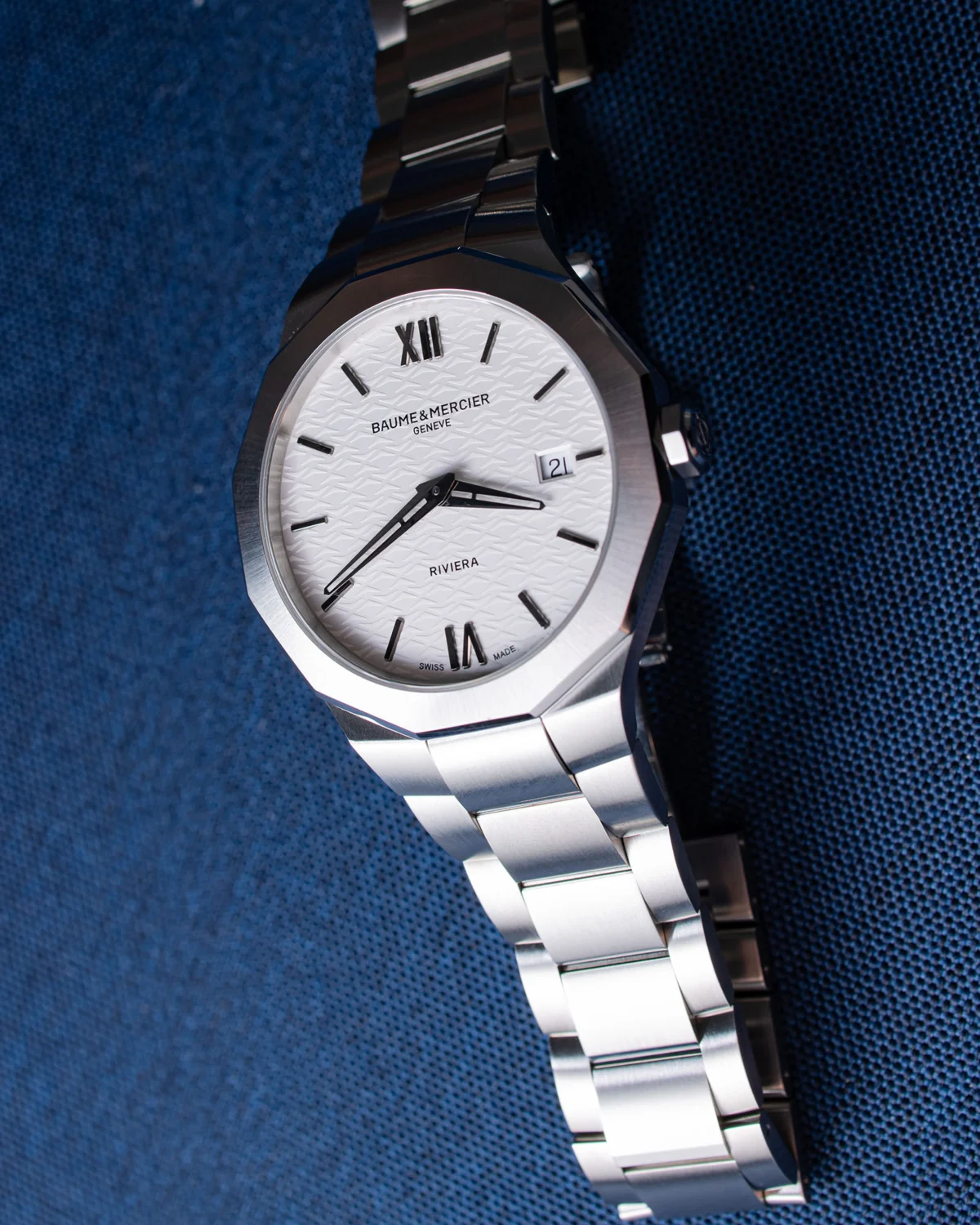
The case architecture features integrated lugs that transition into the bracelet with a softer, more rounded geometry than the previous iterations of the modern Riviera line. This design choice effectively frames the 12-sided bezel, allowing it to stand out as the primary visual element. The bezel itself is a study in material finishing, featuring sunburst brushing on the top surface contrasted against mirror-polished facets. The precision of these transitions is essential, as the complex 12-sided shape requires exacting manufacturing standards to maintain a cohesive look.

The caseback features a thematic engraving of the "73" motif set against a textured background reminiscent of nautical deck planking—a subtle nod to the collection’s namesake, the French Riviera. While the watch is water-resistant to 50 meters, it is positioned more as a refined daily wearer than a high-performance diver.
Dial Execution and Aesthetic Minimalism
Baume & Mercier has opted for a minimalist approach regarding the dial, stripping away extraneous scales and unnecessary text to create a sense of open space. The dial features a signature wave-motif pattern, which, in this execution, appears more subtle than in previous models. Applied Roman numerals and indices provide a sense of depth, appearing to float above the surface.
The handset consists of semi-skeletonized dauphine hands, which maintain the watch’s overall light and airy aesthetic. A point of discussion for purists remains the date window at the 3 o’clock position; while it provides practical functionality, its lack of a frame creates a break in the dial’s visual symmetry. Despite this, the silvery-white colorway enhances the watch’s legibility and aligns with the brand’s push toward a more sophisticated, "quiet luxury" aesthetic.

The Role of the ETA F06.115 Quartz Movement
In a market dominated by mechanical movements, the decision to equip the Riviera 73 with the ETA F06.115 quartz caliber is both a nod to history and a practical business decision. The first-generation Riviera was fundamentally a quartz-powered watch, and throughout the 1970s and 1980s, the line was rarely offered with mechanical movements.
From a performance standpoint, the F06.115 provides significant advantages for the end-user. It offers a five-year battery life and is engineered with high levels of shock resistance, making it an ideal choice for a daily-wear watch. Furthermore, the use of a slim quartz movement is what allows the case to maintain its 7.65mm thickness. By eschewing the "mechanical-only" trend, Baume & Mercier is catering to a younger, fashion-forward audience that values reliability and ease of use over the complexity of a mechanical caliber.
The Bracelet: An Integrated Component of Success
The bracelet of the Riviera 73 is an evolution of the existing three-link design found in the current collection. Because the watch case itself is slimmer and more streamlined, the bracelet appears better integrated than in thicker, more utilitarian models. The links feature linear brushing on the main planes, while the chamfered edges of the center links are polished to catch the light.

The choice of a hidden butterfly clasp reflects the brand’s commitment to a clean, unbroken aesthetic. While some users may prefer a clasp with an integrated micro-adjustment system for increased comfort, the butterfly design is consistent with the watch’s slim profile and vintage-inspired charm.
Market Positioning and Strategic Implications
With an MSRP of $1,950, the Baume & Mercier Riviera 73 is positioned as an entry-level luxury product. This price point is critical for the brand’s growth, as it creates an accessible entry into the world of Swiss-made integrated bracelet watches without requiring the multi-thousand-dollar premiums often associated with rival brands.
Industry analysts suggest that this move is indicative of a broader industry trend: the "democratization" of the integrated bracelet category. As interest in high-end steel sports watches remains high, many consumers are seeking alternatives that offer heritage and design pedigree without the entry barriers of "waitlists" or extreme price volatility. By emphasizing the Riviera’s 1973 roots, Baume & Mercier is effectively leveraging its own history to differentiate itself from the influx of "homage" watches currently saturating the market.

Future Outlook
The launch of the Riviera 73 arrives at a pivotal moment for Baume & Mercier. As the company navigates changes in ownership and shifts its marketing focus, the ability to maintain a clear, consistent identity is paramount. The success of the Riviera 73 will likely be measured by its ability to attract a younger, design-conscious consumer who views the watch as a fashion accessory as much as a horological tool.
The watch is now available through authorized dealers and the brand’s direct-to-consumer online channels. As of September 2026, the brand has signaled that this model will serve as a permanent fixture in the catalog, rather than a limited-edition curiosity. Whether this model can spark a resurgence of interest in the wider Riviera collection remains to be seen, but its arrival confirms that Baume & Mercier is firmly committed to its heritage as a means of defining its future. By embracing its history, the brand has provided a compelling, approachable alternative in a highly competitive sector of the luxury watch market.