









The pavement outside the Bethnal Green underground station presented a scene evocative of an academic institution’s final critique rather than a conventional commercial presentation. Hundreds of fashion students, industry insiders, and recent graduates formed an extensive queue stretching down Cambridge Heath Road on a crisp September evening. Attendees, many draped in avant-garde garments of their own construction, converged to witness the unofficial debut runway collection of recent Central Saint Martins graduates Kai Ghattaura and Fin Forsyth. Staged entirely off the official London Fashion Week calendar for the Spring/Summer 2027 season, the event underscored a growing movement among emerging designers who bypass traditional institutional timelines to showcase their work on their own terms.
Chronology of an Unofficial Showcase
The journey to the Bethnal Green warehouse was years in the making for the creative and romantic partners. Fin Forsyth completed her studies at Central Saint Martins in 2024, quickly establishing a reputation for unconventional textile manipulation and sculptural silhouette development. Shortly thereafter, Kai Ghattaura concluded his Master of Arts studies at the same institution, presenting a critically lauded collection in February 2026 that foreshadowed the collaborative vision seen this September.
Preparations for the Spring/Summer 2027 presentation, titled Glister, began months in advance within makeshift studio spaces across East London. The venue transformation commenced forty-eight hours prior to the show, with the designers and a small team of peers constructing an oversized, rustic cardboard house at the center of the raw industrial space. By the afternoon of September 19, seating arrangements featuring bespoke paper crowns were finalized. The audience began gathering by 8:00 PM, creating a dense crowd that spilled onto the adjacent thoroughfares. The show commenced at approximately 9:15 PM, initiated by a theatrical performance before transitioning into the core runway presentation, concluding with a celebratory reception that lasted well into the night.
The Thematic Architecture of Glister
The conceptual foundation of Glister drew heavily from classic children’s literature, specifically Maurice Sendak’s 1963 masterwork, Where the Wild Things Are, alongside atmospheric undertones reminiscent of William Golding’s Lord of the Flies. This literary dichotomy—balancing the imaginative sovereignty of childhood with the raw, chaotic energy of the natural world—manifested physically throughout the venue and the garments themselves.
The runway presentation opened dramatically when four young children, clad entirely in stark white garments, raced down the central corridor carrying handcrafted cardboard swords and shields. Their brief, unscripted skirmish set a playful yet anarchic tone before public relations personnel gently ushered them off the stage to make way for the primary lineup of models.
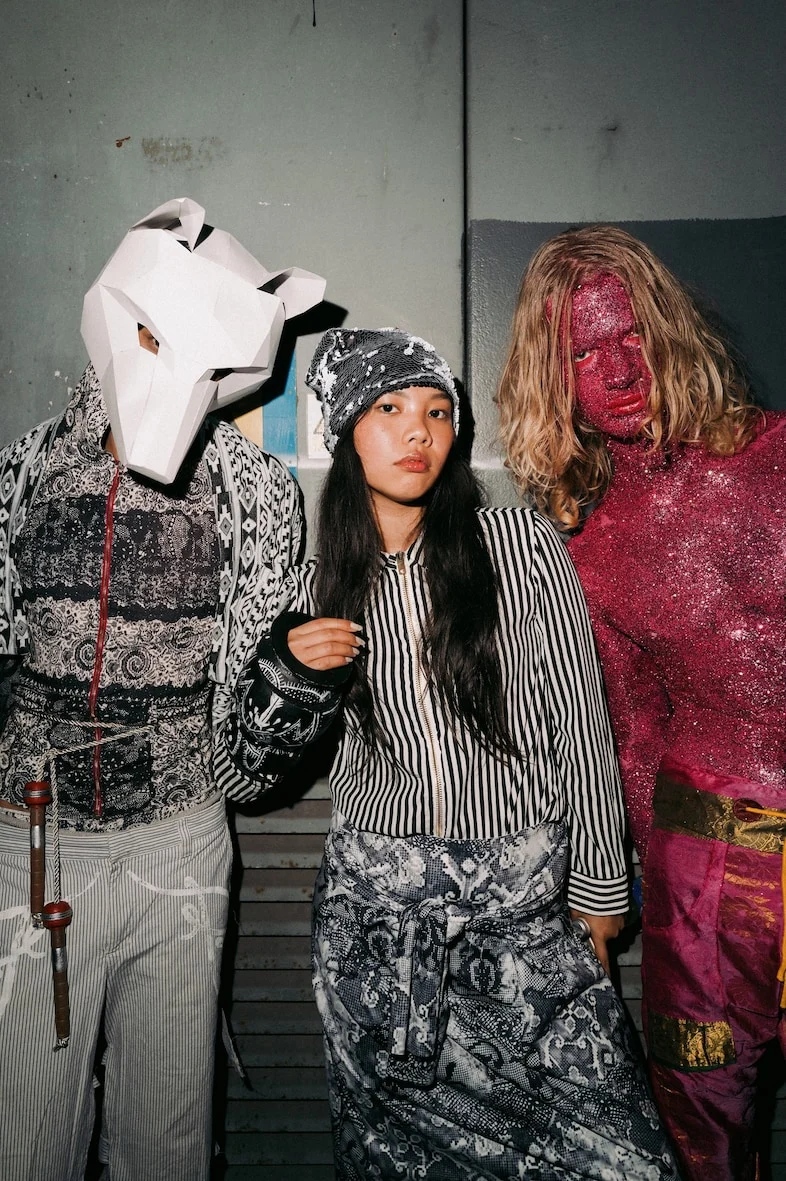
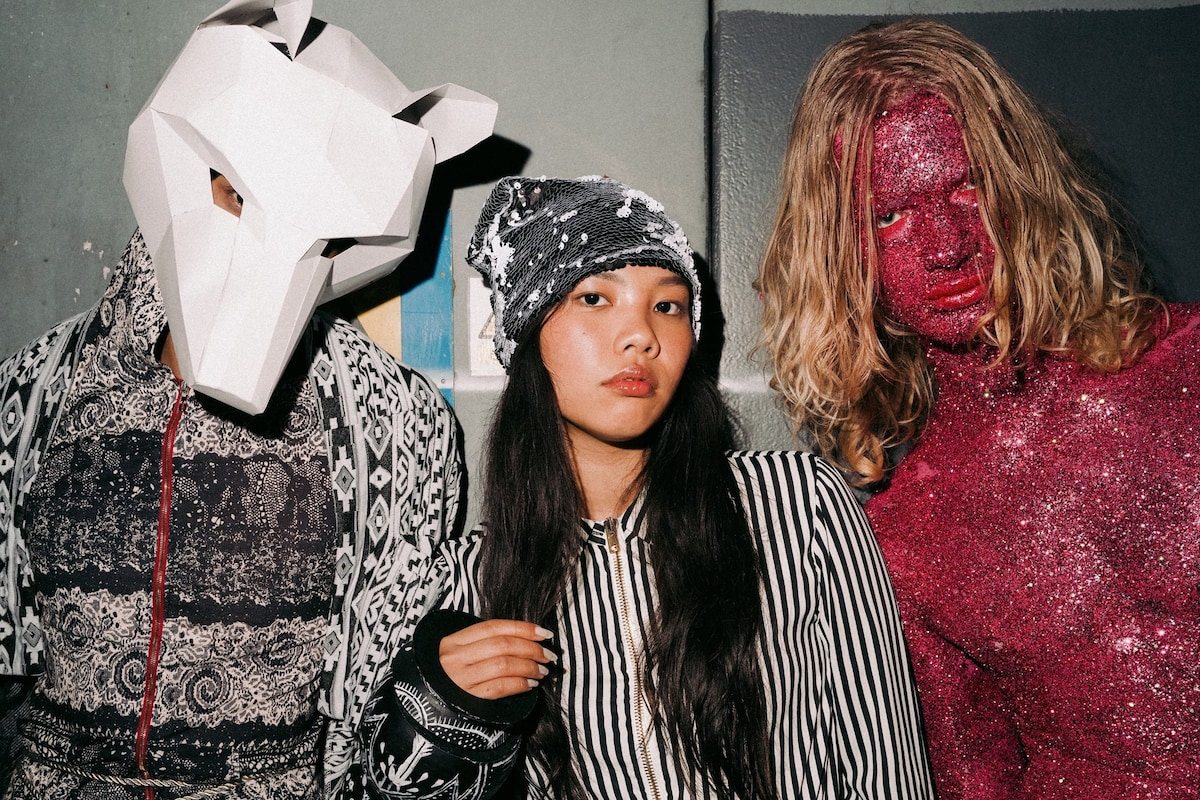
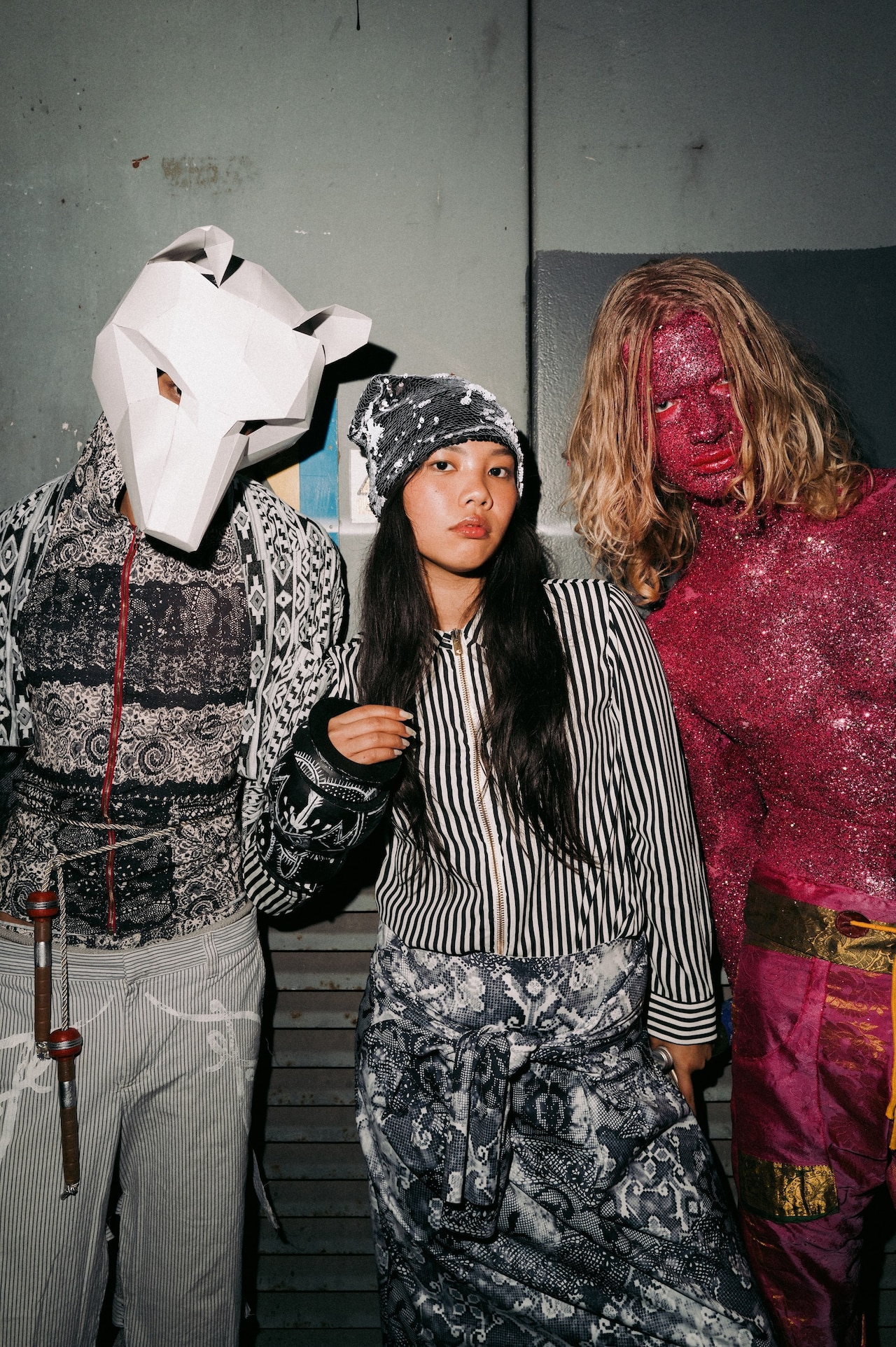
The garments worn by the models reflected a deliberate ethos of resourcefulness and camp-like improvisation. Rather than relying on traditional luxury fabrication, the collection showcased mismatched textiles, improvised cummerbunds, and headscarfs fashioned from bold, clashing prints. Fabric was layered unpredictably around necks, knees, and wrists, functioning simultaneously as structural volume and makeshift ornamentation.
Headwear and facial coverings further blurred the boundaries between human form and fauna. Caps were subtly manipulated to resemble the bills of platypuses, while elaborate masks evoked birds, foxes, and bears. As the collection progressed, the aesthetic shifted toward celestial and mythical realms through the heavy application of physical embellishments. Models emerged coated in vibrant pigments, highlighted by one look entirely covered in fuchsia glitter and a closing look dripping in silver sparkle. The final model carried an oversized, functioning fidget spinner—a whimsical nod to contemporary youth culture that bridged nostalgic touchstones with modern irony.
Contextualizing the Off-Schedule Phenomenon
The decision by Ghattaura and Forsyth to stage an off-schedule presentation reflects broader economic and creative shifts within the London fashion ecosystem. London Fashion Week, coordinated by the British Fashion Council (BFC), has historically served as the premier platform for both established houses and emerging talent through initiatives like NEWGEN. However, the rising costs associated with official schedule registration, venue rental, and production standards have increasingly priced out recent graduates.
Data compiled by independent creative labor organizations indicate that the average cost of mounting an official London Fashion Week runway show exceeds £30,000, a prohibitive sum for designers who have just completed their formal education. Consequently, a vibrant parallel ecosystem has emerged in non-traditional venues across East London neighborhoods such as Bethnal Green, Hackney, and Dalston. These independent shows leverage raw industrial spaces, grassroots marketing via digital platforms, and community-driven peer support to generate substantial cultural impact without the institutional overhead.
Industry Reception and Front-Row Dynamics
Despite operating outside the formal BFC calendar, the presentation attracted significant attention from key industry figures, critics, and prominent educators. The front row featured notable members of the academic staff from Central Saint Martins, alongside alumni from the 2026 MA graduating class who turned out in solidarity with their peers.
Industry analysts noted that the physical turnout—estimated at over four hundred attendees standing shoulder-to-shoulder in the warehouse—demonstrated the formidable networking power and community loyalty possessed by contemporary design graduates. Observers highlighted that the palpable enthusiasm of the crowd provided a stark contrast to the often transactional atmosphere of high-budget corporate runway shows. By fostering an environment of inclusivity and shared creative identity, Ghattaura and Forsyth managed to capture the cultural zeitgeist of the season more effectively than many heavily funded legacy brands.
Implications for the Future of Independent Design
The success of the Glister presentation serves as a case study in the viability of independent, community-financed fashion presentations. As digital channels continue to democratize media access, physical runway shows are increasingly judged not by their proximity to official scheduling calendars, but by their ability to generate authentic emotional resonance and viral cultural currency.
For young designers entering the global marketplace, the ability to curate an immersive narrative—such as the Sendak-inspired world built in Bethnal Green—is paramount. Retail buyers and fashion editors are increasingly scouting off-schedule presentations to discover unpolished, highly original creative voices before they are co-opted by commercial pressures.
Furthermore, the collaborative model demonstrated by Ghattaura and Forsyth points toward a sustainable future for partnerships in independent design. By sharing resources, pooling creative direction, and maintaining direct lines of communication with their peer community, graduates can construct high-impact events that rival scheduled shows in media impression value.
Ultimately, the Bethnal Green intervention proved that the vitality of London fashion remains anchored in its grassroots communities. As institutional structures continue to evolve in response to economic pressures, the audacity of young designers willing to take over warehouses, distribute paper crowns, and celebrate uninhibited creativity will continue to define the vanguard of international style.