








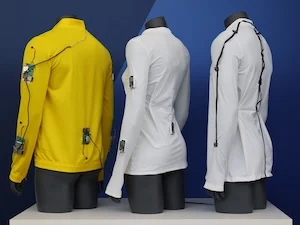
AACHEN, Germany — In a significant advancement for medical technology and wearable electronics, researchers at the Institut für Textiltechnik (ITA) of RWTH Aachen University have unveiled a prototype for a digital smart jacket designed to revolutionize patient-led rehabilitation. Announced on September 11, 2026, the "PhysioTaix" project seeks to bridge the critical feedback gap that often occurs when patients perform recovery exercises outside of clinical settings. By integrating sensor technology directly into washable, reusable fabric, the university is aiming to solve the long-standing challenge of ensuring exercise accuracy, consistency, and data-driven progress tracking.
The development of the PhysioTaix jacket arrives at a time when the healthcare industry is increasingly turning toward digital health solutions to manage the mounting burden on rehabilitation centers. As the global population ages and the prevalence of chronic mobility-related conditions rises, the demand for effective, home-based therapeutic monitoring has never been higher.
The Mechanism of Motion Tracking
At the heart of the PhysioTaix system is a sophisticated integration of sensor hardware into textile fibers. Unlike traditional motion-capture setups, which require a patient to attach multiple discrete sensors, adhesive electrodes, or bulky external markers to their limbs—a process that is often time-consuming and prone to human error—the smart jacket functions as a "wear-and-go" solution.
Once donned, the jacket utilizes an array of embedded sensors to track the wearer’s kinematics in real time. This data is transmitted via a wireless interface to a dedicated mobile application. The backend of this application is powered by artificial intelligence (AI) algorithms capable of processing complex movement patterns. The AI evaluates the quality of the exercise, identifying deviations from prescribed ranges of motion or improper posture, and provides the patient with immediate visual or auditory feedback. This creates a closed-loop system where the patient can correct their form instantly, significantly reducing the risk of performing exercises incorrectly and potentially causing secondary injuries.
Chronology of Development and Future Milestones
The trajectory of the PhysioTaix project is structured around a rigorous three-year development cycle, emphasizing both technical viability and clinical integration.

- Early Development Phase (2024–2025): ITA researchers focused on the material science aspect, experimenting with conductive fibers and biocompatible sensor integration that could withstand repeated machine washing without degradation.
- Prototyping and Testing (Late 2025–Early 2026): The transition from laboratory bench to the Digital Innovation Centre Europe (DICE) marked a turning point. Within the modular smart textiles workshop at DICE, the team began stress-testing the sensor arrays.
- Current Phase (September 2026): The official announcement of the project serves as the launchpad for expanded human trials.
- Project Conclusion (February 2027): The current funding and development cycle is scheduled to conclude in early 2027, at which point the focus will shift toward commercialization, clinical validation, and partnership negotiations with health insurance providers.
The inclusion of students in the development process at the DICE workshop is a strategic move by RWTH Aachen. By involving the next generation of engineers in the practical development of smart textiles, the university is ensuring that the workforce is prepared to maintain and evolve this technology as it moves toward mass adoption.
Addressing the Rehabilitation Gap
The primary impetus for the PhysioTaix project is the "rehabilitation bottleneck." In a typical clinical scenario, a patient may spend an hour with a therapist once or twice a week. However, the efficacy of recovery is largely dependent on the exercises performed at home during the intervening days. Without a professional present, patients frequently struggle with "compensatory movements"—using the wrong muscles to achieve a goal—which can lead to ineffective recovery or, in worse cases, joint damage.
"The challenge has always been the translation of clinical expertise into the home environment," noted a representative involved in the project. By providing objective data, the smart jacket acts as a remote extension of the therapist’s eyes. Therapists can review logs generated by the PhysioTaix app, allowing them to see exactly how many repetitions were completed, the velocity of the movements, and the accuracy of the range of motion. This objective information transforms the patient’s next check-in session; instead of relying on the patient’s subjective recall of their exercises, the therapist can immediately address specific areas of weakness identified by the data.
Technical Implications and Data Privacy
The integration of electronics into garments introduces complex engineering requirements, particularly regarding durability and data security. The ITA team has focused on "washability" as a core requirement, recognizing that if a medical device is not as easy to maintain as standard clothing, it will fail to gain patient compliance.
From a data perspective, the transition to AI-driven rehabilitation also necessitates robust privacy frameworks. As the system transmits movement data to an application, the security of this biometric information is paramount. While the university has not released specific details regarding the encryption standards of the current prototype, project documents indicate that the data is treated as sensitive health information, compliant with current European data protection regulations.
Economic and Healthcare System Impact
The potential impact of the PhysioTaix jacket on health insurance systems is substantial. In many European healthcare markets, the cost of long-term rehabilitation is a significant line item. By shortening the duration of the rehabilitation period through more effective, monitored home exercises, the system could theoretically reduce the total cost of care.

Furthermore, by preventing "failed" or "ineffective" rehabilitation, which often leads to follow-up surgeries or chronic disability, the jacket represents a preventative tool. Analysts suggest that if the PhysioTaix project successfully demonstrates a reduction in hospital readmission rates or a faster return-to-work timeline for patients, it will be highly attractive to insurance providers looking to incentivize "Value-Based Care" models.
Challenges to Scaling
Despite the technological promise, several hurdles remain before the smart jacket can become a standard medical device. Scalability is the primary concern. Manufacturing smart textiles requires a supply chain that is currently more expensive and less robust than the supply chain for standard sportswear. Ensuring that the sensors maintain calibration over hundreds of wash cycles and months of physical stress will require long-term durability testing beyond the current February 2027 deadline.
Additionally, the "human factor" remains a critical variable. User interface design will determine whether elderly patients—a primary demographic for rehabilitation services—find the app and the jacket intuitive to use. The collaboration between the ITA, rehabilitation centers, and healthcare professionals is designed specifically to mitigate these usability issues. By working directly with clinicians, the team is ensuring that the feedback loop provided by the AI is clinically relevant and not overwhelming to the user.
Looking Toward 2027 and Beyond
As the project moves toward its final months of the current development phase, the team at RWTH Aachen is preparing for an assessment of real-world applicability. The focus will likely shift from engineering specifications to clinical outcomes. If the data gathered between now and February 2027 proves that patients using the PhysioTaix jacket reach their milestones faster than those using standard methods, the project will likely secure further funding for large-scale clinical trials.
The PhysioTaix project stands as a testament to the interdisciplinary nature of modern research at RWTH Aachen. By merging textile engineering, artificial intelligence, and clinical physical therapy, the institution is positioning itself at the forefront of the wearable health movement. While the jacket is still in the developmental stage, its potential to redefine the patient-therapist relationship suggests that the future of rehabilitation may lie not in more frequent hospital visits, but in smarter, more connected clothing. The coming months will be crucial as the project transitions from the controlled environment of the DICE workshop to the practical reality of clinical, data-driven healthcare.