





The 2026 Met Gala, centered on the theme of Costume Art in honor of curator Andrew Bolton’s storied tenure at the Metropolitan Museum of Art, served as a significant stage for American designer Thom Browne to present a multi-faceted exploration of human anatomy and the evolution of form. Following the early appearance of Chase Infiniti as the Naked Body, Browne expanded his narrative by dressing nine additional celebrities, each representing a distinct conceptualization of the physical self. The collection functioned as a cohesive artistic installation, moving beyond traditional red-carpet attire to examine the intersections of biological reality, historical silhouette, and sartorial abstraction.

The Curatorial Context of Andrew Bolton and Costume Art
The 2026 exhibition represents a milestone for the Costume Institute, focusing on the technical and philosophical boundaries of "Costume Art." Andrew Bolton, the Anna Wintour Costume Center’s head curator, has historically utilized the Met Gala to challenge the perception of fashion as a decorative medium, instead framing it as a vessel for complex societal and biological inquiries. Thom Browne’s contribution to this year’s gala was specifically designed to align with Bolton’s focus on the "form" of the body, utilizing the designer’s signature precision tailoring to deconstruct and rebuild the human silhouette.
Browne’s approach to the 2026 theme was characterized by a rigorous adherence to his brand’s DNA—gray scales, meticulous embroidery, and structured proportions—while simultaneously pushing into the realm of hyper-symbolism. By assigning each of his guests a specific "Body" type, Browne transformed the red carpet into a living gallery, where each ensemble served as a chapter in a broader discourse on the human condition.

Chronology of the Thom Browne Arrival and Narrative Sequence
The presentation of the "Thom Browne Bodies" followed a deliberate sequence, beginning with the foundational "Naked Body" portrayed by Chase Infiniti. This initial look established the baseline for the subsequent nine interpretations, which grew in complexity and abstraction throughout the evening. The arrival of the Browne contingent was noted by fashion critics for its unified aesthetic, as the group moved through the Met’s Great Hall in a procession that emphasized the thematic continuity of the designs.
Following the initial reveal, the arrivals were categorized by their relationship to the biological and the abstract. The "Vital Body" and "Mortal Body" addressed the internal and external realities of life, while the "Classical Body" and "Abstract Body" focused on the historical and artistic manipulation of the human frame. The sequence concluded with the "Aging Body," a look that utilized the designer’s own history to comment on the passage of professional and biological time.
Adut Akech and the Symbolism of the Pregnant Body
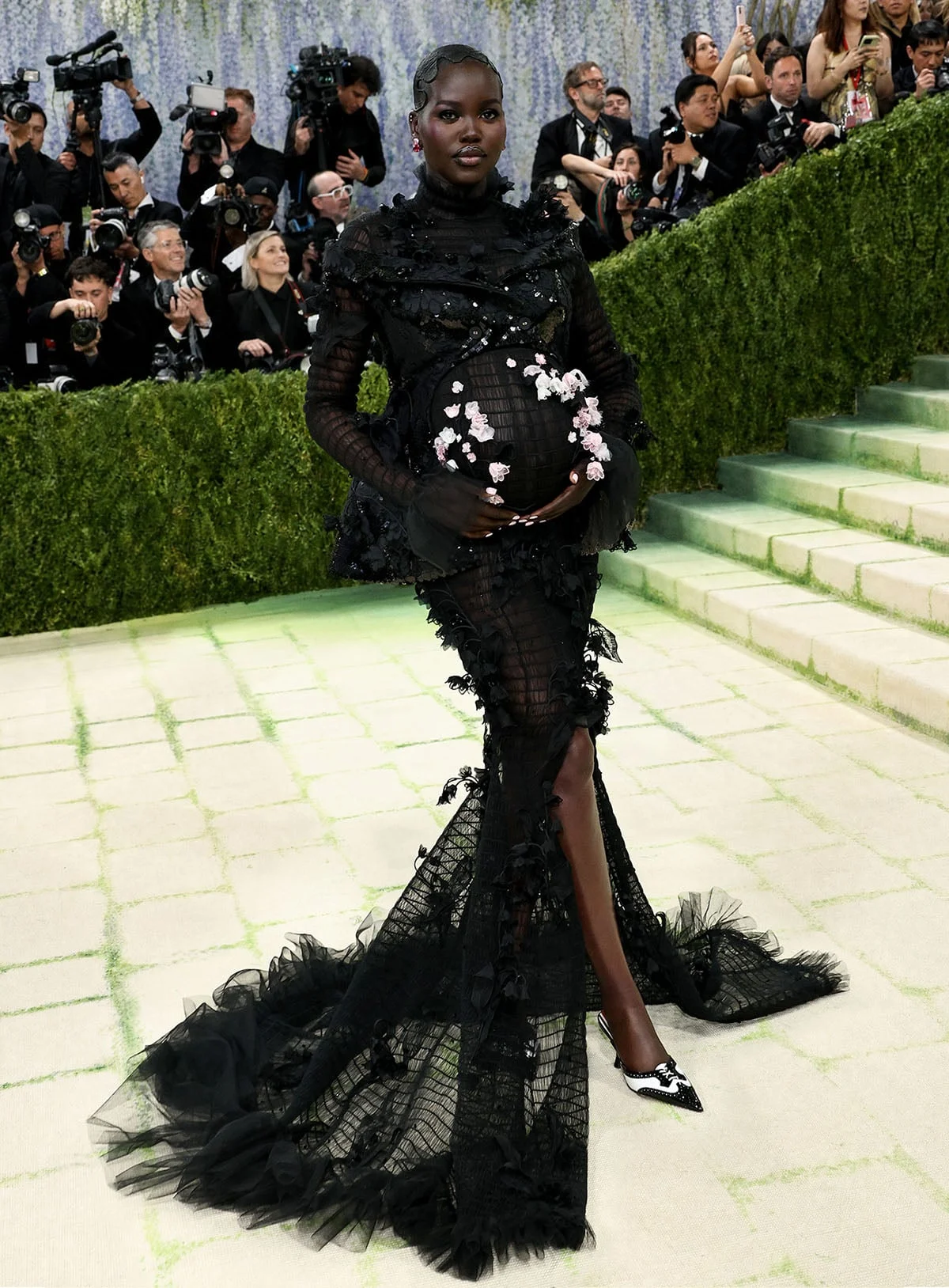
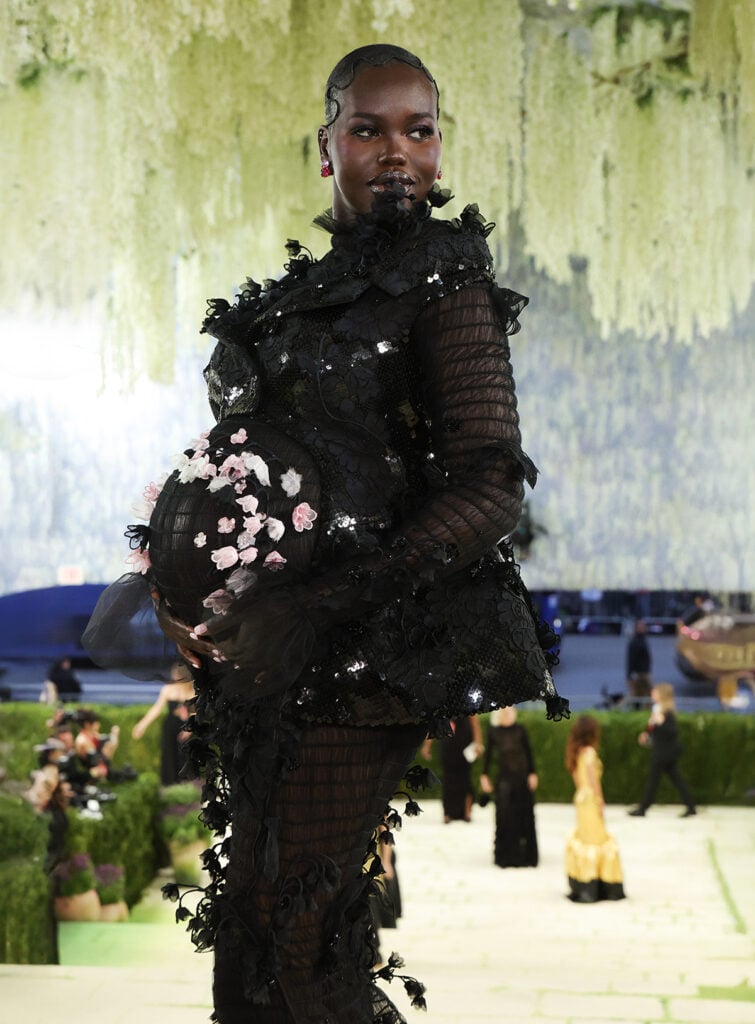
Supermodel Adut Akech represented the "Pregnant Body," an ensemble that focused on themes of birth, renewal, and the cyclical nature of life. The look featured a sculptural black sequin off-the-shoulder jacket paired with a sheer gathered tulle dress. The garment was notable for its intense level of craftsmanship, incorporating over 1,100 handmade silk organza flowers.
The choice of flora was deeply intentional; lily of the valley, a flower traditionally associated with May births, decorated the gown to signify new beginnings. Technical data from the Thom Browne atelier indicates that the dress was constructed from a combination of lace, silk organza, and cut glass beads. A subtle but significant detail included the integration of pink flowers among the white lily of the valley, which was interpreted by observers as a symbolic nod to the birth of a baby girl. This look stood as the most biological interpretation in the collection, grounding the conceptual theme in the reality of human reproduction.

Structural Abstraction and Artistic Inscription: Olivia Wilde and Skepta
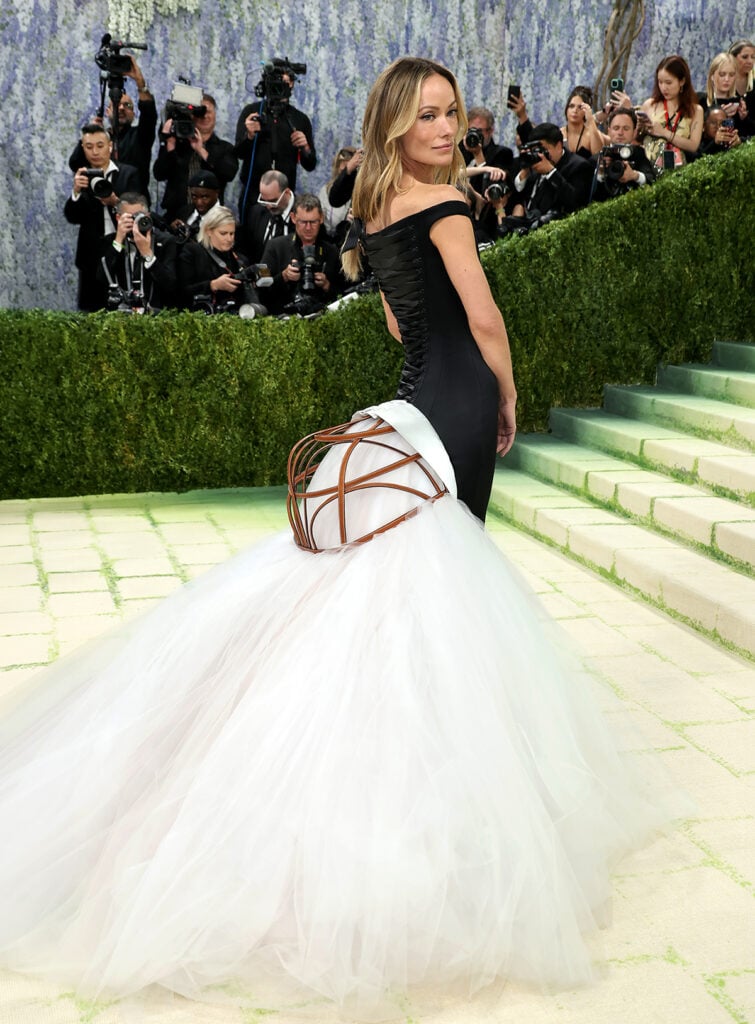
Olivia Wilde’s ensemble, titled the "Abstract Body," shifted the focus from the biological to the structural. Her gown served as a dedication to how the body’s silhouette is transformed through historical undergarments. The design prominently featured an exposed tan leather pannier and a petticoat set within a voluminous cloud of tulle layers. This look highlighted the "tooling" of fashion, showing how cages, stays, and padding have historically been used to distort the natural form into an artistic expression.
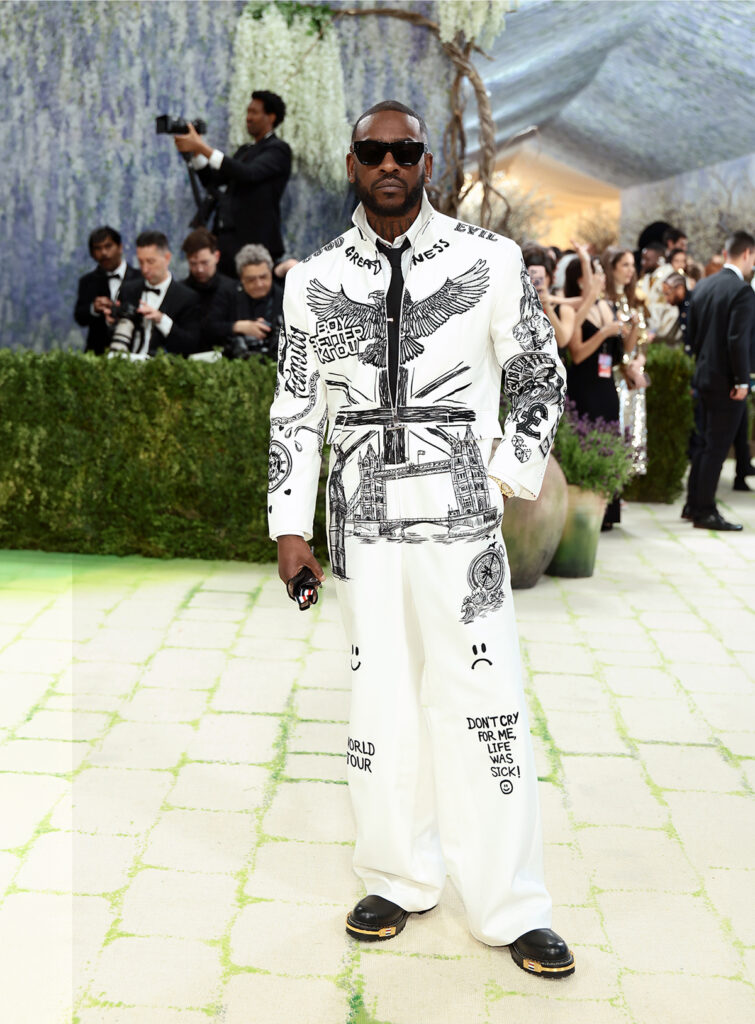
In contrast, the "Inscribed Body," worn by rapper Skepta, explored the skin as a canvas. Skepta appeared in a white tailored jumpsuit detailed with hand-drawn satin-stitch embroidery. The embroidery was custom-developed to mirror Skepta’s own tattoo artwork, with the placement and scale on the fabric corresponding exactly to the ink on his skin. This design effectively turned the garment into a second skin, blurring the line between the permanent markings of the body and the temporary covering of clothing.
Anatomical and Biological Interpretations: Kun and Dwayne Johnson
The "Vital Body," represented by the artist Kun, was perhaps the most technically complex in terms of anatomical representation. The cropped jacket was divided into two distinct halves to represent the interior mechanics of the human frame. One side utilized dégradé overlapping sequins and bugle beads with frayed organza in shades of red to depict the circulatory system. The other half featured hand-stitched tailoring thread interwoven with beaded lung and vein motifs. By externalizing the internal organs, Browne turned the vital functions of the body into decorative art.
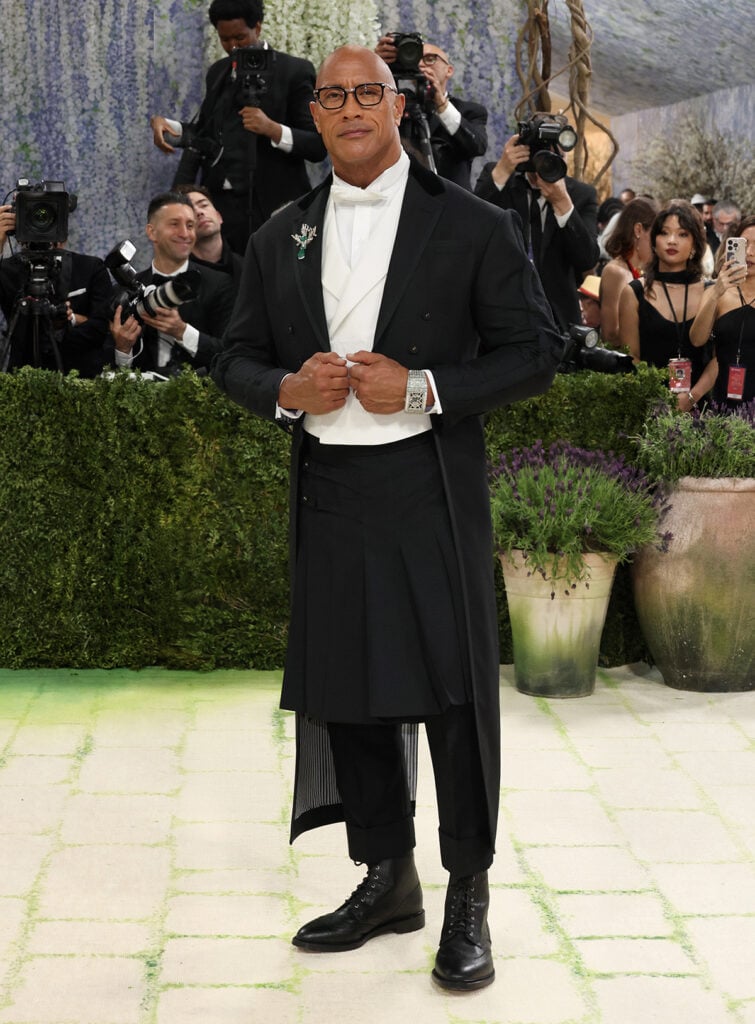
Dwayne Johnson’s "Mortal Body" addressed the skeletal structure that supports the human form. His tailcoat featured hand-pleated silk ribbons arranged in a skeletal composition. The design played on the duality of strength and fragility, using the actor’s physically imposing frame to highlight the elegance of the skeletal system. This look was described by the brand as a reflection on the mortal and immortal body across past, present, and future timelines.
The Reclaimed and Aging Body: Finn Wolfhard and Bill Skarsgård
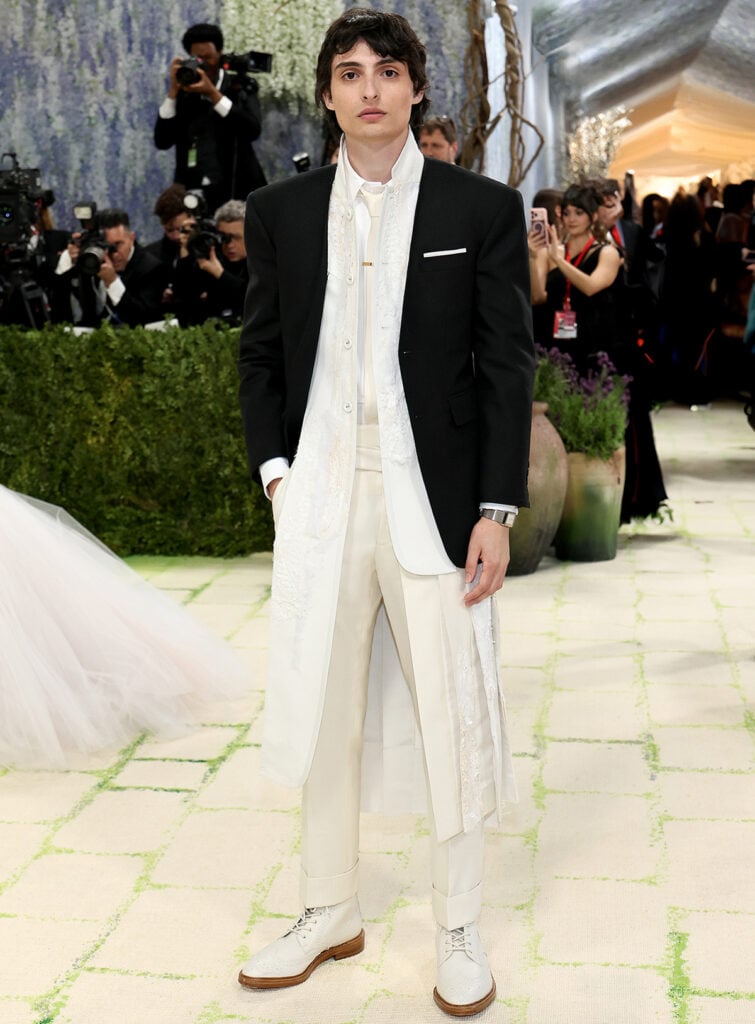
Finn Wolfhard represented the "Reclaimed Body," a look that treated tailoring as a medium for collage and distortion. The deconstructed white portions of the outfit were treated with abstract textural painting, effectively turning the fabric into a canvas. Hand-woven tweeds, silk faille, organza, lace, and muslin were layered to create a sense of reclamation, suggesting a body that has been broken down and rebuilt through artistic intervention.
Bill Skarsgård’s "Aging Body" took a meta-analytical approach to the theme. Rather than using prosthetics or makeup to simulate the passage of time, Browne utilized his own 25-year archive of fabrications. The elongated patchwork tuxedo was constructed from various textiles used throughout the history of the Thom Browne brand. This approach framed "aging" as the accumulation of history and experience, suggesting that the body is built and supported by the layers of its own past.
The Classical Body: Lindsey Vonn and Marcello Hernandez
The concept of the "Classical Body" was interpreted through two lenses: the sculptural and the traditional. Alpine ski racer Lindsey Vonn wore a deconstructed trompe-l’œil gown that referenced the Metropolitan Museum of Art’s collection of classical marble statues. The gown utilized glass-cut and bugle beads in shades of white, grey, and silver to mimic the texture and light-reflective qualities of carved stone. The sheer tulle hem added a modern lightness to the otherwise heavy, statue-like aesthetic.
Marcello Hernandez provided the final counterpoint as a second representation of the "Classical Body." His look was a testament to the "classical" nature of Browne’s own tailoring codes—a clean, timeless black tuxedo with a white shirt and bow tie. In a collection defined by abstraction and anatomical exposure, Hernandez’s look served as the baseline of formal elegance, representing the "idealized" body as defined by modern social standards.
Data and Craftsmanship: The Scale of Production
The production of these nine looks required thousands of hours of labor from the Thom Browne couture and tailoring teams. Supporting data highlights the following technical achievements:
- Adut Akech: 1,100+ handmade silk organza flowers; 400+ hours of embroidery.
- Kun: Dual-hemisphere construction requiring separate teams for the "circulatory" and "respiratory" beadwork.
- Lindsey Vonn: Thousands of individual bugle beads applied in a gradient to simulate the shadows of marble.
- Bill Skarsgård: A "textile biography" utilizing remnants from two and a half decades of brand history.
Broader Impact and Fashion Industry Implications
Thom Browne’s 2026 Met Gala presentation is expected to have a lasting impact on the conversation surrounding "thematic dressing." While many designers use the Met Gala to showcase celebrity brand ambassadors in standard evening wear, Browne’s commitment to a narrative arc—treating his guests as a collective unit of an exhibition—sets a new benchmark for conceptual fashion.

The collection successfully bridged the gap between the biological reality of the human body and the transformative power of clothing. By exploring pregnancy, aging, internal anatomy, and historical distortion, Browne reinforced the idea that fashion is not merely an external covering but an integral part of how the human form is perceived and understood. As the Metropolitan Museum of Art continues to celebrate Andrew Bolton’s curation of Costume Art, this specific collection will likely be remembered as a definitive example of how a designer can translate a complex curatorial theme into a cohesive, multi-layered visual reality.
The reception from the fashion community has been overwhelmingly positive, with analysts noting that Browne’s ability to maintain his strict tailoring codes while adapting to such diverse conceptual requirements is a testament to the brand’s versatility. The 2026 Met Gala has once again proven that when the theme is embraced with technical precision and intellectual rigor, the red carpet can indeed function as a legitimate extension of the museum’s galleries.