









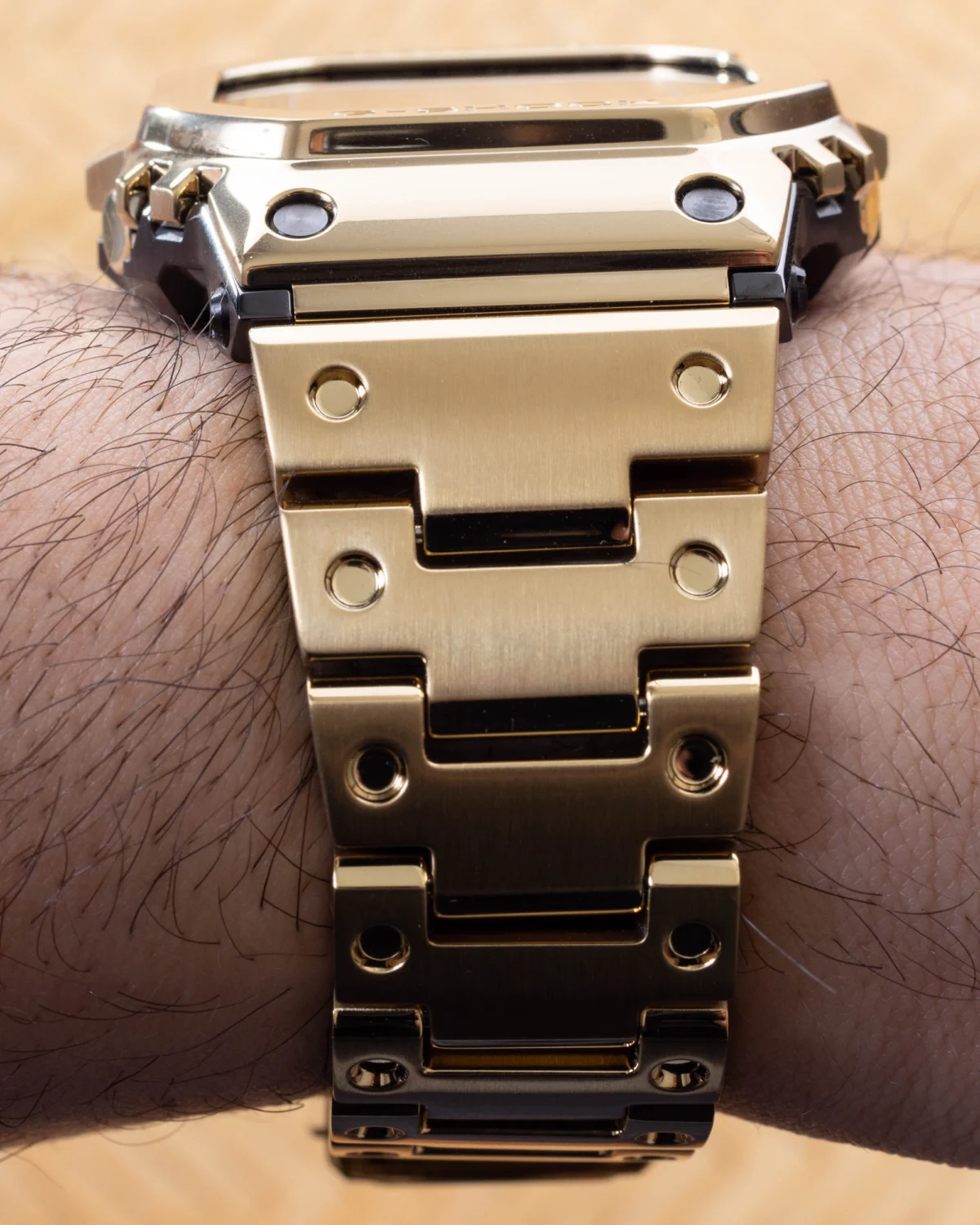
The G-Shock B5000 family, often referred to as the "full metal" G-Shocks, has established itself as a notable segment within Casio’s extensive watch catalog. These models, characterized by their robust metal construction and bracelet, are frequently observed on the wrists of individuals who prioritize both aesthetic appeal and practical functionality. While not the most expensive offerings in the G-Shock lineup, they represent a deliberate step up from the more common, sportier resin-cased models, appealing to those who seek the renowned reliability of Casio with a more sophisticated presentation. The introduction of the Casio G-Shock GMW-B5000GD9 marks a significant development, featuring a refined case design and, crucially, Casio’s pioneering integration of a Memory-in-Pixel (MIP) display, a departure from the traditional Liquid Crystal Display (LCD) technology. This model, presented here in a striking gold-tone steel finish, invites a closer examination of this technological evolution.
The Evolution of G-Shock Displays: MIP vs. LCD
The GMW-B5000GD9, with its reference number GMWBZ5000GD9, is a new entrant to the digital-face full metal watch family. It showcases a slightly altered case shape and prominently features one of Casio’s initial deployments of a MIP screen, designed to replace the conventional LCD found in many of its predecessors. It is important to clarify that a MIP screen is, in essence, a specialized form of LCD, specifically referred to by Casio as a STN-LCD (Super Twisted Nematic Liquid Crystal Display), enhanced with memory capabilities. This technology is paired with a photovoltaic cell, enabling solar charging, a hallmark of many modern G-Shock models designed for sustained operation.

While the GMW-B5000GD9 boasts a well-crafted, solid-feeling case, the practical advantages of its MIP display over Casio’s established LCD technology are not immediately apparent as a definitive upgrade for all users. The perception that MIP displays will eventually supersede LCDs is prevalent, but the reality suggests a more nuanced coexistence. The MIP display can be viewed as a different "flavor" of technology, one with significant untapped potential that Casio has yet to fully explore in its consumer products.
According to Casio, the primary enhancement offered by the new MIP display in the GMW-B5000GD9 lies in its improved contrast and, consequently, enhanced legibility, particularly under very bright lighting conditions. While these performance improvements may be factually correct, their impact might not be dramatically noticeable to every user. The fundamental differences between MIP and traditional LCD screens center on their operational principles and visual characteristics. LCD screens typically rely on a backlight that is always on or activated when needed, while MIP displays retain pixel information even after the signal is removed, allowing for lower power consumption and a display that can be read more easily in direct sunlight without a backlight.
Performance Metrics and Power Consumption
A key point of comparison between MIP and LCD technologies in the G-Shock context is their impact on battery life. Casio equips a lower-priced, black resin-cased G-Shock model with the same MIP screen. As of the time of this review, this model has experienced significant demand and is largely sold out, indicating a clear consumer interest in this display technology and in new Casio innovations for G-Shock.

However, a practical consideration for users is the battery life. A comparable G-Shock watch featuring an LCD screen typically offers an estimated battery life of 10 months in standard operation (not in low-power mode, which extends this duration). The MIP-equipped GMW-B5000GD9, conversely, reduces this average battery life to approximately six months. Although both versions are solar-powered, allowing for recharging via ambient light, this discrepancy highlights that Casio is still refining the power efficiency of its hardware modules incorporating MIP screens to match that of its LCD-based counterparts. This difference in battery life, while still substantial, suggests that efficiency remains an area for further development.
Display Versatility and User Interface Innovations
One of the theoretical advantages of MIP screens is their higher resolution, which theoretically allows for greater graphical variety and more sophisticated user interfaces. This opens the door for Casio to create entirely new time displays and user experiences for watches like the GMW-B5000GD9.
In this new system, Casio has introduced a fresh font for the numerals, which they term "Standard." These numerals are smoother and possess a more refined aesthetic compared to the stencil-style fonts commonly found on older LCD screens. A secondary font option, labeled "Classic," is also available, designed to emulate the visual appearance of the traditional stencil-style LCD numerals. However, beyond these two font choices and minor adjustments for on-screen data display, there are no other significant graphical layouts or font options offered for the main dial information.

One notable, albeit somewhat counterintuitive, design choice is the method for switching between these font styles. The functionality to change the numeral font from "Standard" to "Classic" is not accessible directly on the watch itself. This setting is also conspicuously absent from the instruction manual, not being mentioned even once. Instead, users must rely on the companion Casio smartphone application, which connects to the watch via Bluetooth.
The Role of the Casio Connected App
The Bluetooth connectivity of the GMW-B5000GD9 facilitates seamless integration with the Casio smartphone app. This application provides a user-friendly platform for managing watch settings, synchronizing time, and customizing display preferences. While the app is generally considered a convenient tool for users of Bluetooth-equipped Casio watches, the exclusive requirement of the app for adjusting the dial font, rather than offering native on-watch control, presents a usability friction point. This dependency raises questions about the user interface design philosophy for this new generation of digital displays.
Casio has demonstrated a remarkable capacity for creative and engaging designs in its analog-digital and all-analog watch displays. The company possesses the design talent and resources to develop compelling new concepts for its digital watch faces. The author expresses a hope that Casio will similarly focus on innovating its digital display offerings, moving beyond established classics to introduce fresh visual interfaces and font options that leverage the full capabilities of the MIP technology.

Model Variants and Display Customization Limitations
At its launch, Casio’s full metal G-Shock collection featuring MIP displays comprised two primary models. The GMW-B5000GD9, presented here with its gold-toned finish, features a conventional "positive" light display, where dark text appears on a light background. Its counterpart, the GMW-B5000D-1, in a natural steel tone, utilizes a "negative" display, characterized by light text on a dark background.
An interesting observation is the apparent inability for users to natively switch between light and dark display modes on either model. This limitation seems somewhat arbitrary, as MIP screens are not inherently bound by the same hardware constraints as traditional LCDs, which often require specific configurations for different display modes. The intuition here is that a MIP screen could potentially be reprogrammed to offer both light and dark display styles with relative ease. This lack of immediate display mode flexibility is one reason cited for hesitation in recommending an immediate upgrade to MIP displays for all Casio enthusiasts. While the technology is impressive, its current implementation still has room for refinement, and it is not yet a definitive "game-changer" that justifies an immediate transition for all users.
The watch’s display is protected by a mineral crystal, consistent with previous generations of this model. While the recessed nature of the crystal, shielded by the raised metal bezel, offers a degree of protection against scratches, higher-end Casio watches often feature sapphire crystals, which are significantly more scratch-resistant. Given the price point of the GMW-B5000GD9, Casio might consider incorporating sapphire crystals in future iterations, provided production costs for non-round sapphire crystals can be managed effectively.

Comparative Analysis: GMW-B5000GD9 vs. Legacy LCD Model
To provide a clearer perspective on the differences, the Casio G-Shock GMW-B5000GD9 with the MIP screen is compared with a very similar model, the GMW-B5000GD9, which features a negative LCD display. The reference numbers differ by only a single letter, indicating close kinship.
While there are some subtle case design differences, their overall impact on the user experience is not definitively an upgrade. Casio has re-engineered the black DLC-coated steel case back for the GMW-B5000GD9, which presents a refined aesthetic and a solid feel. The watch retains its robust water resistance rating of 200 meters and maintains largely similar case dimensions: 43.6mm in width and 13mm in thickness. The lug-to-lug distance is measured at 49.3mm. However, the design of the end links, which do not articulate significantly downward, effectively increases the perceived wearing distance to approximately 60mm. Consequently, the GMW-B5000 series, including this MIP model, might not be the optimal choice for individuals with smaller wrists. Furthermore, the MIP screen models are slightly heavier, weighing 172 grams compared to the 167 grams of their LCD counterparts.
Core Functionality and Feature Set
The software and feature set of the GMW-B5000GD9 remain largely consistent with the previous generation of hardware. While it does not introduce substantial new functionalities, it retains all the essential and highly useful features expected from a modern G-Shock. These include a full calendar, a stopwatch, a countdown timer, up to five daily alarms, a world time function capable of displaying times for numerous cities globally, Bluetooth connectivity for smartphone synchronization, six-band atomic clock radio control for automatic time calibration, Tough Solar power, and the highly appreciated auto-illumination feature. The auto-illumination function, when enabled, activates the screen’s LED backlight automatically when the wrist is raised and tilted at an appropriate angle, enhancing usability in low-light conditions.

The Aesthetic Appeal of the Gold-Tone Finish
The gold-toned finish of the GMW-B5000GD9 adds a distinct visual flair. There is a certain playful irony in wearing a substantial metal G-Shock in a gold color, especially when contrasted with its utilitarian digital display. While the ultimate luxury would be solid gold construction, as Casio once produced with the limited edition solid 18ct gold G-SHOCK (GD-5000-9JR), the gold-tone PVD coating on this model offers an accessible nod to precious metal aesthetics. Casio masterfully balances its reputation for producing highly functional, even calculating, timepieces with a keen sense of style and fun.
A significant part of Casio’s design philosophy for these metal G-Shocks is to offer intricate details and robust construction at a relatively accessible price point. The company aims for consumers to appreciate the meticulous finishing of the metal case, its shock and dirt resistance, and its surprisingly formal wearing presence, achieved despite the absence of external plastic components.
Future Outlook for MIP Technology in G-Shock
It is anticipated that it will take several more product generations before Casio fully integrates MIP technology into its mainstream G-Shock offerings. The author suggests that the traditional LCD screens are unlikely to be completely replaced by MIP technology in the immediate future.

To gain a deeper understanding of the benefits and limitations of MIP technology and Casio’s strategic vision for its application, a direct discussion with a Casio engineer would be beneficial. Such a conversation could clarify the potential for MIP screens in future G-Shock lineups and address the current design choices. The GMW-B5000GD9, despite its few points of contention, represents an ambitious step towards a futuristic metal G-Shock, a product that has generated considerable anticipation among enthusiasts.
The Casio G-Shock GMW-B5000GD9 is priced at $720 USD. Further details can be found on the official Casio website. The blend of robust engineering, distinctive aesthetics, and evolving display technology positions this model as a significant piece in the ongoing narrative of the G-Shock brand.