








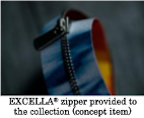
TOKYO — On July 13, 2026, YKK Corporation (YKK), a global leader in fastening solutions, officially announced the development of a concept version of its flagship EXCELLA® zipper series, featuring zipper tapes constructed from nonwoven fabric sheets derived from upcycled clothing and textile waste. This breakthrough represents a significant milestone in the pursuit of a circular economy within the fashion industry, merging high-end luxury aesthetics with advanced recycling technology. The project is the result of a tripartite collaboration between YKK, technology giant Seiko Epson Corporation (Epson), and visionary fashion designer Yuima Nakazato.
The concept zipper was first introduced to the global stage as a functional component in the latest YUIMA NAKAZATO Couture Collection, titled "INFERNO," which premiered at the prestigious Paris Haute Couture Week on July 8, 2026. By integrating hardware made from repurposed textile fibers into a high-fashion collection, the collaborators have demonstrated that sustainable materials can meet the rigorous quality and aesthetic standards of the luxury sector.
Technological Innovation: Epson’s Dry Fiber Technology
The core of this development lies in the application of Epson’s proprietary Dry Fiber Technology (DFT). Originally developed for office paper recycling systems, DFT has been adapted to transform discarded garments and textile scraps into new, high-value materials without the extensive use of water typically required in traditional recycling processes.
Dry Fiber Technology operates through a three-stage process:
- Defibration: Mechanical impact is used to break down used textiles and waste materials into long, thin fibers.
- Binding: Specialized binders are added to the fiberized material to enhance strength and provide specific functional properties.
- Forming: Pressure and heat are applied to form the fibers into sheets of nonwoven fabric.
In this specific application, the DFT-produced sheets were utilized as the base material for the zipper tape—the fabric portion of the zipper that is sewn into a garment. Historically, zipper tapes have been manufactured using woven or knitted synthetic fibers, such as polyester, to ensure the durability and stability required for the mechanical operation of the zipper. Replacing these traditional textiles with nonwoven sheets made from recycled fibers presented significant engineering challenges, requiring YKK to rethink the structural integrity of the fastener.
Engineering the EXCELLA Concept
The EXCELLA® series is YKK’s highest-quality metal zipper, characterized by individual elements (teeth) that are polished on all sides to provide a smooth feel and a brilliant appearance. To adapt this premium product to a nonwoven tape, YKK engineers conducted exhaustive research into material science and mechanical attachment.
The primary hurdle involved the "element attachment" phase. Because nonwoven fabric lacks the structured weave of traditional tapes, the team had to ensure that the metal teeth would remain securely fastened under the stress of repeated opening and closing. The development team performed extensive studies on the density and thickness of the Epson-produced sheets to find a balance between the flexibility required for clothing and the rigidity needed to hold the metal components.
Furthermore, the project necessitated the selection of a specialized slider. The inherent rigidity of the upcycled nonwoven tape meant that standard sliders could cause snagging or premature wear. YKK developed a slider structure specifically tuned to the physical properties of the DFT sheets, optimizing the internal clearance to allow for smooth movement while maintaining the "click" and security expected of the EXCELLA® brand.
The Designer’s Vision: Addressing the Waste Crisis
The impetus for this project came from designer Yuima Nakazato, whose work has increasingly focused on the environmental and social consequences of the global fashion industry. Nakazato’s "INFERNO" collection serves as a creative response to the "waste mountains" of discarded clothing accumulating in regions like Kenya, where massive quantities of second-hand garments from the West are often sent, only to end up in landfills or being burned.
Nakazato’s collaboration with Epson and YKK seeks to create a "closed-loop" inspiration, where the very waste generated by the industry is transformed back into the components of haute couture. By using DFT to fiberize these discarded materials into nonwoven sheets, the project demonstrates a viable pathway for "fiber-to-fiber" recycling that bypasses the need for virgin petroleum-based synthetics.
"The challenge of recycling used clothing is a global issue," a representative from the design house noted. "By collaborating with technology leaders like YKK and Epson, we are proving that even the most overlooked waste can be elevated into a material of beauty and function."
Global Textile Waste: The Data Behind the Development
The development of the upcycled EXCELLA® zipper comes at a critical time for the textile industry. According to data from the Ellen MacArthur Foundation and various environmental agencies, the fashion industry is responsible for approximately 92 million tons of textile waste annually. It is estimated that a truckload of abandoned textiles is landfilled or incinerated every second.
Current recycling rates remain low; less than 1% of the material used to produce clothing is recycled into new clothing. Most "recycled" polyester currently used in the industry is derived from plastic bottles (rPET) rather than old garments. This makes the YKK-Epson-Nakazato initiative particularly noteworthy, as it focuses on true textile-to-textile recycling.
Supporting data highlights the scale of the challenge:
- Waste Generation: Global garment production doubled between 2000 and 2014, while the number of times a garment is worn decreased by 36%.
- Resource Consumption: Traditional textile recycling often involves chemical processes or heavy water usage. Epson’s DFT is a "dry" process, significantly reducing the environmental footprint of the material recovery phase.
- Microplastics: By utilizing nonwoven sheets derived from existing fibers, the project also explores ways to stabilize fibers that might otherwise contribute to microplastic pollution during the washing process.
Chronology of the Collaboration
The journey from concept to the Paris runway involved a multi-year effort of research, testing, and creative iteration:
- 2023–2024: Yuima Nakazato begins exploring the impact of textile waste in Africa, establishing a partnership with Epson to use Dry Fiber Technology for garment materials.
- Early 2025: YKK joins the collaboration to address the "hardware gap"—the fact that even sustainable garments often rely on virgin plastic or metal fasteners.
- Late 2025: Initial prototypes of the nonwoven zipper tape are produced. Engineers identify issues with element displacement and tape tearing.
- January–May 2026: Iterative testing of binder concentrations and heat-pressing techniques in the DFT process. YKK finalizes the specialized slider design.
- July 8, 2026: The "INFERNO" collection debuts in Paris, featuring the upcycled EXCELLA® zippers integrated into several key couture pieces.
- July 13, 2026: YKK officially announces the concept to the global textile and manufacturing industry from its headquarters in Tokyo.
Official Responses and Industry Impact
YKK has long been a proponent of environmental stewardship through its "Cycle of Goodness" philosophy. The company has previously launched the NATULON® series, which features zipper tapes made from recycled PET bottles and textile waste. However, this new EXCELLA® concept goes a step further by incorporating nonwoven technology and high-end aesthetics.
"YKK is committed to supporting a circular economy," the company stated in its official release. "By leveraging the insights gained from this development, we will further enhance the value of EXCELLA® zippers to meet the diverse needs of customers in the luxury sector who are increasingly demanding both performance and sustainability."
Industry analysts suggest that this development could have far-reaching implications for the luxury goods market. As European Union regulations around "Ecodesign" and "Digital Product Passports" become more stringent, luxury brands are under pressure to ensure every component of a garment—including the hardware—is traceable and recyclable.
"The zipper has always been a difficult component in the recycling stream because it is a multi-material assembly," says Dr. Elena Rossi, a textile sustainability consultant. "By moving toward a tape that is essentially made from the same ‘waste’ as the garment itself, YKK is simplifying the eventual deconstruction and recycling of the entire piece."
Broader Implications for the Future of Fastening
While the current EXCELLA® nonwoven zipper remains a "concept version," its successful application in a couture collection proves the technical feasibility of the material. YKK has indicated that the data gathered during this project will inform future commercial products.
The success of this collaboration also highlights the growing trend of "cross-industry innovation," where a printing company (Epson), a hardware manufacturer (YKK), and a fashion house (Nakazato) combine their respective expertise to solve systemic environmental problems.
As the industry moves toward 2030 sustainability targets, the integration of Dry Fiber Technology into garment components offers a glimpse into a future where "new" materials are harvested from the "old." For YKK, the project reaffirms its position not just as a manufacturer of fasteners, but as a critical player in the engineering of sustainable fashion. The EXCELLA® upcycled zipper is more than a functional tool; it is a proof of concept for an era where the fashion industry’s "inferno" of waste is transformed into the high-performance materials of tomorrow.