








The Catalan capital recently served as the epicenter of avant-garde design, international collaboration, and boundary-pushing sartorial expression during the latest edition of 080 Barcelona Fashion Week. Spanning four intensive days, the prominent fashion showcase brought together a dynamic ecosystem of established industry heavyweights, daring independent labels, and rising international names. Against the architectural backdrop of Barcelona—a city globally recognized as a burgeoning hub for creative industries—designers utilized the runway to explore complex conceptual territories, drawing unexpected inspiration from 1990s pop iconography, the psychological depths of cinema, and the historical marginalia of court jesters.
As the global fashion calendar evolves to accommodate both commercial demands and high-concept artistic statements, 080 Barcelona Fashion Week continues to carve out a distinct identity. Positioned outside the traditional "big four" capitals of New York, London, Milan, and Paris, the Catalan showcase offers a vital platform for Mediterranean and European talent to experiment freely. This season’s programming was particularly notable for its intersection of heritage craftsmanship with digital-age anxieties, sustainability narratives, and deeply personal explorations of identity.
The Genesis and Evolution of 080 Barcelona Fashion Week
Established to project Catalan design onto the international stage, 080 Barcelona Fashion Week has historically emphasized innovation, sustainability, and creative freedom. Over the past decade, the event has transformed from a regional showcase into a globally watched incubator for independent design talent. Organizers have consistently prioritized diversity on the runway, encouraging labels to move away from rigid seasonal cycles in favor of narrative-driven collections that reflect contemporary social shifts.

This season’s roster reflected a deliberate curation of contrasting aesthetics. From celebratory milestone anniversaries to high-stakes runway debuts, the four-day event underscored the resilience of independent European fashion houses navigating a shifting global retail landscape. Industry analysts tracking the event noted an increased emphasis on cross-disciplinary inspirations, with designers heavily borrowing from cinematic history, architectural theory, and subcultural archives to construct their Spring/Summer collections.
DOMINNICO Celebrates a Decade of Pop-Infused Futurism
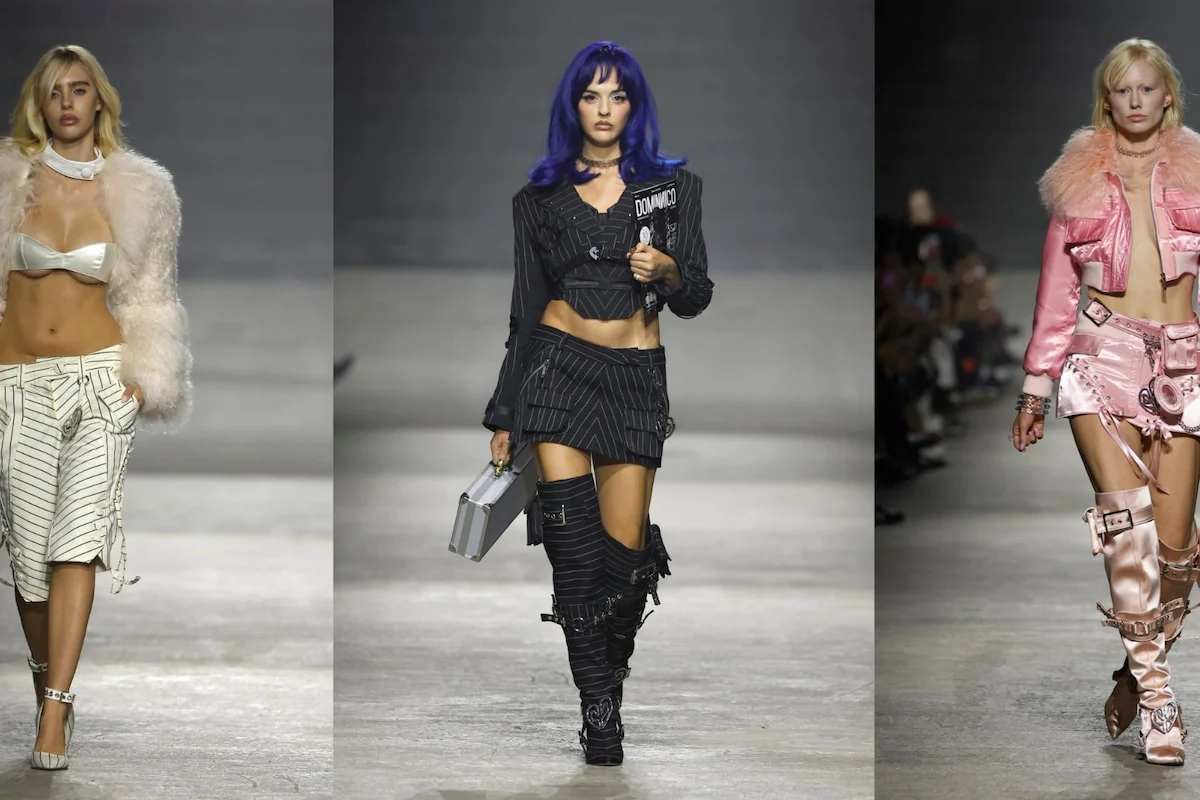
Marking a major milestone in its operational history, DOMINNICO celebrated its tenth anniversary with a high-octane collection titled SUPERNOVA. Creative director Domingo Rodríguez Lázaro used the platform to pivot toward a sophisticated new chapter for the brand, steering away from purely synthetic youth-culture tropes into a mature exploration of 1990s pop glamour.
Drawing direct inspiration from Madonna and her legendary capacity for continuous reinvention, the collection recontextualized corporate officewear for the nocturnal sphere. Pinstriped tailoring, sharply cut pencil skirts, and classic bomber jackets were meticulously rendered in high-gloss leather, rich satin, and intricate knitwear. The color palette acted as a deliberate bridge between eras; pastel pinks, delicate lilacs, and warm corals softened the sharper, more aggressive futuristic elements that have long defined the DOMINNICO aesthetic.
A high-profile casting lineup, featuring runway figures such as Kitty Lever and Sita Abellán, added commercial weight to the presentation. In a self-referential touch that captured the digital-first ethos of the brand, several models walked the runway carrying custom DOMINNICO magazines tucked under their arms, blurring the boundary between media, merchandising, and high fashion.

Outsiders Division Explores the Edges of Adolescence
Shifting from pop grandeur to psychological introspection, Outsiders Division captured the audience’s attention with a collection titled Groomed and Horny. The brand, known for its whimsical and youthful storytelling, tackled the complex and often awkward transition of its fictional universe entering adolescence.
Rather than shying away from the turbulence of growing up, creative leadership leaned into the evolving curiosities of youth, where childhood innocence intersects with emerging awareness of attraction, identity, and personal experimentation. Visually, the collection borrowed codes and motifs traditionally associated with underground sex clubs, introducing tighter, more body-conscious silhouettes alongside provocative graphic prints.
Despite the risqué thematic underpinnings, the brand’s foundational childlike playfulness remained intact. The runway featured an eccentric mix of oversized teddy bear headwear, intricately patterned handkerchiefs, whimsical rosette socks, and heavily embellished flat footwear. Industry observers noted that the collection successfully bridged the gap between avant-garde subversion and wearable commercial separates, marking a maturation in Outsiders Division’s design vocabulary.
Pat Equilux and the Architecture of Unlived Lives

Introspection took a philosophical turn with Pat Equilux’s presentation of Vidas No Vividas (Unlived Lives). Inspired by the poetic manifesto The Building of Unlived Lives, the collection conceptually transformed alternate personal timelines and paths not taken into a physical apartment building, where every illuminated window represented a distinct, unrealized destiny.
This heavy, conceptual framework materialized on the runway through precise, clean tailoring executed in a muted, contemplative color palette. Models navigated the space in structured, buckled jackets and boots, complemented by dramatic, thick ruffled sleeves that added a layer of architectural volume. One of the most talked-about elements of the presentation was the styling of wild, chaotic hairstyles, which provided a stark, jarring contrast to the otherwise disciplined tailoring. Rather than sinking into melancholy or regret, the collection functioned as a stylistic meditation, serving as a reminder to appreciate the reality of the present moment.
Louis Gabriel Nouchi’s Cinematic Archival Study
French designer Louis Gabriel Nouchi offered a sustainable and reflective counter-narrative to the relentless pressure of constant production. Opting out of producing an entirely new set of garments, Nouchi curated Volver – A Study in Desire, an archival presentation that pulled pieces from previous LGN collections and re-styled them into entirely novel ensembles.
The conceptual framework for the styling drew directly from the vibrant, emotionally charged, and melodrama-laden films of acclaimed Spanish director Pedro Almodóvar. By pairing familiar garments in unexpected ways, Nouchi demonstrated that contemporary reinvention does not strictly necessitate virgin material extraction—a nod to circular fashion practices increasingly demanded by European consumers and regulators. On the runway, models wore sweeping, dramatic coats and voluminous tailoring, with select looks featuring intricate lace coverings obscuring the wearers’ faces, heightening the cinematic tension of the presentation.

BOLTAD Makes a Reincarnation-Inspired Debut
Among the most anticipated events of the week was the official runway debut of emerging Spanish label BOLTAD. Founded by Alberto Martín Pozo, the brand used its maiden outing to present Billy | El Hermoso, a collection deeply invested in the metaphysical concept of reincarnation.
Pozo explored the idea that human beings carry multiple, distinct versions of their past selves across a single lifetime, evolving through successive cycles of personal transformation. This philosophical premise was translated into a playful and visually chaotic aesthetic characterized by unexpected layering, clashing prints, and high-contrast color blocking. The garments appeared intentionally mismatched, as though assembled from entirely different wardrobes, historical eras, and social strata, signaling a bold and uninhibited arrival for the young label on the official Catalan calendar.
Acceptance Letter and the Melancholy of the Court Jester
Drawing from historical marginalia and cinematic tragedy, Acceptance Letter presented Jester’s Prayer. The collection examined the fascinating sociological history of the medieval court jester, whose vibrant, multicolored attire and licensed absurdity historically granted them the unique privilege of mocking absolute power without facing immediate execution.

To capture the emotional complexity of the archetype, the designers also referenced Federico Fellini’s 1970 cinematic masterwork I Clowns, exploring the inherent sadness behind comedic performance. This dual nature of humor as a coping mechanism manifested in eccentric silhouettes, exaggerated layering, and avant-garde styling combinations. Kaleidoscopic patterns reminiscent of a jester’s handkerchief were paired with brightly colored, clog-like mules, grounding the whimsical performance art of the presentation in tangible, wearable footwear.
404 Studio and the Boundary of Dreams with Paprika
Closing out a robust week of design innovation, 404 Studio—under the creative direction of Anaïs Vauxcelles—brought an explosive injection of color to the Barcelona schedule. Titled Paprika, the Spring/Summer collection took direct inspiration from Satoshi Kon’s acclaimed anime film of the same name, which interrogates the permeable boundary between human dreams and waking reality.
Vauxcelles utilized this psychological premise as a metaphor for creative and personal growth. Models moved through the space wearing muted foundational dresses and shorts that were dramatically punctured by bursts of hyper-saturated color. Standout accessories included sequinned slouchy beanies, surreal crocheted lips, and upturned handbags that pushed the boundaries of accessory design.
A major highlight of the presentation was a collaborative footwear capsule with Brazilian footwear giant Melissa. 404 Studio reimagined Melissa’s iconic, signature jelly shoes, applying a high-fashion, dystopian lens to the nostalgic plastic footwear, thereby sealing the bridge between mass-market familiarity and independent design curation.

Implications and the Broader Fashion Landscape
The collections showcased at 080 Barcelona Fashion Week collectively point to several broader shifts within the contemporary fashion economy. As European regulatory frameworks tighten around environmental sustainability, designers are increasingly compelled to adopt circular practices, as evidenced by Louis Gabriel Nouchi’s archival reuse. Simultaneously, the heavy reliance on cinematic and literary narratives—from Satoshi Kon to Pedro Almodóvar—indicates that consumer demand is shifting away from fast-trend replication toward intellectual depth and narrative-driven consumption.
Furthermore, the prominence of independent and emerging labels like BOLTAD and Acceptance Letter demonstrates that market appetite remains strong for risk-taking design. By rejecting homogenized commercial uniformity in favor of hyper-personalized storytelling—whether through the lens of reincarnation, medieval history, or pop music nostalgia—Barcelona’s fashion ecosystem has reinforced its position as a vital, forward-thinking crucible for European style. As the industry looks toward the upcoming retail seasons, the creative risks taken along the Catalan coast will undoubtedly reverberate through international retail and editorial landscapes alike.