











Across the United Kingdom and continental Europe, a pervasive topic of conversation has dominated public discourse: the relentless and unprecedented heat. As regions experienced record-breaking temperatures for June, the fragility of infrastructure and daily routines in the face of extreme weather became acutely apparent. This annual, albeit brief, confrontation with scorching conditions serves as a stark reminder that many parts of Britain and Europe are simply not engineered to withstand prolonged periods of intense heat, leading to widespread discomfort, disruption, and a collective yearning for respite.
The Climate Context: A New Normal?
The heatwaves gripping the UK and Europe are not isolated incidents but rather symptomatic of a broader, accelerating trend driven by global climate change. June 2023, for instance, was officially declared the hottest June on record globally, according to data from the Copernicus Climate Change Service (C3S), surpassing the previous record set in 2019. In the UK, the Met Office confirmed that June 2023 was the warmest June since records began in 1884, with an average temperature of 15.8°C, exceeding the previous record by 0.9°C. These statistics underscore a worrying trajectory, where extreme weather events, including prolonged heatwaves, are becoming more frequent and intense.
Scientists from the Intergovernmental Panel on Climate Change (IPCC) have consistently warned that human-induced climate change is increasing the likelihood and severity of such events. The burning of fossil fuels releases greenhouse gases into the atmosphere, trapping heat and leading to a global temperature rise. This rise manifests locally as more frequent and longer heatwaves, challenging long-established climate norms and forcing societies to confront new environmental realities. The World Meteorological Organization (WMO) has also highlighted that the current warming trend means that future summers are likely to see even more extreme temperatures, making adaptation an urgent necessity rather than a distant goal.
Coping Mechanisms and Societal Strain
The immediate impact of such heatwaves on daily life is profound. Public health advisories are routinely issued, warning of the dangers of dehydration, heatstroke, and the exacerbation of pre-existing medical conditions, particularly among vulnerable populations such as the elderly, young children, and those with chronic illnesses. Hospitals report increased admissions related to heat-stress, straining healthcare systems already under pressure.
From a practical standpoint, the UK’s housing stock and urban planning often exacerbate the problem. A significant majority of homes lack air conditioning, a feature common in countries accustomed to hotter climates. Traditional building materials, designed to retain heat during colder months, become heat traps in summer. Urban areas, with their abundance of concrete and asphalt, experience the "urban heat island effect," where temperatures are significantly higher than in surrounding rural areas. This leads to nights that offer little relief, severely impacting sleep quality and overall well-being.
The economy also feels the strain. Productivity often dips as individuals struggle to concentrate in hot working environments. Public transport networks face challenges, with speed restrictions on railways to prevent buckling tracks and increased risk of delays due to overheating equipment. Outdoor workers, from construction to agriculture, face hazardous conditions, prompting employers to adjust working hours or implement stricter safety protocols. Schools and offices often become stifling, leading to calls for closures or flexible working arrangements. The collective experience becomes one of a primal struggle: seeking shade, consuming iced drinks, frequent cold showers, and for many, a longing for the respite of cooler climes or even just a functional air conditioner.
Escapism and Reflection: Cinema’s Hot Embrace
In times of such pervasive discomfort, art often provides a unique form of solace, escape, or even a mirror to our collective experience. When the world outside feels stifling, turning to cinema can offer a powerful means of navigating the psychological and physical toll of extreme heat. Films that masterfully weave heat into their narrative fabric, making it a character in itself, resonate deeply. They capture the desire, the madness, the languor, and the tension that can arise when the mercury climbs, transforming sweat into a cinematic language of eroticism, desperation, or decay. These curated selections offer a compelling journey through the varied ways filmmakers have explored the profound impact of heat on human emotions and actions.
BODY HEAT (1981)
Lawrence Kasdan’s directorial debut, Body Heat, opens with an immediate immersion into its sweltering atmosphere: "My God, it’s hot. I stepped out of the shower and started sweating again." This neo-noir erotic thriller, set against the backdrop of a Floridian heatwave, is drenched in a palpable humidity that serves as a constant, oppressive presence. Inspired by Billy Wilder’s 1944 classic Double Indemnity, the film follows William Hurt as Ned Racine, a small-town lawyer ensnared in a dangerous affair with Kathleen Turner’s manipulative femme fatale, Matty Walker. Their illicit romance blossoms amidst the stifling heat, which becomes a metaphor for their burning desire and the increasingly perilous nature of their conspiracy to murder Matty’s wealthy husband.
Cinematographer Richard H. Kline uses deep shadows and golden hues to evoke a sense of perpetual twilight, emphasizing the oppressive, inescapable nature of the climate. John Barry’s sultry, saxophone-driven score further enhances the film’s steamy, suspenseful mood. The characters’ constant perspiration is not merely a visual detail but an integral part of their psychological state, reflecting their escalating paranoia and the breakdown of their moral compass. Body Heat masterfully uses its humid setting to amplify the themes of forbidden passion, betrayal, and the intoxicating, destructive power of obsession, making it a quintessential "hot weather" film that drips with tension and sensuality. It solidified Turner’s status as a formidable screen presence and remains a celebrated example of the neo-noir genre.
THE NIGHT OF THE IGUANA (1964)
John Huston’s The Night of the Iguana is a quintessential adaptation of Tennessee Williams’ play, a writer renowned for his exploration of psychosexual drama set against sweltering Southern backdrops. Filmed in the humid, lush landscapes of Puerto Vallarta, Mexico, the film embodies a sense of suffocating desperation and moral decay. Richard Burton delivers a powerful performance as T. Lawrence Shannon, a defrocked Episcopalian priest turned troubled tour guide, grappling with his inner demons and a crisis of faith. He leads a group of Baptist schoolteachers on a disastrous trip, eventually stranding them at a dilapidated hotel run by the spirited Maxine Faulk (Ava Gardner).
The film’s atmosphere is thick with heat and tension, expertly captured by Mexican cinematographer Gabriel Figueroa, whose close-ups of Burton’s sweat-drenched face convey his inner turmoil. Shannon finds himself caught between the competing desires and needs of three women: the sensual Maxine, the prim and repressed Hannah Jelkes (Deborah Kerr), and the young, seductive Charlotte Goodall (Sue Lyon). The oppressive heat mirrors the characters’ claustrophobic emotional states and the suffocating pressures of their desires. The legendary off-screen drama during production, notably Elizabeth Taylor’s jealous antics while visiting Burton on set, only adds to the film’s reputation for intense, tempestuous energy. The Night of the Iguana is a masterful study of human fragility, repression, and the explosive consequences when societal constraints meet primal urges, all under the relentless gaze of a tropical sun.
LA CIÉNEGA (2001)
Lucrecia Martel’s debut feature, La Ciénega (The Swamp), is a masterclass in atmospheric filmmaking, where the muggy heat of rural Argentina becomes a character in itself, a metaphor for social and moral stagnation. Set in Martel’s hometown of Salta, the film offers a disquieting portrait of an extended, decaying upper-class family whose languor and disarray reflect broader societal malaise. The narrative, inspired by Martel’s own family observations, is deliberately quiet, eschewing conventional plot for a series of vignettes that reveal the slow decomposition of social order.
The heat in La Ciénega is debilitating and omnipresent. Martel makes viewers feel the suffocating humidity through meticulous sound design—the buzz of insects, distant thunderstorms, the clinking of ice in perpetually refilled glasses. Visually, the film is often hazy, with characters perpetually sweating, their clothes clinging to them. The family’s swimming pool is dirty, children roam unsupervised, and the adults drink themselves into oblivion, oblivious to their surroundings or the creeping dangers. The film perspires from the screen, as noted by Stephen Holden in The New York Times, creating a sense of unease and foreboding. La Ciénega is not just a film about heat; it is a film about the heat of a specific social and psychological climate, portraying a disturbing yet beautiful decline that cemented Martel’s reputation as one of the most significant voices in contemporary Argentinian cinema.
THE SWIMMER (1968)
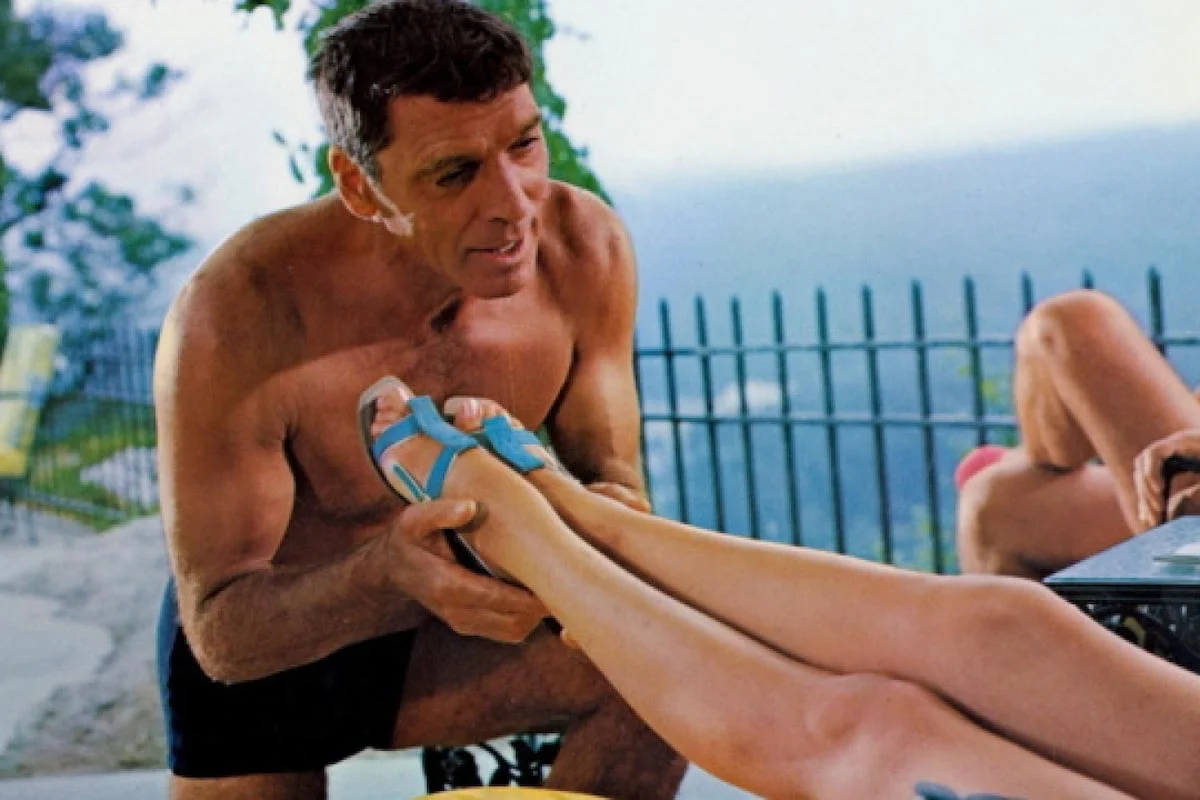
Frank Perry’s The Swimmer is a surreal and haunting exploration of the American Dream’s dark underbelly, where the oppressive summer heat of suburban Connecticut becomes a catalyst for existential unraveling. Burt Lancaster stars as Ned Merrill, an advertising executive who, on a whim, decides to "swim home" by traversing the backyard pools of his wealthy neighbors. What begins as an eccentric, seemingly joyous adventure gradually transforms into a poignant and disturbing odyssey through his past and present.
Based on John Cheever’s celebrated short story, the film uses the bright, idyllic summer setting to juxtapose Ned’s increasingly strained encounters with friends and acquaintances. Each pool represents a different stage of his life or a relationship, and as he progresses, the veneer of his successful, charismatic persona begins to crack. The relentless sun beats down, amplifying the tension and the growing sense of disillusionment. The dreamlike editing and fragmented narrative reflect Ned’s deteriorating grip on reality, leading to a climax that is both devastating and profoundly unsettling. Though initially met with mixed reviews and a troubled production, The Swimmer has since gained recognition as a cult classic and a quintessential work of late-1960s American cinema, masterful in its portrayal of suburban angst and the corrosive effects of denial, all under the inescapable glare of a summer sky.
SWEPT AWAY (1974)
Lina Wertmüller’s provocative and highly stylized Swept Away by an Unusual Destiny in the Blue Sea of August, commonly known as Swept Away, is a searing anti-romance that uses the isolation of a sun-scorched desert island to explore themes of class, gender, and power dynamics. Set against the stunning backdrop of the Mediterranean, the film pits wealthy Milanese socialite Raffaella Pavone Lanzetti (Mariangela Melato) against Gennarino Carunchio (Giancarlo Giannini), a Communist deckhand on her luxury yacht. Raffaella, embodying aristocratic arrogance, subjects Gennarino to constant verbal abuse and demands.
However, their roles dramatically reverse when they become shipwrecked on a deserted island. Stripped of societal structures and privileges, Gennarino asserts dominance over Raffaella, leading to a complex, violent, and ultimately sadomasochistic love affair. The relentless sun and the raw, untamed nature of the island amplify their primal struggle, baking their skin and stripping away their inhibitions. Wertmüller, known for her bold blend of sex, politics, and dark comedy, crafts a satirical narrative that challenges conventional notions of romance and power. Shot in the breathtaking province of Nuoro on the eastern Sardinian coast, the film’s vibrant colors contrast sharply with the characters’ feral behavior. Swept Away earned Wertmüller the distinction of being the first woman ever nominated for a Best Director Oscar, and while its themes remain divisive, its unflinching portrayal of human nature under extreme conditions endures as a powerful cinematic statement.
CASA DE LAVA (1994)
Pedro Costa’s Casa de Lava (House of Lava) transports viewers to the scorched, surreal landscape of Fogo, one of Cape Verde’s volcanic islands, creating an atmosphere of relentless heat, isolation, and post-colonial melancholy. Loosely inspired by Jacques Tourneur’s classic horror film I Walked with a Zombie, Costa’s film follows Mariana (Inês de Medeiros), a young Portuguese nurse who accompanies a comatose Cape Verdean construction worker, Leão (Isaach De Bankolé), back to his remote homeland.
Upon arrival, Mariana finds herself adrift in a community that seems largely indifferent to Leão and steeped in a languid, almost dreamlike existence. The landscape itself, dominated by volcanic rock and sparse vegetation, exudes an oppressive heat that mirrors the film’s themes of historical trauma and cultural displacement. Costa intentionally cultivated a sense of delirium on set, reportedly acting irrationally and straying from the script, and this disorienting energy permeates the film. The "wild dogs and zombie-like figures" mentioned in the original description contribute to a pervasive sense of unreality and decay. Casa de Lava is a profound, meditative reflection on Portugal’s colonial legacy and the enduring impact of migration, where the physical heat of the island becomes inseparable from the emotional and historical burdens carried by its inhabitants. It is a slow-burning, intensely atmospheric work that draws the audience into its unique, scorching reality.
LOSING GROUND (1982)
Kathleen Collins’ Losing Ground stands as a radiant and intellectually vibrant portrayal of an East Coast summer, notable not only for its narrative depth but also for its groundbreaking status as one of the first feature-length films directed by an African-American woman. This low-budget drama centers on Sara (Seret Scott), a philosophy professor meticulously researching "the ecstatic experience," and her husband, Victor (Bill Gunn, director of Ganja & Hess), a painter searching for inspiration. Seeking a change of scenery, they rent a house in upstate New York, where their individual pursuits and marital dynamics begin to diverge under the summer sun.
Inspired by the quiet philosophical films of Éric Rohmer, Collins masterfully crafts a narrative rich in dialogue and intellectual inquiry, exploring themes of artistic pursuit, marital strain, and personal liberation. The summer heat, while not overtly oppressive as in other films on this list, provides a languid backdrop against which the characters’ internal struggles and intellectual awakenings unfold. The film beautifully captures the specific milieu of 1980s Black artistic and intellectual culture in New York, offering a nuanced glimpse into their lives, ambitions, and relationships. Long unavailable to wider audiences, Losing Ground has experienced a significant rediscovery and critical re-evaluation in recent years, solidifying its place as a seminal work. It is a witty, insightful, and profoundly moving film that offers an "ecstatic" viewing experience, proving that the heat of summer can be a powerful crucible for self-discovery and relational transformation.
Conclusion: The Enduring Allure of the Scorching Screen
As global temperatures continue their upward trend, making extreme heat a more frequent reality for many, the relevance of these cinematic explorations only intensifies. These films, far from being mere distractions, offer profound insights into the human condition when confronted with the elemental force of heat. They serve as potent reminders of how physical discomfort can amplify psychological states, expose societal fault lines, and ignite both destructive passions and quiet epiphanies.
From the sweaty desperation of a neo-noir thriller to the languid decay of a social commentary, from the existential dread of a suburban odyssey to the primal struggle on a deserted island, these seven films demonstrate cinema’s unparalleled ability to capture and convey the multifaceted impact of heat. They allow us to vicariously experience the intensity, the madness, and the surprising beauty that can emerge when life is lived under the relentless gaze of a scorching sun. In a world grappling with the immediate and long-term consequences of climate change, these works of art offer not just entertainment, but a reflective lens through which to better understand our own relationship with an increasingly hot planet.