








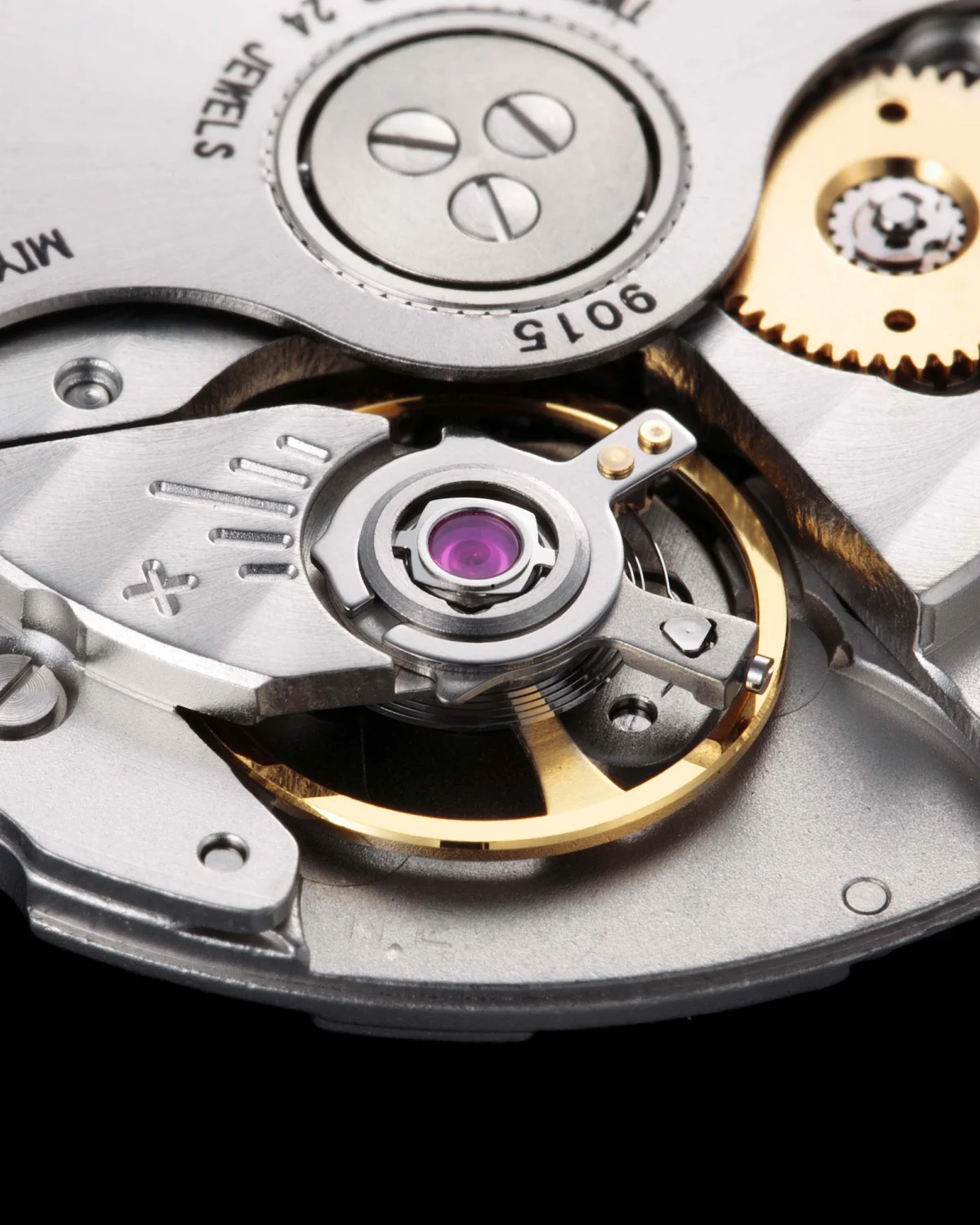
The intrinsic quality of a mechanical watch movement is fundamentally defined by the unwavering precision that underpins its manufacturing. Every component, from the most minuscule screw to the intricate balance wheel, demands absolute accuracy to ensure the watch fulfills its primary purpose: keeping time. This precision is not merely a matter of aesthetics; it is the bedrock upon which a movement’s functionality, performance, design, and overall caliber are built. For decades, MIYOTA, a name synonymous with reliability and precision in the watchmaking industry, has dedicated itself to mastering this intricate art. Their commitment to in-house production, from the creation of individual parts to the final rigorous quality control, all conducted within their state-of-the-art facilities in Japan under the watchful eyes of seasoned engineers, sets them apart. This exploration delves into the ultra-high-precision components that form the heart of MIYOTA’s extensive range of mechanical watch movements, revealing the dedication and technological prowess involved.
The Genesis of Precision: MIYOTA’s In-House Manufacturing Philosophy
MIYOTA’s philosophy is rooted in a vertically integrated approach to watch movement production. This means that the vast majority, if not all, of the critical components that constitute a MIYOTA mechanical movement are designed, engineered, and manufactured under one roof. This holistic control allows for an unparalleled level of quality assurance and an intimate understanding of how each element interacts within the larger mechanism. Unlike many manufacturers who may outsource specific components, MIYOTA’s decision to maintain this entire process in-house in Japan is a testament to their unwavering commitment to excellence.

The history of MIYOTA’s dedication to precision can be traced back to its founding. Established in 1959 as a subsidiary of Citizen Watch Co., Ltd., MIYOTA was initially tasked with producing watch cases. However, its ambition quickly expanded to encompass the intricate world of watch movements. By the 1970s, MIYOTA was already making significant strides in quartz technology, but it was the burgeoning demand for reliable and affordable mechanical movements that spurred their dedicated development in this area. Their early mechanical movements, though perhaps not initially positioned at the haute horlogerie level, set a benchmark for accessibility and robustness, laying the groundwork for the sophisticated calibers produced today. This foundational experience in mass production, coupled with an inherent Japanese dedication to meticulous craftsmanship, has allowed MIYOTA to continually refine its processes, achieving a remarkable balance between high-volume output and exceptional precision.
The Powerhouse: Mainspring and Mainspring Barrel
At the very core of any mechanical watch lies the mainspring, the engine that provides the motive force for the entire mechanism. Housed within the mainspring barrel, this long, flat, and incredibly powerful spring is crafted from a specialized alloy and coiled into a tight spiral. When the watch is wound, either manually or through an automatic rotor, potential energy is stored within the mainspring. As this energy is gradually released, it converts into kinetic energy, driving a complex series of gears and ultimately dictating the smooth, consistent movement of the watch’s hands. The mainspring barrel itself is a finely engineered component, featuring a gear that facilitates its connection to both the winding mechanism and the subsequent gear train.
MIYOTA’s pursuit of excellence in mainspring production is evident in their meticulous approach. They machine the thickness of each mainspring to exacting tolerances, ensuring uniformity and consistent performance. Furthermore, their expertise in heat treatment is unparalleled. This critical process imbues the mainspring with the necessary hardness, elasticity, and stability required for reliable power delivery. MIYOTA achieves this by optimizing furnace arrangements to eliminate temperature variations across the heating element, ensuring that each mainspring undergoes a uniform thermal cycle. This rigorous control over the heat treatment process results in a component capable of delivering even and reliable power transmission, a cornerstone of accurate timekeeping. The implications of a precisely manufactured mainspring are profound: it directly impacts the watch’s power reserve, the consistency of its beat rate, and its overall longevity. A poorly made mainspring can lead to erratic timekeeping, premature wear, and a significantly reduced power reserve, making MIYOTA’s commitment to this component’s quality a critical factor in their movements’ reputation.

The Regulator: Hairspring and its Intricate Dance
While the mainspring provides the power, it is the balance assembly, comprising the hairspring and the balance wheel, that acts as the watch’s regulator, dictating the precision of its timekeeping. The hairspring, a delicate spiral of metal, repeatedly expands and contracts, governing the oscillations of the balance wheel. This rhythmic motion is the very pulse of the mechanical watch, ensuring accurate and consistent timekeeping.
The manufacture of a hairspring is considered one of the most challenging feats in watchmaking. Despite its seemingly simple appearance, this component must be crafted with a level of precision that surpasses almost any other part within a movement. Any imperfection, any deviation from its perfect spiral form, can lead to significant inaccuracies in timekeeping. MIYOTA’s mastery of this delicate art is demonstrated through their highly controlled manufacturing process. Hairsprings are produced by drawing metal into extremely thin strips, which are then meticulously coiled into a precise spiral. This intricate process is undertaken in environments with strictly controlled temperature and humidity, with precision measured down to 0.1 microns.
The difficulty and cost associated with mastering hairspring production mean that only a select few movement manufacturers worldwide possess the capability to produce these vital components at scale. MIYOTA’s success in this arena is a testament to their significant investment in technology, expertise, and stringent quality control. The hairspring’s performance is directly linked to the watch’s isochronism – its ability to maintain a consistent rate regardless of the mainspring’s unwinding state. A well-made hairspring ensures that each oscillation of the balance wheel is of the same duration, leading to superior timekeeping accuracy. The implications of this precision are far-reaching, as even minute deviations in the hairspring’s behavior can translate into seconds or even minutes of error over a day.

The Heartbeat: Balance Wheel and its Rhythmic Oscillation
The balance wheel, working in tandem with the hairspring, forms the oscillating system that defines the watch’s timekeeping accuracy. As the hairspring expands and contracts, it compels the balance wheel to swing back and forth in a precise, rhythmic motion. This oscillation, interacting with the escapement mechanism, creates the steady beat that governs the passage of time.
The paramount factor in the manufacturing of a balance wheel is uniformity. The more perfectly symmetrical and balanced the balance wheel, the greater the achievable accuracy. This quest for uniformity involves a combination of MIYOTA’s advanced mechanical engineering capabilities and meticulous craftsmanship. They pay close attention to the eccentricity and levelness of the hairspring’s attachment points, ensuring a flawless integration with the balance wheel. To further minimize the potential for errors and to control as many variables as possible, MIYOTA has implemented automated assembly processes for the balance wheel within the movement. This automation is complemented by a final, thorough quality inspection performed by highly skilled technicians, ensuring that each balance wheel meets MIYOTA’s exacting standards.
The balance wheel’s oscillation rate, often referred to as the "beat," is typically measured in vibrations per hour (vph). Common rates include 21,600 vph (3 Hz), 28,800 vph (4 Hz), and even higher. A higher beat rate generally leads to smoother sweep of the second hand and potentially greater accuracy, as it allows for more frequent corrections. MIYOTA’s commitment to precision in the balance wheel ensures that their movements can achieve and maintain these desirable beat rates consistently. The implications of a perfectly balanced and uniform balance wheel are critical for the watch’s ability to withstand external shocks and magnetic fields without significant disruption to its timekeeping.

Beyond the Core Components: A Symphony of Precision
While the mainspring, hairspring, and balance wheel are fundamental to a mechanical movement’s function, MIYOTA’s dedication to precision extends to every other component. The gear train, for instance, is a complex system of wheels and pinions that transmit power from the mainspring to the escapement and ultimately drive the hands. Each tooth on these gears is precisely cut and finished to minimize friction and ensure smooth power transfer. Even the smallest screws and jewels, which serve to reduce friction and support rotating components, are manufactured to incredibly tight tolerances.
The escapement, the critical interface between the powered balance wheel and the rest of the movement, is another area where MIYOTA’s precision engineering shines. This intricate mechanism, often consisting of an escape wheel and an anchor, is responsible for converting the continuous power of the mainspring into discrete impulses that drive the balance wheel’s oscillations. The precise geometry and finishing of these components are vital for efficient energy transfer and accurate timekeeping.
The meticulous assembly of these hundreds of individual parts is a testament to the skill of MIYOTA’s watchmakers and the sophistication of their manufacturing facilities. Robotic assembly lines handle repetitive tasks with unwavering accuracy, while skilled human hands perform the more delicate adjustments and final inspections. This hybrid approach ensures both efficiency and the critical human touch necessary for the highest levels of watchmaking.

The Broader Impact: MIYOTA’s Influence on the Watch Industry
MIYOTA’s commitment to producing high-precision mechanical movements has had a profound impact on the global watch industry. By offering reliable, accurate, and relatively affordable mechanical calibers, MIYOTA has enabled a vast array of watch brands, from independent microbrands to established names, to incorporate genuine mechanical movements into their timepieces. This accessibility has democratized mechanical watchmaking, allowing enthusiasts to experience the artistry and engineering of these complex mechanisms at various price points.
The widespread use of MIYOTA movements means that their precision is not confined to a niche market but is experienced by millions of watch wearers worldwide. This broad reach underscores the significance of their manufacturing standards. The consistency and reliability of MIYOTA movements have, in turn, contributed to the enduring appeal of mechanical watches in an era dominated by digital technology. They represent a tangible connection to a rich horological heritage, powered by cutting-edge engineering and an unwavering dedication to precision.
The analysis of MIYOTA’s manufacturing process reveals a strategic approach to quality control that is deeply embedded in their corporate culture. This commitment is not merely about meeting industry standards but about exceeding them. The continuous investment in research and development, coupled with the ongoing refinement of manufacturing techniques, ensures that MIYOTA remains at the forefront of mechanical movement production. Their ability to consistently deliver high-quality movements year after year solidifies their position as a cornerstone of the modern watchmaking landscape.

Looking Ahead: The Future of MIYOTA Precision
As the watch industry continues to evolve, MIYOTA remains dedicated to innovation and the relentless pursuit of precision. Their ongoing efforts to explore new materials, enhance energy efficiency, and further refine their manufacturing processes promise to yield even more sophisticated and reliable mechanical movements in the future. The foundational principles of meticulous craftsmanship, in-house control, and a deep understanding of horological mechanics will undoubtedly continue to guide MIYOTA as they push the boundaries of what is possible in mechanical watchmaking. Their legacy is not just in the movements they produce today, but in the inspiration they provide for the future of timekeeping.