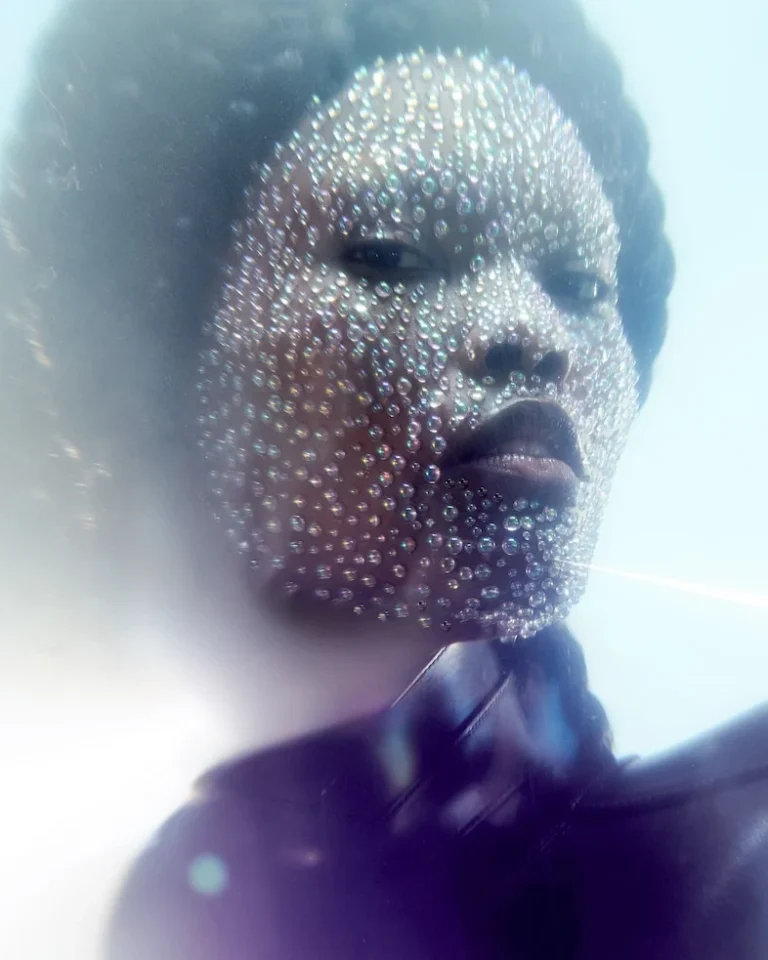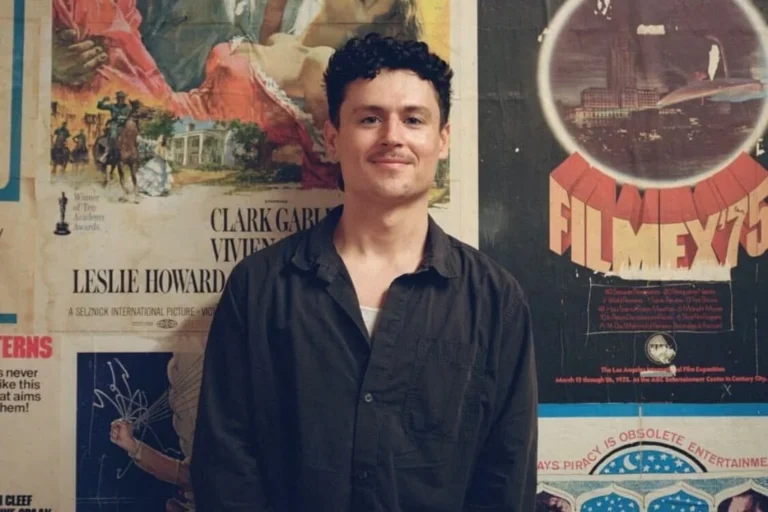












The contemporary arts landscape in Berlin has long served as a crucible for radical, boundary-pushing performance art, consistently challenging the conventional boundaries between audience and spectator, architecture and anatomy. On October 13, 2026, this experimental ethos reached a visceral new zenith inside the Haus der Visionäre, a sprawling 1,100-square-metre industrial warehouse space. The occasion was the inaugural staging of SKINDEEP, a multidisciplinary performance night founded by creative collaborators Hugh Gleeson, gh0re.grl, and Luke Tackaberry. Designed to investigate the complex interplay between physical environments and human morphology, the event brought together spatial installation, live soundscapes, and extreme durational performance to interrogate the limits of vulnerability, trauma, and bodily resilience.
Architectural Brutality and Spatial Immersion
Rather than treating the vast expanse of the Haus der Visionäre as a neutral gallery white-cube, the curatorial team sought to construct an entirely autonomous ecosystem. Spatial designer Hugh Gleeson spearheaded the architectural configuration, which utilized four distinct installations to carve out a tense, claustrophobic arena within the industrial expanse.
The physical environment of SKINDEEP was engineered to evoke a precarious equilibrium between danger and fragility. At the center of the warehouse loomed a six-metre-wide steel structure balanced precariously on twelve handmade spikes, each meticulously sharpened to a one-millimeter point. Suspended directly above this precarious apparatus hung a fully functioning DJ booth. According to the organizers, the architecture was deliberately chosen to reflect the dualities of modern existence—simultaneously constructing a zone of radical freedom and a deliberately dystopian enclosure. In this environment, the audience did not merely observe the action from a safe distance; instead, the boundaries between viewer and participant dissolved as performances emerged directly from the milling crowd, integrating the spectatorship into the physical architecture of the room.

Chronology of Performances: A Trajectory of Transformation
The evening unfolded as a carefully sequenced progression of sonic compositions and physical interventions, each artist exploring distinct facets of physical undoing and reconstruction.
The event commenced with a collaborative opening by Post Organic Bauplan, who emerged through dense billows of smoke into an intricate sonic composition crafted by Oliver Torr. Their bodies became physically entangled in a biomechanical mass, establishing a tone of organic-synthetic hybridity. This was followed by a set from Pavel Milyakov, whose ambient guitar textures and atmospheric drones briefly lowered the collective pulse of the room, preparing the audience for the intense physical theater that followed.
As the evening progressed, co-founder gh0re.grl delivered one of the night’s most striking interventions. Dressed in a translucent latex skirt and white underwear, she entered the performance arena already wounded, with real blood actively running from surgical-like incisions around her navel. Flanked by three suspended sheets of latex inscribed with poetry detailing temporal trauma, she engaged in a grueling act of self-repair. Using a traditional needle and thread, she slowly and visibly passed the thread through her skin, stitching herself back together in real time.
In post-performance commentary, gh0re.grl revealed that the piece had been conceived nearly a year prior in the direct aftermath of personal trauma. The act of stitching served as a literal and metaphorical manifestation of reintegrating a fractured self. However, the prolonged gestation period of the work meant that by the time she finally performed it, her internal state had shifted. Noting that the work belonged to a past iteration of her identity rather than her present reality, she chose not to abandon the piece, allowing the performance to absorb the passage of time and personal evolution.

The emotional weight of the evening shifted toward collective memory and mourning with a performance by Trace Polly. Utilizing a horsehair bow drawn across the strings of a guitar slung low from her waist, Polly alternated between deafening sonic reverberations and near-silence. Introducing a vibrator to the guitar strings, she created an abrasive, unconventional acoustic texture that underscored her spoken-word eulogy dedicated to lost siblings. Addressing a seated audience, Polly articulated themes of grief, remembrance, and systemic forgetting, declaring, "The plural of grief is us." Her performance relied on non-verbal resonance, demonstrating how silence and vibration can communicate profound loss when conventional language fails.
Durational Endurance and Earthly Rituals
The latter half of the program featured groundbreaking durational works that tested the absolute limits of physical endurance. Shalva Nikvashvili undertook his first-ever durational performance, spending the entirety of the evening draped motionlessly in a pool of blood and sweat beside a fractured stripper pole, his blonde hair trapped where the structural metal had seemingly bisected his form. The striking visual was the result of a conceptual dialogue between Nikvashvili and Gleeson during the design phase, wherein the artist remarked on the stark reality of the physical demands placed upon performers. Hours into the night, a subtle physical twitch marked what the production team termed a "little resurrection," as Nikvashvili slowly and painfully clawed his way back to physiological animation.
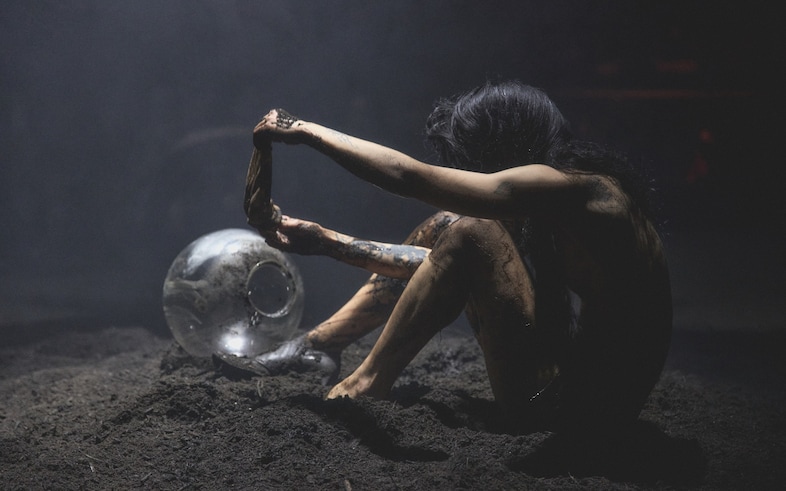
The evening concluded with Dafni Krazoudi’s performance piece, Guilty, styled in selections from Ann Demeulemeester curated via Voo Store. Krazoudi approached the complex psychological construct of guilt through a lens of childlike playfulness and ritualistic baptism. Circling a prominent mound of industrial earth in high heels, she moved through cycles of consumption, undressing, and physical descent. By pouring wine over her body and into the soil, she blurred the boundaries between a baptismal cleansing and a premature burial. The incorporation of ambient maternal and childhood voice recordings reinforced the cyclical nature of guilt—an emotion to be toyed with, buried, and perpetually excavated.
Analytical Perspective: Implications for Contemporary Performance Art
The successful execution of SKINDEEP highlights a broader paradigm shift within contemporary European performance art, particularly within Berlin’s underground cultural sector. In recent years, post-industrial venues like the Haus der Visionäre have increasingly served as laboratories for multidisciplinary art forms that reject traditional theatrical separation in favor of total spatial immersion.
From an analytical standpoint, the event’s emphasis on somatic trauma, bodily fluids, and architectural jeopardy addresses a cultural fatigue with sanitized, digital-first art presentations. By compelling audiences to bear witness to genuine physical vulnerability—ranging from gh0re.grl’s active suturing to Nikvashvili’s exhaustion—SKINDEEP repositioned the human body as both a site of political resistance and an unstable archive of historical memory.
The integration of high-fashion curation, brutalist industrial design, and avant-garde noise composition points to an emerging commercial and critical appetite for intersectional art experiences that do not shy away from discomfort. As Berlin continues to grapple with gentrification and the commercialization of its nightlife and arts districts, initiatives like SKINDEEP demonstrate that the city’s underground remains uniquely capable of producing intellectually rigorous, boundary-defying cultural commentary. The event ultimately succeeded not by offering tidy resolutions or comfortable viewing experiences, but by establishing a temporary autonomous zone where bodies could safely unravel, bleed, and undergo radical transformation in plain sight.