











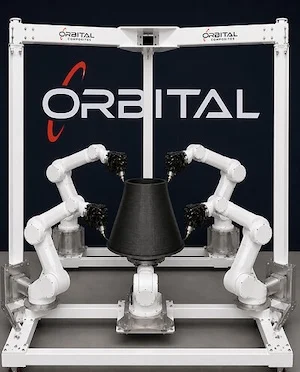
Orbital Composites, Inc., a California-based leader in advanced manufacturing, has been awarded a $1.9 million Tactical Funding Increase (TACFI) contract by SpaceWERX, the innovation arm of the United States Space Force. This funding is specifically earmarked for the continued development of the company’s proprietary robotic additive manufacturing (AM) platform, which is designed to produce components capable of withstanding the most punishing conditions known to modern engineering. These "extreme environment materials" are engineered to maintain structural integrity in temperatures exceeding 3,000 degrees Celsius while enduring high-velocity combustion gases and violent thermal shock cycles—conditions that typically incinerate or fracture conventional aerospace components.
The contract reflects an intensifying focus within the Department of the Air Force and the broader Department of Defense (DoD) to resolve a chronic structural shortfall in the domestic production of advanced materials. As the United States seeks to modernize its strategic deterrents and expand its presence in low-Earth orbit and beyond, the demand for high-performance materials has outpaced the capacity of traditional manufacturing methods. Currently, the production of specialized components such as rocket nozzles and hypersonic heat shields is often hampered by lead times ranging from 12 to 18 months, coupled with exorbitant costs and a dwindling number of domestic facilities capable of handling such complex fabrication. Orbital Composites aims to disrupt this paradigm by integrating high-speed robotics, advanced material science, and "physical AI" to automate and accelerate the production of these critical assets.
The Technological Challenge of Extreme Environments
Manufacturing for the vacuum of space or the friction-heavy environment of hypersonic flight requires a departure from standard industrial processes. Components like solid rocket motor (SRM) nozzles must survive the transition from ambient temperatures to several thousand degrees in a matter of seconds. Historically, these parts have been manufactured using labor-intensive processes involving carbon-carbon composites or refractory metals, which require massive autoclaves and manual layup procedures that are prone to human error and significant material waste.
Orbital’s approach utilizes a multi-robot additive manufacturing platform, known as the "Orbital S," which can coordinate several robotic arms to print complex, large-scale structures simultaneously. By using additive manufacturing rather than subtractive methods, the company can create intricate internal geometries—such as regenerative cooling channels—that are impossible to achieve through traditional casting or machining. The integration of physical AI allows these robots to monitor the printing process in real-time, making micro-adjustments to compensate for thermal fluctuations or material inconsistencies, ensuring that every part meets the rigorous qualification standards required for spaceflight and defense applications.
Strategic Context and the Solid Rocket Motor Crisis
The timing of this contract award is significant, as it coincides with a period of heightened concern regarding the U.S. defense industrial base. Recent geopolitical shifts and the ongoing consumption of munitions in global conflicts have highlighted a "bottleneck" in the production of solid rocket motors. These motors power everything from tactical missiles used in theater defense to the heavy boosters required for satellite deployment.
Amolak Badesha, Chief Executive Officer of Orbital Composites, emphasized that the primary objective of this new funding is to break the supply constraints that have historically limited the deployment of advanced missile systems and space vehicles. According to Badesha, the goal is not merely to improve a single product line but to restore a sense of dominance in U.S. manufacturing through the mastery of materials that are foundational to national security. By reducing the production cycle from over a year to a matter of weeks or months, Orbital aims to provide the U.S. warfighter with a level of operational flexibility that current supply chains cannot support.
Chronology of Development and SpaceWERX Partnership
The $1.9 million TACFI award is the latest milestone in a multi-year collaboration between Orbital Composites and various branches of the U.S. military. The trajectory of this development began several years ago with Small Business Innovation Research (SBIR) Phase I and Phase II contracts, which allowed the company to prove the feasibility of its robotic printing heads and high-temperature thermoplastic composites.
In 2024 and 2025, Orbital focused on the "qualification" phase, working closely with the Air Force Research Laboratory (AFRL) to test the durability of 3D-printed nozzles under simulated launch conditions. These tests confirmed that additively manufactured composites could indeed match or exceed the performance of traditionally manufactured carbon-phenolic parts. The transition to a TACFI contract represents a "bridge" funding mechanism designed to help high-potential technologies cross the "Valley of Death"—the gap between successful prototyping and full-scale commercial or military adoption.
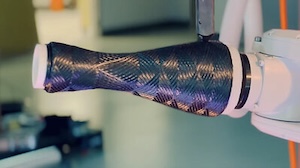
The current phase of development, funded by this June 2026 award, will focus on scaling the size of the components the Orbital S platform can produce. It will also involve the integration of new material feedstocks, including ceramic matrix composites (CMCs), which are essential for the next generation of reusable spacecraft and ultra-high-speed jet engines.
Economic and Geopolitical Implications
The move toward automated, robotic manufacturing of advanced materials has implications that extend far beyond the aerospace sector. In the commercial realm, the "New Space" economy—valued at hundreds of billions of dollars—depends on the ability to launch payloads cheaply and frequently. By lowering the cost of engine components, Orbital’s technology could facilitate a more competitive commercial launch market, benefiting satellite internet providers, orbital manufacturing startups, and deep-space exploration ventures.
Furthermore, the emphasis on "domestic capacity" highlighted in the contract announcement speaks to a broader trend of "reshoring" critical technologies. The reliance on foreign sources for rare-earth elements and specialized chemical precursors has long been identified as a strategic vulnerability for the United States. Orbital’s ability to utilize domestically sourced raw materials in an automated, software-driven factory environment reduces this dependency and ensures that the U.S. can maintain its technological edge regardless of global supply chain disruptions.
Industry Reaction and Future Outlook
Industry analysts suggest that the success of Orbital Composites could signal a shift toward "software-defined manufacturing" in the defense sector. Rather than building massive, single-purpose factories, the future may lie in modular, robotic cells that can be reconfigured via software to produce a rocket nozzle one day and a structural wing component for a drone the next.
Cole Nielsen-Cole, Founder and Chief Technology Officer of Orbital Composites, envisions a future where the constraints of traditional manufacturing are entirely removed. He noted that the company is building toward a vision where AI-driven factories can ingest a digital design file and produce a mission-ready part with minimal human intervention. This "on-demand" manufacturing capability would allow the military to respond to emerging threats with unprecedented speed, printing necessary components at the "edge" or near the point of need.
Orbital is currently in active negotiations with several major defense prime contractors to integrate its manufacturing cells into existing production lines. Additionally, the company is looking toward the energy sector, where extreme environment materials are desperately needed for the development of nuclear microreactors and high-efficiency geothermal energy systems.
As the $1.9 million TACFI project progresses, the focus will remain on rigorous testing and the gathering of empirical data to satisfy the stringent requirements of the U.S. Space Force. With the backing of SpaceWERX and AFRL, Orbital Composites is positioned to remain at the forefront of a manufacturing revolution that promises to make the "impossible" materials of yesterday the standard components of tomorrow.
The views expressed in the announcement of this contract are those of the company and do not necessarily reflect the official policy or position of the Department of the Air Force, the Department of Defense, or the U.S. government. However, the continued financial support from these entities suggests a strong alignment between Orbital’s technological roadmap and the nation’s strategic industrial goals.
Source: Orbital Composites
Updated: June 29, 2026