










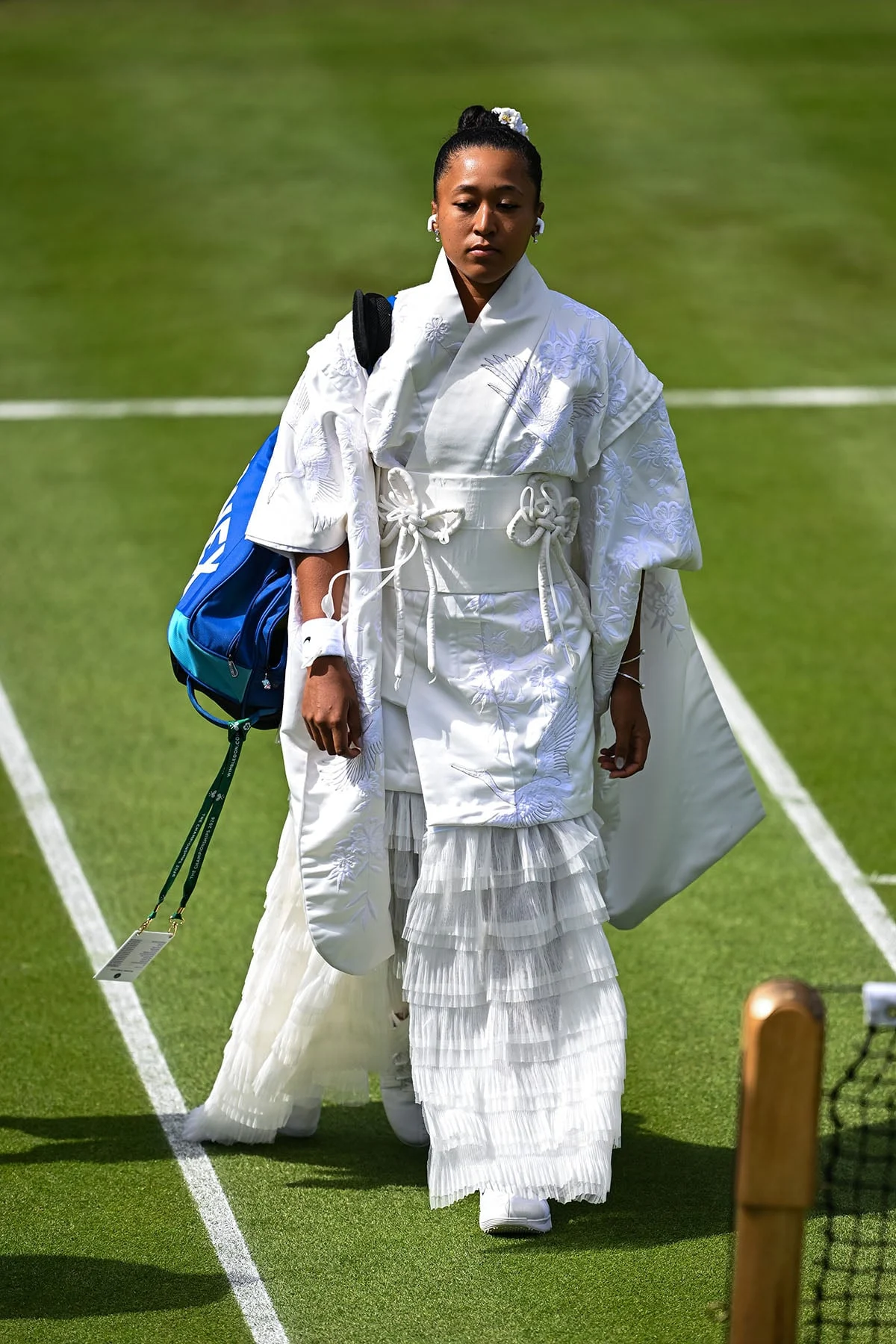
The All England Lawn Tennis and Croquet Club, synonymous with its rigid adherence to tradition and a storied history dating back to 1877, became the backdrop for a significant intersection of cultural heritage and modern athletic branding as Naomi Osaka arrived for her opening-round match. The four-time Grand Slam champion, known for utilizing her platform to highlight social issues and personal identity, navigated the tournament’s notoriously strict "all-white" dress code by debuting a custom ensemble that paid homage to her Japanese roots. The arrival look, designed by Tokyo-based creator Hana Yagi, served as a prelude to Osaka’s successful performance on the grass courts, where she secured a straight-sets victory over France’s Elsa Jacquemot.
The Architectural Composition of Evolving Ceremony
The ensemble, titled "Evolving Ceremony," represents a sophisticated exercise in sustainable luxury and cultural storytelling. Designer Hana Yagi, whose work often explores the tension between ancestral techniques and contemporary silhouettes, constructed the piece using a meticulous upcycling process. The primary components of the garment were sourced from vintage kimonos, a traditional shiromuku—the heavy, white silk kimono worn by brides in Shinto wedding ceremonies—and elements of a deconstructed Western-style wedding gown.
By merging these materials, the design acted as a bridge between Eastern and Western sartorial traditions. The shiromuku is historically significant in Japanese culture, symbolizing the bride’s purity and her willingness to be "dyed" in the colors of her new family’s traditions. In the context of Wimbledon, this choice mirrored the athlete’s own integration into the historical fabric of the tournament while maintaining her distinct cultural identity. The garment featured intricate textures and tonal variations of white, satisfying the All England Club’s requirement that "white does not include off-white or cream," while providing a depth of detail rarely seen in standard athletic apparel.
The look was completed with a sleek bun adorned with cascading white floral hair ornaments. These accessories were inspired by kanzashi, the traditional hairpins used in Japanese hairstyles, particularly by geishas and brides. The inclusion of kanzashi reinforced the ceremonial theme of the arrival, transforming the walk to the locker room into a deliberate performance of cultural pride.
Navigating the Strictures of Wimbledon Rule 9
The All England Club’s dress code, formally codified in the tournament’s Rule 9, is among the most demanding in professional sports. The regulations specify that players must be dressed in "almost entirely white" from the moment they enter the court surroundings. This includes undergarments, caps, headbands, and even the soles of shoes. While these rules have occasionally been a point of contention for players seeking to express individuality, Osaka’s approach demonstrated a strategic alignment with the regulations rather than a challenge to them.

Industry analysts noted that the move was a masterclass in athlete branding. By working within the confines of the "all-white" rule, Osaka avoided the controversy that occasionally follows more rebellious fashion choices at SW19. Instead, she utilized texture and cultural symbolism to differentiate herself. This arrival follows a more polarizing appearance at the 2026 French Open, where Osaka wore a brown ensemble by Germanier that divided fashion critics. The shift from the avant-garde experimentation of Roland Garros to the structured, ceremonial elegance of Wimbledon suggests a curated seasonal narrative for the athlete.
Competitive Performance: Victory Over Elsa Jacquemot
Following the high-profile arrival, Osaka transitioned from the ceremonial to the competitive, maintaining the momentum of her 2026 season. She faced Elsa Jacquemot of France in the opening round, delivering a performance characterized by the powerful baseline play and high-velocity serves that have become her trademark.
Osaka dominated the first set, closing it out at 6-1 in under 30 minutes. Her ability to find the corners of the court and dictate the pace of the rallies left Jacquemot with few defensive options. The second set proved more competitive as the French player adjusted her return position, pushing the set to 5-5. However, Osaka’s composure during the critical points allowed her to break Jacquemot’s serve in the eleventh game before serving out the match to win 7-5.
Statistical analysis of the match highlighted Osaka’s efficiency on her first serve, winning over 80% of those points. The victory marks a vital step in her quest for a first Wimbledon title, a surface that has historically been the most challenging for her compared to the hard courts of the US Open and Australian Open.
A Timeline of Athletic Fashion Evolution
The arrival of "Evolving Ceremony" is the latest entry in a long chronology of fashion-forward moments at Wimbledon. To understand the significance of Osaka’s 2026 look, it is necessary to view it within the historical context of the tournament’s relationship with style:
- 1949: Gussy Moran caused a stir by wearing lace-trimmed knickers, leading the All England Club to accuse her of bringing "vulgarity and sin into tennis."
- 1985: Anne White competed in a white spandex unitard, which was subsequently banned by tournament officials for future rounds.
- 2008: Serena Williams introduced the "trench coat" warmup, signaling a new era of theatrical arrivals.
- 2019-2024: A period of increasing brand collaborations, where Nike, Adidas, and independent designers began creating custom "walk-on" kits that adhered to white rules but featured high-fashion silhouettes.
- 2026: Naomi Osaka’s collaboration with Hana Yagi marks a shift toward "narrative sustainability," using upcycled heritage fabrics to tell a personal story within the framework of the tournament.
Expert Reactions and Market Implications
The intersection of sports and high fashion has become a multi-billion-dollar industry, and Osaka remains at the forefront of this trend. Market analysts suggest that her ability to generate "Earned Media Value" (EMV) through these arrival looks is unparalleled in women’s tennis.

"Naomi Osaka is no longer just a tennis player; she is a cultural curator," stated an industry consultant specializing in sports marketing. "By partnering with a Tokyo-based designer like Hana Yagi, she is strengthening her brand equity in the Asian market while simultaneously appealing to the global luxury sector’s growing interest in sustainability and upcycling."
Environmental advocates have also praised the choice. The use of deconstructed wedding gowns and vintage kimonos addresses the fashion industry’s significant waste problem. In an era where "fast fashion" athletic wear is often discarded after a single tournament, the "Evolving Ceremony" look serves as a high-profile endorsement of circular fashion principles.
The Broader Impact on the Sport
Osaka’s focus on the "arrival moment" reflects a broader trend in professional sports, popularized by the NBA’s "tunnel walk." As social media platforms like Instagram and TikTok become primary drivers of sports engagement, the moments before and after the match have become nearly as valuable to sponsors as the match itself.
For Wimbledon, these moments provide a necessary bridge between the tournament’s Victorian-era roots and a younger, more diverse global audience. While the All England Club maintains its traditions, it has increasingly allowed for these brief displays of personality during arrivals, recognizing that such moments drive digital engagement and keep the tournament relevant in a fast-paced media landscape.
As the tournament progresses, the focus will inevitably shift back to the grass-court mechanics and the pursuit of the Venus Rosewater Dish. However, Naomi Osaka’s arrival has already ensured that her 2026 Wimbledon campaign will be remembered as much for its cultural depth as for its competitive results. By transforming a strict dress code into a canvas for Japanese craftsmanship, Osaka has demonstrated that tradition and evolution are not mutually exclusive, but are instead the two threads required to weave a modern athletic legacy.
With the first round concluded, Osaka moves into the second week of the tournament as a formidable contender. Her performance against Jacquemot suggests a level of focus and physical readiness that, combined with her stylistic confidence, makes her a significant threat to the field. As she continues her run, the sporting world will be watching not only her footwork on the baseline but also the thoughtful narratives she chooses to present to the world.