








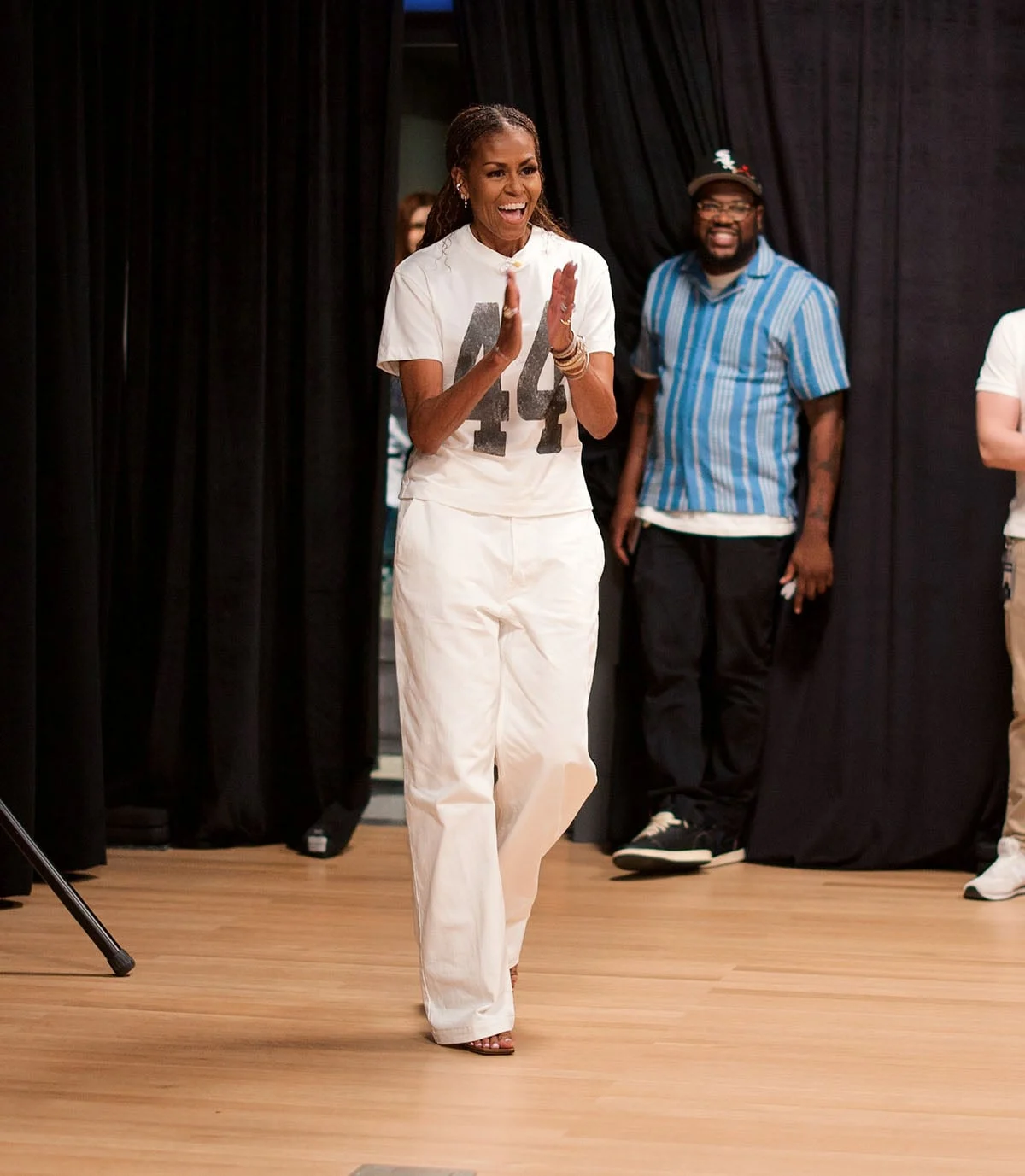
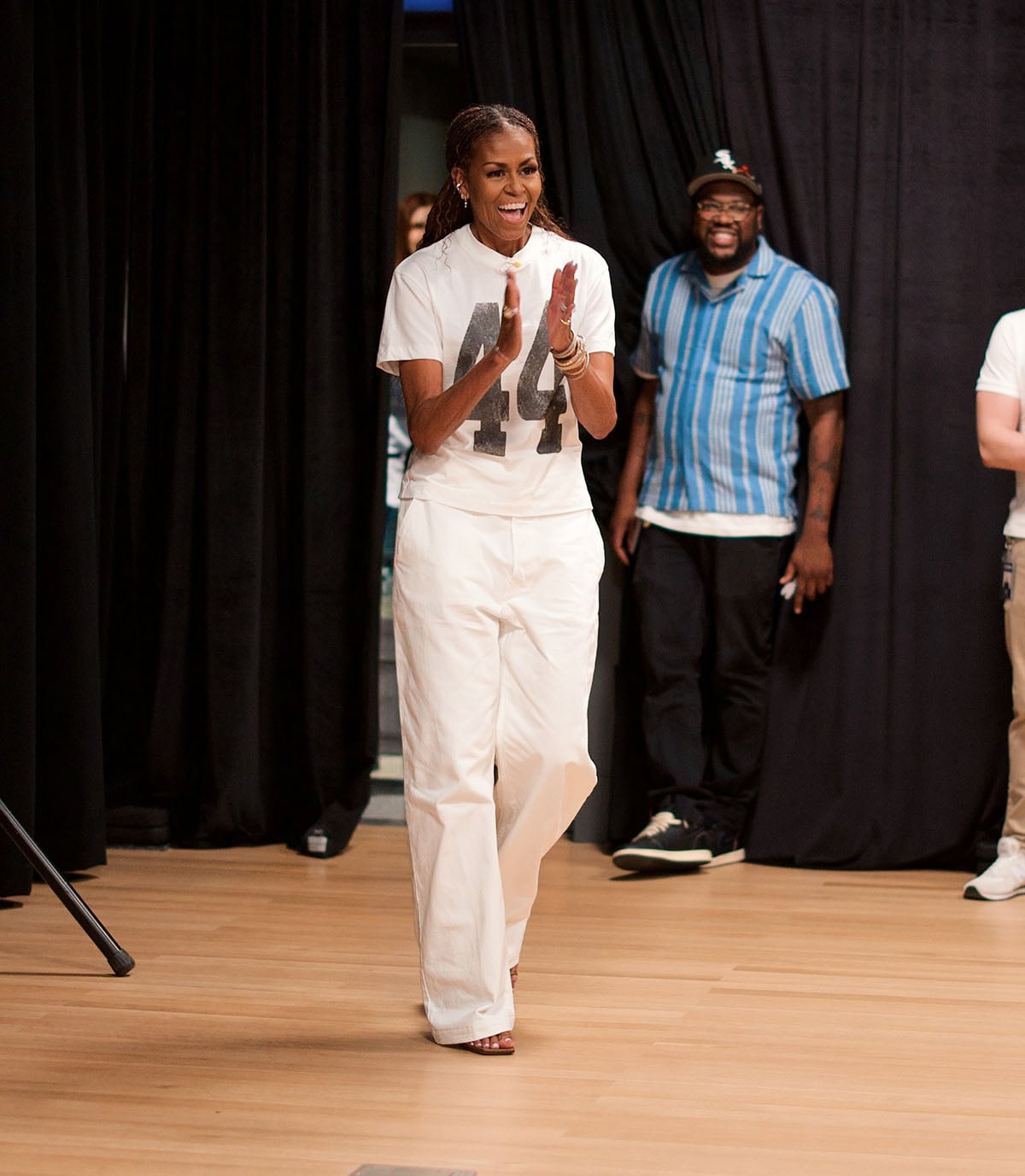
Former First Lady Michelle Obama made a high-profile appearance in Chicago this week to promote the ongoing development and upcoming milestones of the Obama Presidential Center, utilizing her wardrobe as a medium for both personal tribute and support for American luxury craftsmanship. During a series of engagements in the city, Mrs. Obama was photographed wearing a custom ensemble by the Los Angeles-based label Fear of God, designed by Jerry Lorenzo. The centerpiece of the look was a white, custom-made T-shirt featuring the number "44" emblazoned on the front—a direct and symbolic reference to her husband, Barack Obama, who served as the 44th President of the United States. This sartorial choice served as a visual anchor for the promotional efforts surrounding the Presidential Center, which aims to cement the 44th president’s legacy in the heart of Chicago’s South Side.
The former First Lady’s attire consisted of pieces from Fear of God’s Spring 2026 collection, specifically the Japanese broken twill workwear trousers in a crisp white palette. The selection of these garments highlights a continued collaboration between Mrs. Obama and her long-time stylist, Meredith Koop, who has been credited with navigating the transition of the former First Lady’s style from the structured formality of the White House years to a more experimental, "elevated casual" aesthetic in the post-presidency era. The choice of Fear of God is particularly noteworthy within the fashion industry, as the brand represents a successful intersection of streetwear influences and high-end luxury, founded by an African American designer who has redefined modern American silhouettes.
The Architectural and Cultural Mission of the Obama Presidential Center
The appearance in Chicago comes at a critical juncture for the Obama Presidential Center (OPC). Located in historic Jackson Park, the center is designed to be more than a traditional repository for presidential papers; it is envisioned as a world-class museum, a public park, and a hub for community engagement and leadership training. Unlike previous presidential libraries, which are often managed entirely by the National Archives and Records Administration (NARA), the OPC is a private-public partnership. While the official records of the Obama administration are being digitized by NARA, the physical campus in Chicago will focus on the future of civic activism.
The campus itself covers approximately 19.3 acres and features three main buildings: the Museum Tower, the Forum, and the Library. The Museum Tower, the most prominent structure on the site, is designed by the architectural firm Tod Williams Billie Tsien Architects. It features a facade of light-colored stone and glass, intended to evoke the idea of hands held together in prayer or community. Mrs. Obama’s choice of a monochromatic white outfit during her recent appearance mirrors the clean, modernist lines of the center’s architecture, suggesting a deliberate alignment between her personal brand and the institutional identity of the OPC.
Chronology of Development and Construction Milestones
The journey to the opening of the Obama Presidential Center has been marked by years of planning, legal reviews, and construction phases. Following the selection of Jackson Park as the site in 2016, the project underwent a rigorous federal review process due to the park’s status on the National Register of Historic Places.
- September 2021: Official groundbreaking ceremony held with President Obama, Mrs. Obama, Illinois Governor J.B. Pritzker, and Chicago Mayor Lori Lightfoot.
- 2022–2023: Deep foundation work and the structural framing of the Forum and Library buildings were completed.
- 2024–2025: The Museum Tower reached its full height, and the installation of the exterior masonry began. During this period, the Obama Foundation intensified its community outreach programs, including the "Obama Foundation Scholars" and various local hiring initiatives.
- 2026: The current phase involves the interior fit-outs, landscape restoration of Jackson Park, and the finalization of exhibit installations.
The appearance of Mrs. Obama in Spring 2026 attire coincides with the final push toward the center’s grand opening. This timeline reflects a decade-long effort to transform a portion of the South Side into a global destination for tourism and civic education.
Economic Impact and Local Workforce Data
The Obama Foundation has released several reports detailing the economic implications of the center for the city of Chicago, particularly the South Side. According to the foundation’s data, the construction of the OPC is expected to create over 5,000 jobs. A key pillar of the project has been the "Diversity and Inclusion" mandate, which requires that a significant percentage of the construction contracts be awarded to minority-owned and female-owned businesses.
As of the latest reporting cycle, the Obama Foundation announced that it had surpassed its goal of awarding $200 million in contracts to diverse vendors. Furthermore, the center is projected to attract approximately 700,000 visitors annually, which local economists estimate will generate an economic impact of $3.1 billion over the first ten years of operation. These figures are central to the argument that the center serves as an engine for urban renewal, providing sustainable growth for neighborhoods that have historically faced divestment.
The Strategic Evolution of Michelle Obama’s Public Image
Michelle Obama’s use of fashion as a tool for communication has been a subject of academic and journalistic study since 2008. During her tenure as First Lady, she famously championed emerging American designers such as Jason Wu, Isabel Toledo, and Tracy Reese. By choosing Fear of God for her Chicago appearance, she continues this tradition of elevating American talent while adapting to the current fashion landscape, which favors "quiet luxury" and sophisticated workwear.
Meredith Koop, who has worked with Mrs. Obama for over a decade, has frequently noted that the goal of the former First Lady’s wardrobe is to be "accessible yet aspirational." The "44" T-shirt exemplifies this strategy. While the shirt is a custom piece from a luxury label, the T-shirt silhouette is inherently democratic and relatable. It bridges the gap between the monumental nature of a presidential legacy and the grassroots, community-focused mission of the Chicago center.
The shift toward workwear-inspired pieces, such as the Japanese broken twill trousers, also reflects a broader trend in the 2020s where professional attire has become more fluid. By wearing "workwear" to promote a center that is currently under construction and focused on "the work" of community organizing, the outfit functions as a literal and metaphorical representation of the task at hand.

Institutional and Community Reactions
The reception to the Obama Presidential Center has been largely positive among city officials and global leaders, who view it as a landmark addition to Chicago’s cultural map. However, the project has also faced scrutiny from local community groups concerned about gentrification and the potential displacement of long-term residents in the Woodlawn and South Shore neighborhoods.
In response to these concerns, the Obama Foundation helped facilitate the Woodlawn Housing Preservation Ordinance, which was passed by the Chicago City Council to ensure that affordable housing remains available in the area surrounding the center. The Foundation has also emphasized that the center’s public spaces, including a new branch of the Chicago Public Library and a fruit and vegetable garden, will be accessible to local residents free of charge.
Fashion industry analysts have reacted to the Fear of God ensemble as a masterclass in "legacy branding." By wearing the number 44, Mrs. Obama reinforces the historical significance of the Obama presidency at a time when the physical manifestation of that legacy—the center—is nearing completion. The collaboration with Jerry Lorenzo’s Fear of God also signals a support for Black entrepreneurship within the luxury sector, aligning with the Foundation’s broader goals of economic empowerment.
Broader Implications for Presidential Legacies
The Obama Presidential Center represents a departure from the traditional model of presidential libraries. Historically, these institutions have been somewhat static, serving primarily as archives for historians and tourists. The OPC, by contrast, is designed as an "active" campus. It includes a recording studio, a theater, and spaces for athletic programs, reflecting the Obamas’ interest in youth development and culture.
Mrs. Obama’s active role in the promotion of the center, underscored by her strategic public appearances, highlights the modern role of the First Spouse in maintaining the relevance of a presidential legacy. The integration of fashion, community activism, and urban development suggests a new blueprint for how former presidents and their families interact with the public. As the construction in Jackson Park nears its conclusion, the focus shifts from the physical structures to the programs and people that will inhabit them.
The custom Fear of God look worn by Michelle Obama in Chicago is more than a fashion statement; it is a calculated element of a broader narrative regarding the 44th presidency’s enduring impact on American life. By balancing the personal significance of the "44" graphic with the practical, forward-looking nature of the workwear trousers, she has signaled that while the center honors the past, its primary focus remains firmly on the future.