






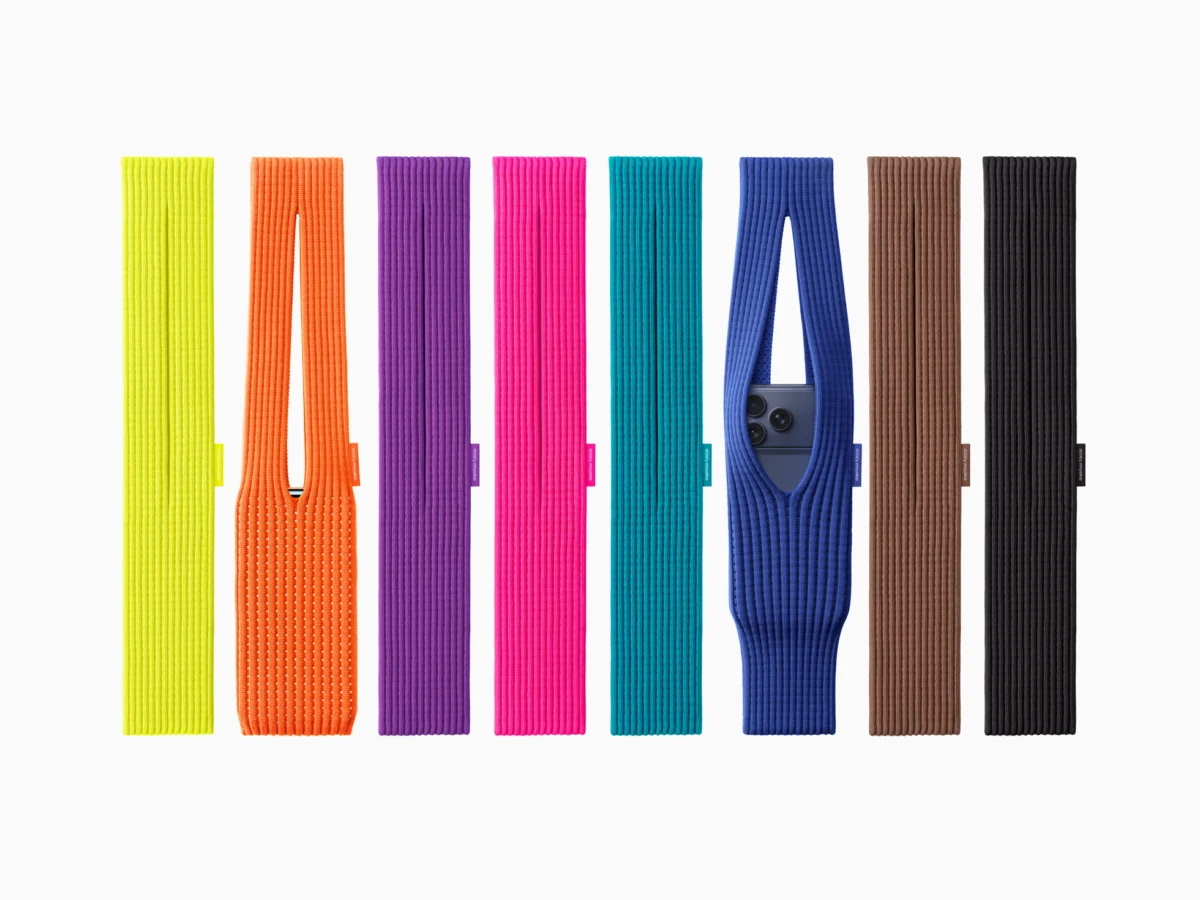
Apple Inc. has expanded its portfolio of premium lifestyle accessories through a collaborative project with the Issey Miyake fashion studio, introducing the iPhone Pocket. The new accessory, a specialized textile pouch designed for the iPhone, is available in two primary configurations: a short "pocket" version retailing for $149.95 and a longer crossbody variant priced at $229.95. This launch represents a significant intersection between high-performance consumer technology and avant-garde Japanese industrial design, utilizing the proprietary "A-POC" (A Piece of Cloth) manufacturing philosophy.
The iPhone Pocket is constructed from a specialized ribbed mesh structure that mirrors the signature pleats synonymous with the Issey Miyake brand. According to technical specifications provided by Apple, the textile is engineered to be both protective and translucent; when the fabric is stretched, the open weave allows the user to view the iPhone display and notifications without removing the device from the pouch. The product is marketed as a "limited edition" release, signaling Apple’s continued push into the luxury fashion segment.
The A-POC Philosophy and Design Engineering
The foundation of the iPhone Pocket lies in the "A-POC" (A Piece of Cloth) concept, a revolutionary manufacturing process introduced by the late designer Issey Miyake and textile engineer Dai Fujiwara in 1997. Unlike traditional garment construction, which involves cutting patterns from fabric and sewing them together—a process that often results in significant material waste—A-POC utilizes computer-programmed knitting machines to create entire garments from a single continuous tube of fabric.
This engineering-first approach to fashion aligns with Apple’s own industrial design language. By utilizing a single piece of material to form the entire structure of the iPhone Pocket, the design minimizes seams and structural vulnerabilities. The ribbed mesh is not merely an aesthetic choice; it provides a mechanical elasticity that secures the phone while maintaining a lightweight profile. The integration of this technology into a consumer electronics accessory highlights a focus on sustainable manufacturing and minimalist utility, as the A-POC process is noted for its ability to reduce textile scrap during production.
The Historical Connection: Steve Jobs and Issey Miyake
The collaboration between Apple and the Issey Miyake label is rooted in a decades-old relationship between the tech giant’s co-founder, Steve Jobs, and the Japanese designer. In the early 1980s, during a visit to Sony’s factories in Japan, Jobs observed that employees wore unified outfits designed by Miyake. Jobs, intrigued by the sense of corporate identity and the practical simplicity of a uniform, commissioned Miyake to design a similar vest for Apple employees.
While Apple employees famously rejected the idea of a corporate uniform, the partnership between Jobs and Miyake persisted on a personal level. Jobs requested that Miyake design a personal uniform for him to simplify his daily routine. This collaboration resulted in the creation of the iconic black mockneck sweater, which Jobs wore for nearly every public appearance for the remainder of his life. Miyake reportedly provided Jobs with hundreds of these sweaters, establishing a visual identity that became synonymous with Apple’s "Think Different" era.

Although Issey Miyake passed away in 2022, his studio continues to operate under the principles he established. The release of the iPhone Pocket serves as a formal, public-facing culmination of a creative affinity that has existed behind the scenes for over thirty years. It marks the first time the Miyake brand name has been officially co-branded with an Apple hardware accessory.
Market Positioning and the "Luxury Accessory" Strategy
The pricing of the iPhone Pocket—ranging from roughly $150 to $230—places it in a controversial category of high-margin Apple accessories. This strategy is not without precedent. In 2021, Apple released a $19 Polishing Cloth, which faced initial mockery on social media but quickly became a backordered bestseller. Similarly, the company has released $699 Mac Pro Wheels and $299 leather sleeves for the iPad.
Industry analysts suggest that these products serve a dual purpose. First, they cater to a high-net-worth demographic for whom the iPhone is as much a fashion statement as a communication tool. Second, they reinforce Apple’s brand positioning as a luxury house rather than a mere hardware manufacturer. The iPhone Pocket follows the release of a $59 Apple-branded crossbody strap earlier in 2025, which served as a more entry-level precursor to the Miyake collaboration.
Supporting data from the luxury goods sector indicates that "tech-cessories" are one of the fastest-growing segments in the fashion industry. Brands such as Hermès, Prada, and Bottega Veneta have all released phone-specific bags and pouches. By partnering with Issey Miyake, Apple is reclaiming a portion of the secondary market that was previously dominated by third-party luxury fashion houses.
The Evolution of the "Accessory for an Accessory"
The short version of the iPhone Pocket reflects a broader cultural trend toward "accessorizing the accessory." This phenomenon has been observed in various consumer segments, most notably with the "Labubu" craze and the customization of Stanley tumblers. Labubu, a character created by artist Kasing Lung, became a global sensation in 2024 and 2025, with plush keychain versions often attached to high-end handbags like those from Telfar or Louis Vuitton.
Like the Labubu charms, the short iPhone Pocket is designed to be clipped or tied to larger bags, serving as a modular extension of a person’s carry system. This trend is driven by the increasing functionality of the smartphone. With the widespread adoption of "Tap to Pay" (NFC) technology and digital car and house keys, the smartphone has effectively replaced the traditional wallet for many urban consumers. Consequently, the "phone bag" or "phone pocket" has transitioned from a niche item to a primary piece of luggage.
The iPhone Pocket crossbody size also taps into the "utilitarian chic" trend, where functional items—such as camera straps and climbing ropes—are repurposed as fashion accessories. This has been particularly prevalent in the photography community, where similar crossbody systems are used to keep equipment accessible but secure.

Comparative Pricing and Consumer Reception
The $229.95 price point for the long iPhone Pocket has drawn comparisons to other high-end textile products. To provide context, a standard Issey Miyake Pleats Please garment can range from $250 to $600, while high-end tech slings from brands like Bellroy or Peak Design typically retail between $50 and $120.
Initial consumer reactions have been polarized. Fashion enthusiasts have praised the collaboration for its historical significance and the use of the A-POC technique, which is highly regarded in the design world. Conversely, tech-focused consumers have questioned the value proposition of a fabric pouch that exceeds the cost of Apple’s own leather or silicone cases by more than 300%.
However, Apple’s "Wearables, Home, and Accessories" segment continues to be a vital part of its revenue stream. In recent fiscal quarters, this category has consistently outperformed expectations, driven by the Apple Watch, AirPods, and a rotating selection of seasonal accessories. The iPhone Pocket, despite its high price, targets a specific "pro-sumer" and fashion-forward audience that prioritizes design pedigree over raw utility.
Broader Impact on the Tech-Fashion Landscape
The launch of the iPhone Pocket may signal a new era of collaborations for Apple. While the company has had a long-standing partnership with Hermès for the Apple Watch, the Miyake collaboration feels more aligned with Apple’s internal design DNA—focusing on material science and manufacturing innovation rather than just traditional leather craftsmanship.
The success or failure of the iPhone Pocket will likely influence how Apple approaches its 2026 product roadmap. If the limited edition sells out, it could lead to more integrated collaborations with other industrial design firms. Furthermore, the use of A-POC technology hints at a future where Apple may explore more textile-based hardware, potentially involving smart fabrics or haptic-integrated clothing.
As the line between personal technology and personal style continues to blur, the iPhone Pocket stands as a testament to the enduring influence of the Jobs-Miyake aesthetic. It is a product that prioritizes the "concept of a piece of cloth" over the complexities of hardware, suggesting that in the world of high-end tech, sometimes the most valuable innovation is the one that returns to the simplest materials.