






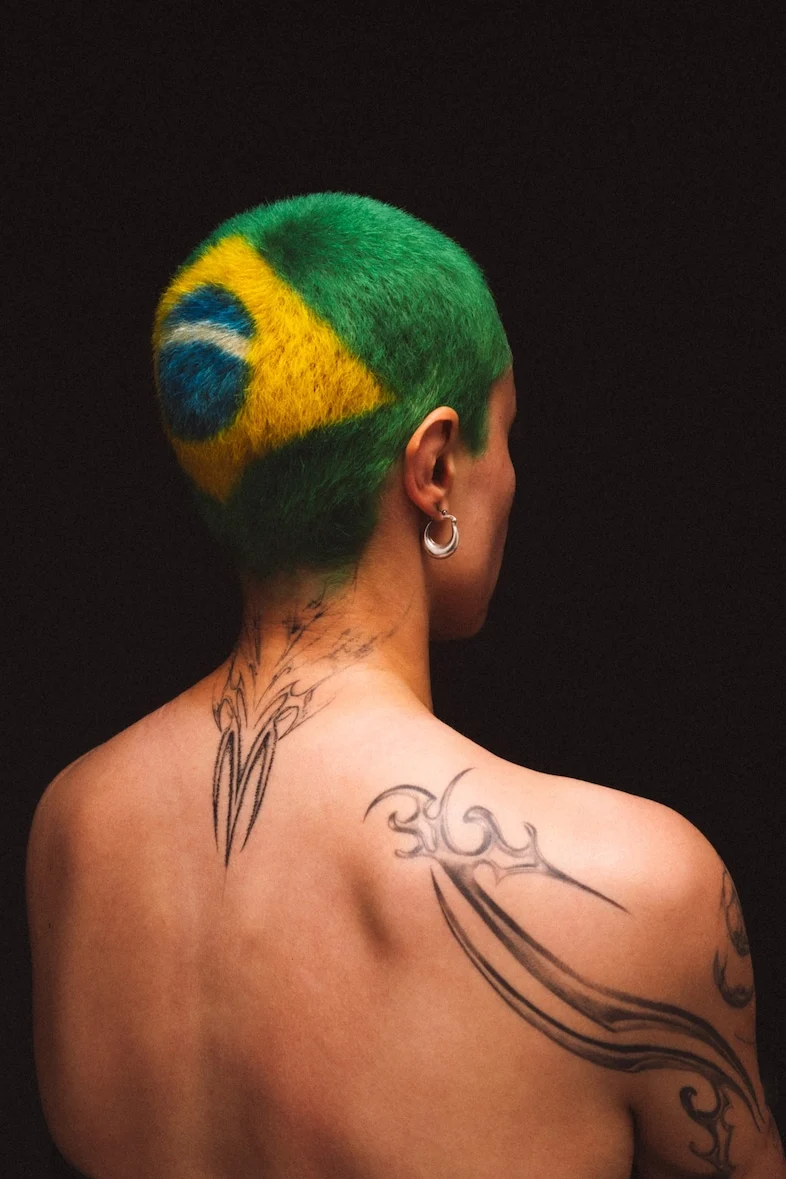
The intersection of sport, art, and national identity has found a vibrant new canvas in the latest project by Ami Fall, the visionary hair artist known professionally as THICKCUTS. Her series, Heads of State, transcends traditional fan merchandise by transforming buzzcuts into meticulously painted national flags, celebrating the profound influence of football culture on personal expression. This innovative endeavor, which has garnered significant attention, positions hair as a dynamic medium for wearable art, challenging perceptions of both sports fandom and contemporary aesthetics.
The Genesis of Heads of State: A Fusion of Culture and Canvas
Ami Fall, a London-based artist whose work is characterized by its "sharp, experimental, and loud" aesthetic, has consistently pushed the boundaries of hair art. Her journey began organically, evolving from experimental sessions with friends in a living room to a rapidly expanding cult following on Instagram, ultimately culminating in the establishment of THICKCUTS as a recognized brand for vibrant, intricate hair designs. Heads of State represents a significant evolution in her portfolio, directly addressing the symbiotic relationship between football culture and self-expression, particularly through hair.
"Football culture has always influenced the way people express themselves through their appearance," Fall states, encapsulating the core philosophy behind her latest work. The project was conceived as an exploration of this enduring connection, focusing specifically on how national identity, often passionately displayed during global sporting events like the World Cup, can be reimagined as a personal and artistic statement. The choice of buzzcuts as the medium is deliberate, offering a clean, bold canvas that allows the intricate details and vibrant colors of national flags to stand out with striking clarity.
The Enduring Legacy of Football and Hair as Expression
The history of football is replete with iconic hairstyles that have not only defined eras but have also become indelible parts of the sport’s cultural tapestry. From players whose daring cuts and colors made headlines every World Cup to the legions of supporters who dye their hair in team colors, hair has always played a significant role in expressing allegiance and individuality within the football world.
One cannot discuss this phenomenon without recalling David Beckham’s trendsetting fauxhawk at the 2002 World Cup, a style that was instantly replicated by fans globally and solidified his status as a fashion icon. Similarly, Brazilian Ronaldo’s distinctive shaved front patch during the same tournament became an unexpected, yet memorable, emblem of his team’s triumph. Nigeria’s Taribo West famously sported radioactive green braids, a bold statement that transcended mere aesthetics to embody national pride and a flamboyant spirit. These examples, alongside the recurring trend of players bleaching their hair en masse for major tournaments, underscore hair’s capacity to communicate identity, solidarity, and a competitive edge.
This rich legacy serves as the wellspring from which Fall draws inspiration for Heads of State. By elevating these forms of expression to a higher artistic plane, she not only acknowledges the historical significance of football hair but also recontextualizes it for a contemporary audience. The project, realized in collaboration with photographer Bet Bettencourt, began by identifying countries with a profound football identity. Crucially, Fall also considered how the color combinations inherent in their national flags could create compelling visual contrasts and weave a broader narrative of identity and heritage.
The Artistic Process: Crafting National Identity on a Human Canvas
The lineup for Heads of State currently features Brazil, England, France, and Portugal – nations renowned for their fervent football culture and distinctive flag designs. Each chosen flag is meticulously painted onto the shaved heads of models, transforming them into living embodiments of national pride. The artistic process behind each "head of state" is as intricate as it is time-consuming, often requiring several hours from conception to completion.
Fall meticulously details the stages involved: "A lot of time also goes into developing the visual concepts beforehand and figuring out how to translate a country’s visual identity and heritage into something that works as hair art." This preliminary conceptualization is critical, ensuring that the final design is not merely a replication of a flag but an artistic interpretation that resonates with the nation’s spirit. The physical execution involves a precise sequence of bleaching to create a uniform base, careful color placement to ensure accuracy and vibrancy, and finally, the meticulous application of paint to achieve the desired flag design. The precision required for such detailed work on a three-dimensional, curved surface like the human head highlights Fall’s exceptional skill and dedication.
The project consciously moves beyond the realm of ephemeral fan merchandise. While World Cup seasons traditionally see flags plastered across t-shirts, banners, and even temporary tattoos, Heads of State elevates this celebration of national identity by integrating it directly into the realm of personal presentation. Fall frames these national colors and symbols as "wearable art rather than fan merchandise," imbuing them with a deeper artistic and cultural significance. This distinction is vital, positioning the work not just as a fleeting trend but as a thoughtful commentary on the enduring power of symbols and the human body as a medium for artistic expression.
Football as a Unifying Force: A Global Phenomenon
Fall’s personal connection to football deeply informs her artistic vision. Growing up in London, a city renowned for its diverse diaspora communities, she experienced firsthand how football culture served as a bedrock, connecting people from myriad backgrounds, cultures, and generations. "Football is one of the few things that connects people across so many different backgrounds, cultures and generations," she observes, reflecting on its unparalleled ability to foster a sense of collective identity and shared experience.
This unifying power is perhaps best exemplified by the FIFA World Cup, a quadrennial global spectacle that transcends geographical, political, and socio-economic divides. The anticipation surrounding events like the upcoming World Cup 2026, which will be jointly hosted by Canada, Mexico, and the United States, underscores the tournament’s immense cultural footprint. Data from previous World Cups illustrate this global reach: the 2022 FIFA World Cup in Qatar, for instance, attracted a cumulative global audience of 5 billion people across all platforms, with nearly 1.5 billion tuning in for the final match alone. These staggering figures demonstrate football’s unique capacity to captivate and unite a significant portion of humanity.
In this context, Fall’s Heads of State project feels particularly poignant. "Right now, it feels extra special to intersect those two worlds," she notes, referring to the convergence of art and football. The project taps into the intense emotional investment that billions have in the sport, transforming symbols of national pride into intimate, personal statements. It’s a celebration of global camaraderie filtered through the lens of individual artistic expression, reflecting the very essence of how football transcends mere sport to become a cultural phenomenon.
Broader Implications: Art, Identity, and the Digital Age
Ami Fall’s work, particularly Heads of State, has several broader implications for the worlds of art, fashion, and cultural commentary. Firstly, it significantly contributes to the burgeoning field of hair art, demonstrating its potential as a serious artistic medium. By moving beyond conventional salon practices, Fall establishes hair as a canvas capable of conveying complex narratives and high-concept designs. This helps to legitimize hair art within the broader art community, pushing its boundaries beyond mere styling.
Secondly, the project offers a compelling commentary on national identity in a globalized world. In an era where national borders are often fluid and identities multifaceted, Fall’s work uses powerful, recognizable symbols – national flags – to explore how individuals connect with their heritage. By placing these symbols directly on the human body, she prompts viewers to consider the personal and public dimensions of identity and allegiance. It’s a nuanced exploration of patriotism that avoids jingoism, focusing instead on the shared human experience of belonging.
The project also highlights the crucial role of social media in contemporary art dissemination. THICKCUTS’ rise to prominence, from informal experiments to a "cult following" and booking inquiries, is intrinsically linked to platforms like Instagram. These platforms provide artists like Fall with direct access to a global audience, enabling rapid sharing and discussion of their work. This digital amplification is vital for niche art forms, allowing them to bypass traditional gatekeepers and reach enthusiasts worldwide, fostering new communities around shared aesthetic interests.
Furthermore, Heads of State challenges conventional notions of beauty and self-expression. The buzzcut, historically associated with various subcultures and often carrying connotations of rebellion or uniformity, is here transformed into a sophisticated, high-fashion statement. Fall’s ability to infuse such a bold, minimalist cut with intricate, vibrant artistry speaks to a broader trend in contemporary fashion that values individuality, experimentation, and a departure from mainstream beauty standards. This aligns with a growing movement towards personalized aesthetics, where self-expression trumps conformity.
The Future of THICKCUTS and Hair as a Medium
Building on the success and conceptual depth of Heads of State, Ami Fall and THICKCUTS are poised to continue their trajectory as pioneers in hair art. The project not only showcases Fall’s technical mastery but also her profound understanding of cultural phenomena. The meticulous planning, execution, and conceptual underpinning of Heads of State demonstrate a commitment to artistic integrity that resonates with both art connoisseurs and football enthusiasts.
The potential for expansion of the Heads of State series is considerable. Future iterations could explore flags of other nations with strong footballing traditions, delve into historical team jerseys, or even incorporate abstract interpretations of national symbols. The versatility of the buzzcut as a canvas, combined with Fall’s creative vision, suggests a rich vein of artistic possibilities.
In conclusion, Ami Fall’s Heads of State is more than just a series of striking hair designs; it is a profound artistic statement that skillfully weaves together the threads of football culture, national identity, and contemporary art. By elevating the passionate expressions of football fandom to the realm of high art, Fall not only celebrates the sport’s unifying power but also redefines the boundaries of hair as a medium for profound cultural commentary. Her work serves as a powerful reminder that art can be found in the most unexpected places, transforming the everyday into the extraordinary and inviting us to look at familiar symbols with fresh, appreciative eyes.