






The fashion industry stands at a profound technological crossroads, forced to navigate the disruptive rise of generative artificial intelligence and its encroachment upon traditional creative labor. This seismic shift gained widespread attention in March 2023 when Levi Strauss & Co. partnered with digital fashion studio Lalaland.ai to introduce hyper-realistic, AI-generated models for its online apparel catalog. The stated objective was to increase corporate diversity by displaying garments on a broader spectrum of digital ethnicities and body types. However, the initiative triggered immediate industry-wide backlash, with critics and cultural analysts pejoratively labeling the strategy as artificial diversity.
For professional commercial models like Sarah Murray, the debut of digital mannequins was both disheartening and alarming. Modeling as a profession has long been defined by fierce competition, financial instability, and strict physical parameters. The introduction of software that could algorithmically generate flawless, customizable human replicas without the need for travel, makeup artists, styling crews, or hourly wages presented an existential threat to working professionals. Two years following the initial Levi’s controversy, those early concerns have rapidly materialized into broader industry adoption, culminating in fresh debates regarding the value of human labor in commercial creative arts.
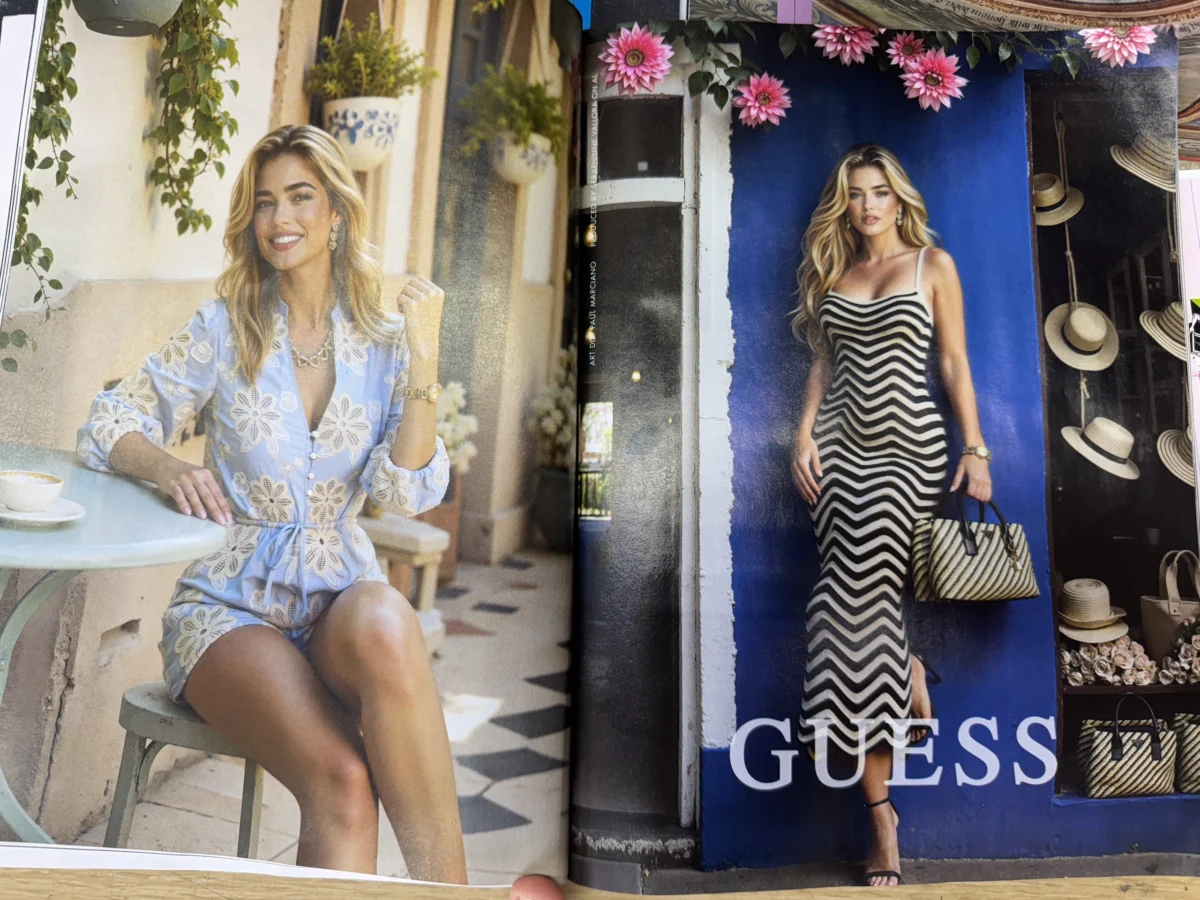
The tipping point for the recent wave of public scrutiny occurred with the publication of Vogue’s July print edition. Prominently featured within its advertising pages was a promotional campaign for Guess, showcasing a model who perfectly embodied traditional North American commercial standards: slender yet voluptuous proportions, glossy blond hair, and pouty lips. The controversy erupted not because an AI model was used, but because the advertisement appeared within the pages of Vogue, historically regarded as the ultimate arbiter of style and acceptable industry standards. While the placement was strictly commercial rather than editorial, the inclusion signaled a tacit institutional acceptance that reverberated across global fashion capitals.

The Economic Drivers Behind Automated E-Commerce
To understand the rapid proliferation of artificial intelligence in fashion advertising, industry experts point to basic economic pressures and the exponential demand for digital content. Sinead Bovell, a professional model and founder of the digital literacy advocacy group WAYE, notes that e-commerce models face the most immediate threat of automation. Unlike high-fashion editorial or runway models who achieve celebrity status and lucrative haute couture contracts, e-commerce models rely on catalog work and online storefront shoots for their financial livelihood and daily stability.
This reliance clashes directly with the modern commercial requirements of apparel brands. According to Paul Mouginot, an art technologist with extensive experience advising luxury labels, photographing human models across thousands of seasonal stock keeping units (SKUs)—including varying colors, sizes, and accessory combinations—incurs immense operational costs. Generative AI allows brands to bypass physical logistics entirely, transforming flat-lay product photographs onto photorealistic virtual avatars placed within digitally rendered backdrops that mimic authentic editorial locations.
Major retail conglomerates have steadily incorporated these technologies into their standard operating procedures over the past decade. Retailers such as Veepee, H&M, Mango, and Calvin Klein have experimented with various forms of virtual models and computer-generated imagery to reduce overhead. PJ Pereira, co-founder of the AI-driven advertising agency Silverside AI, explains that the traditional marketing apparatus was historically structured around producing a minimal number of major seasonal campaigns per year. The rise of social media platforms and hyper-fast e-commerce has flipped this model upside down, forcing brands to generate anywhere from 400 to 400,000 distinct pieces of visual content annually to satisfy algorithmic feeds on TikTok, Instagram, and specialized shopping portals.
For small and mid-sized enterprises, scaling output through traditional studio production is financially unsustainable. Proponents argue that generative systems are not necessarily designed to maliciously displace human artists, but rather to serve as an indispensable infrastructure upgrade required to meet modern commercial volume demands.

Ethical Concerns, Robot Cultural Appropriation, and Labor Rights
Despite the economic justifications provided by technologists, human models and labor advocates raise deep ethical concerns regarding representation, copyright, and exploitation. Sarah Murray points out that the narrative promoted by corporate brands—that AI merely supplements human talent—rings hollow to the thousands of diverse commercial models actively seeking employment through standard open casting calls.
Critics have introduced terms such as "robot cultural appropriation" to describe the corporate practice of algorithmically generating diverse identities to market products to specific demographics without employing or compensating real people from those communities. Furthermore, working professionals have expressed growing anxiety regarding contract language. Many worry that standard booking agreements increasingly contain clauses designed to capture their likeness, facial expressions, and physical characteristics to train proprietary machine-learning models for future campaigns.
In response to these emerging labor vulnerabilities, industry organizations are mobilizing. Sara Ziff, a former model and founder of the Model Alliance, has actively championed legislative measures such as the Fashion Workers Act. This proposed framework aims to mandate explicit informed consent and financial compensation whenever a brand utilizes a digital replica or avatar derived from a human model. While some technologists, such as Mouginot, suggest that authorized digital avatars could theoretically allow sought-after models to be in multiple places simultaneously and generate passive income during international travel, critics counter that the net reduction in available jobs will ultimately harm the broader labor pool.
To survive this transition, thought leaders like Bovell advise models to focus heavily on personal brand building, audience engagement, and multi-channel entrepreneurship through podcasting, public speaking, and direct endorsements. The core argument remains that while software can replicate physical appearances, it cannot manufacture a genuinely lived human story.

The Quest for Imperfection and Nuance in AI Artistry
As the technology matures, creative studios and boutique agencies are actively attempting to move beyond the homogenous, hyper-symmetrical aesthetics that characterized early generative models. Sandrine Decorde, CEO and co-founder of the digital art studio Artcare, describes her team as "AI artisans" who utilize advanced foundational architectures like Black Forest Labs’ Flux to fine-tune digital models that retain subtle human imperfections.
Decorde notes that a significant portion of Artcare’s current commercial work involves generating synthetic models of children and infants. Employing minors in commercial fashion photography has historically presented complex legal and ethical challenges related to labor regulations, safeguarding, and potential exploitation. By utilizing generative AI for children’s apparel campaigns, brands can effectively eliminate these operational and ethical risks entirely.
However, the challenge of avoiding bland uniformity remains paramount. Many early AI models suffer from predictable facial structures, identical jawlines, and generic expressions that fail to capture consumer attention. Industry veterans emphasize that successful fashion imagery relies on distinct personality traits—a unique gaze, asymmetrical features, or a characteristic smile—that are difficult to capture solely through raw code. Pereira stresses that overcoming algorithmic homogeneity requires intentional prompting and diverse training datasets, warning that uncurated systems will simply amplify pre-existing cultural and aesthetic biases embedded within historical training data.
Market Reception and the Uncertain Future of Luxury Heritage
The long-term viability of artificial intelligence within high fashion remains a subject of intense debate among booking executives and luxury brand custodians. Claudia Wagner, founder of the modeling platform Ubooker, views the recent integration of AI models primarily as an experimental marketing tactic designed to capture media headlines rather than a permanent paradigm shift. She notes that while technological executions like the recent Guess campaign generate temporary internet chatter, true brand value continues to rely on authentic storytelling and emotional resonance.

Interestingly, consumer reaction data presents a complex dichotomy. While public comment sections on social media platforms frequently feature vocal criticism and backlash against fully synthetic advertisements, quantitative metrics often tell a different story. Industry testing reveals that AI-generated video content can yield significantly higher engagement rates, increased click-through velocity, and measurable uplifts in product sales compared to traditional media assets.
Luxury heritage houses, known for their deliberate caution and reliance on exclusivity, continue to enforce rigorous internal policies regarding digital representation, often prohibiting fully synthetic humans in their core marketing materials. However, industry observers acknowledge that institutional barriers are slowly eroding. The cautious endorsement implied by mainstream fashion publications like Vogue testing the waters with commercial AI integration suggests that the industry may soon reach a critical tipping point.
As fashion historian and author Amy Odell observes, cultural resistance to new aesthetic standards or disruptive figures has historically dissolved once endorsed by premier institutional gatekeepers. Whether the fashion ecosystem ultimately embraces artificial intelligence as a standard creative medium or retreats toward human-centric authenticity will depend heavily on consumer tolerance, regulatory developments, and the ongoing evolution of digital craftsmanship.