










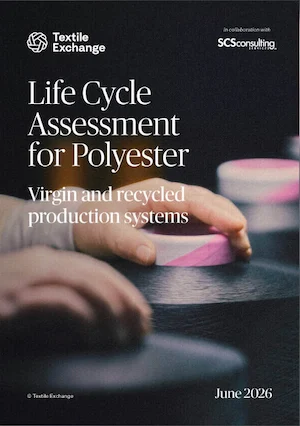
The global textile industry reached a significant milestone in its pursuit of data-driven sustainability on June 11, 2026, as Textile Exchange officially published its latest polyester Life Cycle Assessment (LCA) study. This landmark report provides the most robust, accurate, and credible data to date, specifically designed to strengthen the fashion, textile, and apparel industry’s understanding of the environmental and social impacts associated with various polyester production methods. As the most widely used fiber in the world, polyester’s footprint has long been a subject of intense scrutiny, yet the industry has frequently grappled with fragmented or outdated data. This new study addresses these critical limitations, offering a transparent look into the complexities of synthetic fiber manufacturing.
The publication represents the second installment in a series of comprehensive LCA studies spearheaded by Textile Exchange, a global non-profit dedicated to driving positive impact on climate change and nature across the fiber and materials industry. By focusing on polyester, the study tackles the material that currently dominates global fiber production, accounting for over half of the total market share. The release follows the organization’s cotton LCA study published in March 2026 and sets the stage for a rollout of further material-specific assessments scheduled throughout the remainder of 2026 and into 2027.
Bridging the Southeast Asian Data Gap
Perhaps the most significant contribution of this study is the inclusion of what is believed to be the first publicly available data on the environmental impacts of virgin polyethylene terephthalate (PET) production originating from Southeast Asia. This region is a critical focal point for the global supply chain, as it currently accounts for more than 50% of the world’s virgin PET production. Historically, industry analysts and brands have had to rely on proxy data from other regions or proprietary datasets that were not accessible for public verification.
By providing specific data for Southeast Asia, Textile Exchange allows brands to move beyond broad generalizations. The study identifies major "impact hotspots"—specific stages in the production process where resource consumption or emissions are highest—allowing manufacturers to pinpoint exactly where technological upgrades or shifts to renewable energy are most urgently needed. This regional specificity is vital for the development of localized sustainability strategies that account for the unique energy grids and industrial infrastructures of Southeast Asian nations.
Advancing Recycled Polyester and Circularity
The study arrives at a time of massive transition within the industry, as brands pivot from virgin synthetics toward recycled alternatives. Textile Exchange has provided updated data on both thermomechanical and chemical recycling technologies, reflecting the rapid innovation occurring in the textile-to-textile recycling sector.
Thermomechanical recycling, which involves melting plastic flakes into new pellets, remains the most common form of recycling, particularly for plastic bottles (rPET). However, the study also delves into chemical recycling, a process that breaks polyester down into its molecular monomers, allowing for the removal of dyes and contaminants. This technology is viewed as the "holy grail" for true circularity, as it theoretically allows for infinite recycling without the loss of fiber quality. By providing credible and up-to-date data on these systems, the LCA study helps stakeholders evaluate the trade-offs between energy intensity and material longevity.
The LCA+ Approach: Integrating Human Rights
In a departure from traditional environmental assessments, Textile Exchange utilized its "LCA+" methodology. While standard LCAs typically focus on ecological metrics such as carbon emissions and water usage, the LCA+ approach takes a holistic view by incorporating an assessment of human rights impacts associated with polyester production.
This social dimension recognizes that the polyester value chain is not merely a sequence of chemical reactions but a vast network of human labor. From the extraction of petrochemical feedstocks to the operation of high-tech recycling plants, millions of people are impacted by the industry’s labor practices. The study highlights the significant social influence that exists well before a material reaches a recycling plant, emphasizing that a truly sustainable system must protect and support the livelihoods of everyone throughout the value chain.
Chronology of the Textile Exchange LCA Series
The release of the polyester study is part of a multi-year strategic roadmap designed to overhaul the industry’s data infrastructure. The following timeline outlines the progression of this initiative:
- 2023–2025: Initial data collection and methodology development, including the publication of the position paper "Ensuring Integrity in the Use of Life Cycle Assessment Data."
- March 2026: Publication of the Cotton LCA study, providing updated metrics for both conventional and organic cotton production.
- June 11, 2026: Publication of the Polyester LCA study, introducing the first public Southeast Asian PET data and expanded recycling metrics.
- Late 2026: Anticipated release of studies focusing on animal-derived fibers, including wool and mohair.
- 2027: Scheduled publication of assessments for man-made cellulosic fibers (MMCFs) and alternative bio-based synthetics.
Technical Scope and Methodology
The polyester study utilizes a "cradle-to-gate" approach. This means the assessment covers every stage of the fiber’s life cycle starting from resource extraction (oil and gas for virgin polyester, or waste collection for recycled polyester) through to the final formation of the fiber.
Geographically, the study focuses on:
- Virgin Polyester: Primarily Southeast Asian production.
- Recycled Polyester: Production facilities across China, Europe, and the United States.
The analysis adheres to the 16 indicators recommended in the European Commission Environmental Footprint (EF) 3.1 database reference package. These indicators include climate change (carbon footprint), ozone depletion, human toxicity (cancer and non-cancer effects), particulate matter, ionizing radiation, photochemical ozone formation, acidification, terrestrial and aquatic eutrophication, and resource use (minerals, metals, and fossils).
Official Responses and Leadership Perspectives
Beth Jensen, Chief Impact Officer at Textile Exchange, emphasized the foundational nature of the new data. "This LCA study marks a significant update to existing polyester LCA data and advances our understanding of the impacts of its production for the fashion, textile, and apparel industry," Jensen stated. "By addressing known data gaps across both virgin and recycled polyester, and by identifying major hotspot impact areas, these findings create a stronger foundation for making informed decisions that support the shift toward preferred production systems."
Adam Gardiner, Recycled Lead at Textile Exchange, highlighted the importance of the study for the emerging circular economy. "There is significant industry investment and momentum behind the development of new technologies for textile-to-textile recycling. This LCA study provides both brands and recyclers with credible and up-to-date data on such systems, while identifying opportunities to reduce their impact," Gardiner noted. He further explained the value of the LCA+ approach: "To design a successful lower impact recycling system, it needs to protect and support the livelihoods of all people throughout the value chain."
Industry Implications and Future Accessibility
The data from the study will be submitted to various industry databases, ensuring that it is accessible to sustainability consultants, supply chain managers, and researchers worldwide. Textile Exchange intends for this data to serve as a high-quality "proxy" in instances where specific, primary data from a particular supplier is unavailable.
The publication also serves as a cautionary guide against the misuse of LCA data. Textile Exchange reiterated that comparisons should not be made between different studies or between datasets within individual studies—such as comparing a regional average in Southeast Asia directly against a specific plant in Europe—due to differences in methodological choices and boundary settings.
As regulatory bodies in the European Union and the United States move toward stricter "green claim" legislations, having ISO-conforming, peer-reviewed data becomes a legal necessity for brands. The 2026 polyester LCA study provides the empirical evidence required for companies to back up their environmental marketing with hard science, reducing the risk of greenwashing and fostering a more transparent global marketplace.
With this new data in hand, the textile industry is better equipped to navigate the transition away from fossil-fuel-based virgin materials. The focus now shifts to implementation: using these findings to drive investment into lower-impact technologies and ensuring that the shift toward a circular economy is as socially equitable as it is environmentally sound.