








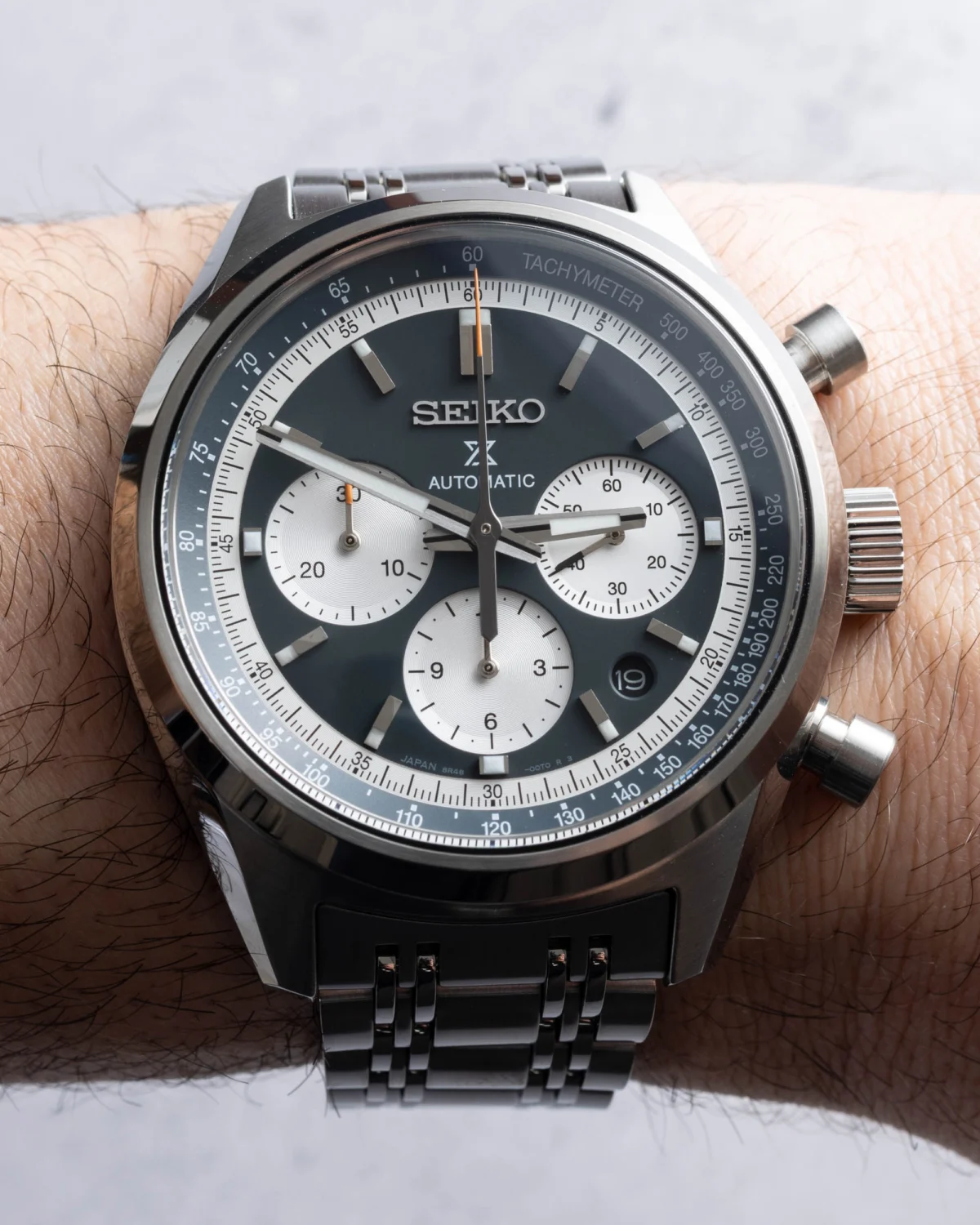
The horological world has long recognized Seiko’s prowess in crafting exceptional timepieces, and the Seiko Prospex Speedtimer Chronograph SRQ049 stands as a testament to this enduring legacy. This limited edition, restricted to just 1,000 pieces, not only showcases Seiko’s commitment to mechanical chronograph excellence but also pays homage to a rich history rooted in pivotal moments of Japanese sporting achievement. The SRQ049, with its striking "reverse panda" dial featuring a deep blue face contrasted by silver subdials and accents, represents a modern interpretation of timekeeping instruments that have defined precision for decades. Alongside this limited edition, Seiko also offers other variations within the Speedtimer line, including the SRQ047J1 (silver and black), SRQ051J1 (blue and silver), and the classic reverse panda SRQ053J1 (black and white), each carrying the same DNA of performance and historical resonance.

The Genesis of Speed: Seiko and the 1964 Tokyo Olympics
The narrative of the Seiko Speedtimer is inextricably linked to a singular event that profoundly shaped Japan’s technological and sporting identity: the 1964 Tokyo Olympic Games. For Seiko, this was not merely an opportunity to showcase its watchmaking capabilities; it was a crucible that demanded unprecedented innovation and a rapid advancement in timekeeping technology. Tasked with the monumental responsibility of being the official timekeeper, Seiko faced a formidable challenge. Unlike established European competitors such as Omega and Longines, who possessed decades of experience in sophisticated timing systems, Seiko was a relative newcomer to this specialized domain. The demands of Olympic timekeeping extended far beyond the creation of accurate wristwatches; it necessitated the development of complex electronic timing devices, synchronized systems for various sporting venues, and the ability to precisely record and display results with unparalleled accuracy. This undertaking spurred a significant investment in research and development, laying the groundwork for Seiko’s future leadership in precision timekeeping.
The 1964 Games served as a catalyst for several key innovations. In anticipation of this global event, Seiko launched its first wristwatch with a stopwatch function, the Seiko Crown Chronograph. This pioneering timepiece introduced the column-wheel mechanism for chronograph actuation, a sophisticated system that ensures smooth and precise operation of the stopwatch functions. This was a significant technical achievement, placing Seiko at the forefront of chronograph technology. The success of the Crown Chronograph paved the way for further advancements, culminating in the development of the caliber 6139 in 1969. This landmark movement was one of the world’s first automatic-winding chronographs, a technological marvel that placed Seiko in the company of esteemed watchmakers like Zenith and Heuer, who also released their own automatic chronograph movements that same year. The caliber 6139 further refined the chronograph’s functionality by incorporating a vertical clutch mechanism, working in tandem with the column wheel. This combination of a column wheel and vertical clutch in a mass-produced automatic chronograph movement was revolutionary, offering enhanced precision and reliability. While the "Speedtimer" name itself may not have been in common parlance during the 1960s, the design ethos and technical underpinnings of today’s Speedtimer chronographs can trace their lineage directly back to these groundbreaking innovations of that pivotal decade.

The Heart of the Speedtimer: Caliber 8R48
At the core of the modern Seiko Prospex Speedtimer Chronograph SRQ049 lies the in-house caliber 8R48, an automatic chronograph movement that embodies Seiko’s dedication to precision engineering and robust performance. This meticulously crafted movement operates at a frequency of 4Hz (28,800 vibrations per hour), ensuring excellent timekeeping accuracy. It boasts a power reserve of approximately 45 hours, sufficient for daily wear and intermittent use of the chronograph functions. The movement is a 12-hour chronograph, capable of measuring elapsed time with precision, and also incorporates a date complication.
The operational experience of the caliber 8R48 is particularly noteworthy. The presence of both a column wheel and a vertical clutch system provides a superior tactile sensation when engaging the chronograph pushers. Users will appreciate the crisp, precise, and smooth engagement of the stopwatch functions, offering a more refined experience than many other chronographs found in a similar price bracket. Column wheel mechanisms are known for their durability and require less frequent maintenance over the lifespan of the watch, contributing to the long-term reliability of the timepiece.

However, Seiko’s communication regarding the performance of its movements often presents a conservative outlook. The official stated accuracy for the caliber 8R48 is a range of +25 to -15 seconds per day. This figure, while appearing less stringent compared to the ±2 to ±4 seconds per day typically advertised by brands like Rolex, should be understood within its context. Seiko, like many manufacturers, often provides a broader, legally defensible performance window. In practice, the average performance of Seiko’s movements frequently exceeds these stated parameters, demonstrating a higher degree of actual accuracy. This discrepancy is often attributed to regulatory requirements and warranty considerations. It is crucial for consumers to understand that these published figures do not necessarily reflect the true potential accuracy of Seiko’s meticulously engineered movements.
Design and Construction: A Symbiosis of Form and Function
The case of the Seiko Prospex Speedtimer Chronograph SRQ049, measuring 42mm in width with a lug-to-lug distance of 49.5mm, presents a substantial yet balanced profile. The case’s thickness of 14.6mm is a direct consequence of the sophisticated mechanical chronograph movement housed within. While this may be considered on the thicker side for some preferences, it is a common characteristic of watches equipped with such intricate mechanical complications. The case is constructed from stainless steel, meticulously finished with a combination of polished and brushed surfaces, enhancing its visual appeal and durability.

A key feature that significantly enhances the watch’s resilience is Seiko’s proprietary "super hard coating." This advanced clear coating is applied to the steel, providing a remarkable increase in scratch resistance. This innovation is a significant benefit for wearers, ensuring that the watch maintains its pristine appearance for longer periods, resisting the inevitable minor abrasions of daily life.
The dial of the SRQ049 is a direct homage to the iconic stopwatches that Seiko produced throughout the 20th century, particularly those designed for the 1964 Tokyo Olympics. The "reverse panda" aesthetic, with its deep blue base dial and contrasting silver subdials, offers exceptional legibility. Applied baton-style hour markers and hands are treated with Seiko’s Lumibrite luminous material, ensuring readability in low-light conditions after adequate charging. While the lume application is discreet, it provides sufficient illumination for timekeeping in darkness. A tachymeter scale is integrated into the periphery of the dial, a functional element for measuring speed over a known distance. The Prospex branding, including the distinctive "X" logo, signifies its placement within Seiko’s collection of high-performance sports watches. Protecting the dial is a domed sapphire crystal with anti-reflective coating, offering superior scratch resistance and minimizing glare for enhanced visibility. The watch is further engineered for practicality with a water resistance rating of 100 meters, making it suitable for a variety of activities.

This limited edition SRQ049 is presented with two strap options, a rarity for Seiko timepieces, typically reserved for special releases. It comes equipped with a multi-link stainless steel bracelet that complements the case’s finishing, along with a black leather strap featuring white contrast stitching. The leather strap is attached to a deployant clasp, adding a touch of refinement. It is important to note that neither the bracelet nor the strap utilizes quick-release spring bars, meaning traditional watchmaking tools will be necessary for strap changes.
A Legacy Reimagined: Value and Broader Implications
The Seiko Prospex Speedtimer Chronograph SRQ049 represents exceptional value in the current watch market. While its 14.6mm thickness might be a consideration for some, the overall package—a robust stainless steel case with a super hard coating, a sapphire crystal, 100-meter water resistance, and the highly capable 8R48 automatic chronograph movement—is undeniably impressive. Seiko’s pricing strategy further underscores the value proposition; the brand often charges more for simpler three-hand watches that do not possess the same level of mechanical complexity.

The SRQ049 was produced as part of Seiko’s centenary celebration, marking 100 years of watchmaking innovation. This limited edition comes with a retail price of $2,700 USD, a modest increase of $200 over the non-limited edition Speedtimer models, which retail for $2,500 USD. This premium for the limited edition is justified by the exclusivity and the inclusion of the additional leather strap.
The existence of watches like the Speedtimer Chronograph SRQ049 has broader implications for the watch industry. It demonstrates that Seiko continues to be a formidable force in mechanical watchmaking, capable of producing complex, high-performance timepieces that rival those from established Swiss brands, often at more accessible price points. The brand’s commitment to in-house movement development and its ability to imbue its watches with a rich historical narrative provide a compelling proposition for collectors and enthusiasts alike. The Speedtimer line, in particular, serves as a powerful reminder of Japan’s significant contributions to the evolution of the wristwatch and the enduring appeal of mechanical chronographs.

In conclusion, the Seiko Prospex Speedtimer Chronograph SRQ049 is more than just a timekeeping instrument; it is a piece of history meticulously engineered for the modern era. Its blend of advanced mechanical performance, thoughtful design, and deep historical roots makes it a standout offering from a brand that consistently pushes the boundaries of what is possible in watchmaking. The legacy of precision initiated at the 1964 Tokyo Olympics continues to resonate in the remarkable engineering and enduring appeal of this exceptional timepiece.