






Solar-powered timekeeping technology has long been relegated to the background of watch design, often hidden behind semi-opaque dials in an effort to maintain a traditional aesthetic. However, the Swiss manufacturer Mondaine has opted for a paradigm shift with the release of the Mondaine Doppio Solar Skeleton. By opting to expose the solar panels that power the movement, the brand is transforming a utility-driven component into a focal point of industrial design. This release represents a significant departure from the brand’s historically rigid adherence to the minimalist Bauhaus-inspired aesthetic synonymous with the Swiss Federal Railways (SBB) clocks, signaling a new, experimental chapter for the company.

Historical Context and the Evolution of Solar Power
The horological industry’s relationship with solar power is deeper than many contemporary consumers realize. While the 1976 Citizen Crystron Solar Cell is frequently cited in textbooks as the world’s first analog solar watch, Mondaine maintains a competing claim based on internal records dating back to 1973. This historical rivalry underscores the brand’s long-standing interest in sustainable, battery-free energy sources.
The introduction of the Doppio collection in 2025 was initially met with mixed reviews from purists who felt the line drifted too far from the iconic, high-contrast black-and-white railway aesthetic. The Doppio Solar Skeleton, however, provides a conceptual bridge between Mondaine’s heritage and its future. By embracing the skeletal aesthetic, the brand is acknowledging that modern collectors are increasingly interested in the mechanics—or in this case, the electronics—that drive their timepieces. The decision to expose the solar cells is a deliberate move to celebrate the functional technology that removes the burden of periodic battery changes, a maintenance hurdle that has historically deterred some consumers from quartz watches.

Technical Specifications and Construction
The Doppio Solar Skeleton is constructed from 316L stainless steel, a standard in durable, corrosion-resistant watchmaking. The case measures 41mm in diameter, with a slim profile of 7.5mm, which increases to 9mm when accounting for the domed sapphire crystal. Despite these dimensions, the watch maintains a sophisticated ergonomic profile; the lugs are compact, resulting in a 42.5mm lug-to-lug span that makes the watch accessible to a wide variety of wrist sizes.
One of the most notable architectural features of the Doppio case is the absence of flat, slab-like sides. The case curvature extends from the top of the lugs, wrapping around the mid-case to form a seamless transition to the caseback. This design choice, combined with the lack of sharp edges, ensures that the watch remains comfortable for daily wear. The watch is water-resistant to 50 meters, a rating sufficient for daily activities, though it is not intended for professional maritime use.

The movement powering the watch is the Swiss-made Ronda Caliber 215. This quartz-based solar caliber is highly efficient: it requires only one minute of direct sunlight to resume operation if the power cell is completely depleted. Once fully charged, the movement provides a power reserve of approximately eight months in total darkness. This level of reliability is consistent with the expectations for a modern "set-and-forget" timepiece.
Dial Design and the Aesthetics of Transparency
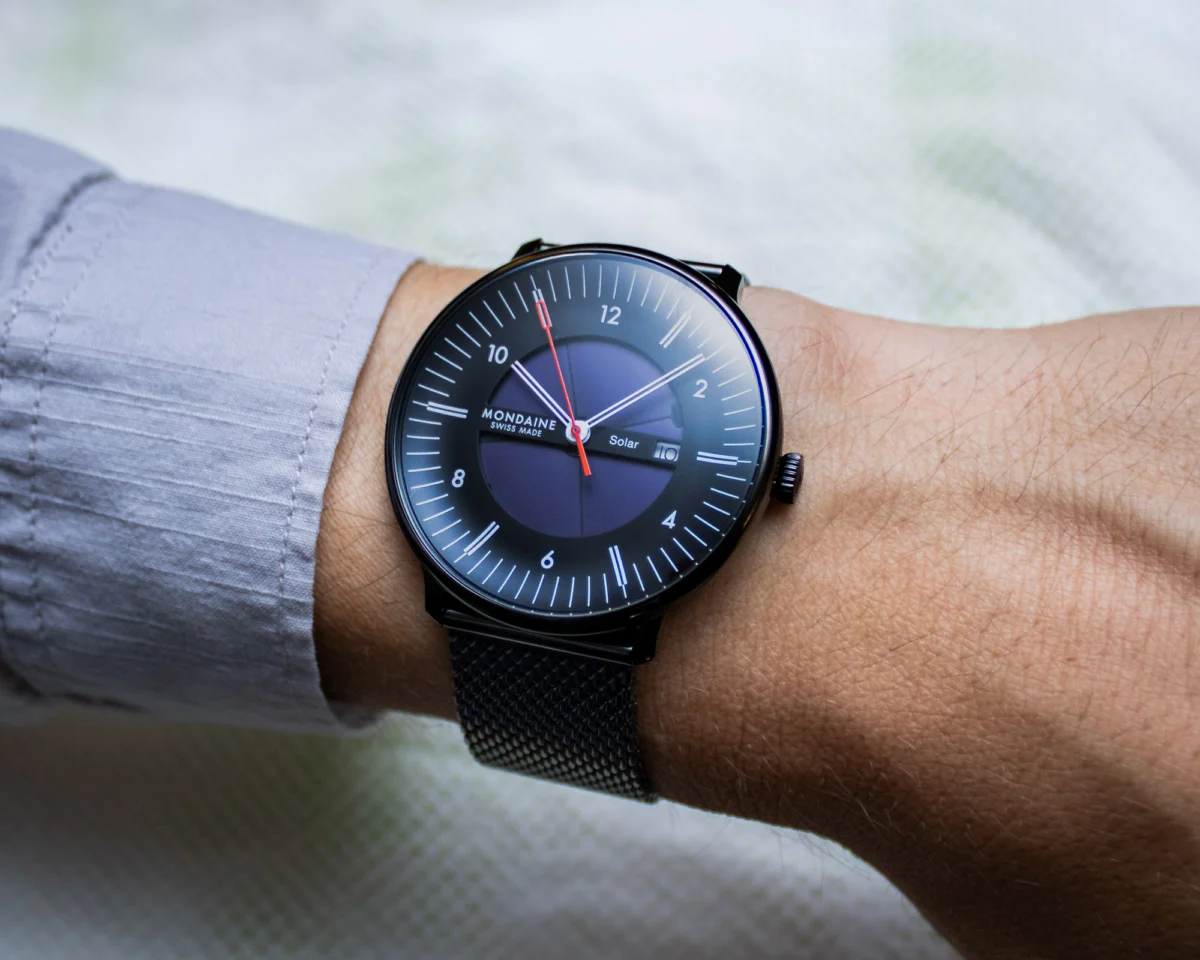
The dial of the Doppio Solar Skeleton is perhaps its most polarizing element. It features a matte black surface with a central open-worked aperture that allows for a direct view of the solar panels. This design choice highlights a reality of solar-powered horology: the components were not originally designed for aesthetic exposure.

Upon close inspection, users will notice faint lines radiating from the center, which are segments of the solar panel array. There are also visible technical connectors near the 2 o’clock position and glimpses of the underlying gear train. While some may view these as design "quirks," they serve as a testament to the authentic integration of the solar mechanism. Mondaine has attempted to balance this raw technical look with refined elements, such as ultra-thin, skeletonized hour and minute hands. In a nod to the brand’s signature style, the seconds hand remains finished in a high-visibility, vibrant red, providing a crucial pop of color that anchors the otherwise monochromatic dial.
Market Positioning and Model Variations
Mondaine has launched two distinct versions of the Doppio Solar Skeleton to cater to different aesthetic preferences:

- Ref. MLE.41921.LBV: This model features a polished stainless steel case paired with a black vegan leather strap. The use of grape-based leather reflects the brand’s commitment to sustainable materials, aligning with the eco-conscious nature of solar power.
- Ref. MLE.41921.SM: This iteration features a gunmetal IP-finished case and a matching stainless steel mesh bracelet. The mesh bracelet utilizes a quick-release spring bar system and a sliding latch-style clasp, offering a balance of utility and a more contemporary, industrial look.
The pricing strategy for these models is consistent with Mondaine’s market position: the strap-equipped version is priced at $465 USD, while the bracelet version retails for $495 USD. These price points place the watch in the "accessible luxury" segment, where competition is fierce. By offering both a classic leather option and a modern mesh bracelet, Mondaine aims to capture both the traditionalist buyer and the younger demographic interested in technical, modern aesthetics.
Strategic Implications for the Brand
The release of the Doppio Solar Skeleton is not merely a product launch; it is a strategic repositioning. Mondaine is clearly attempting to broaden its appeal beyond the "Swiss Railways" niche. By experimenting with open-worked dials and varied case finishes like gunmetal, the brand is signaling that it is willing to innovate within its established identity.

From an industry perspective, the move is significant because it validates the "solar-skeleton" category. Most solar watches are hidden; by choosing to reveal the mechanics, Mondaine is creating a new sub-genre that emphasizes transparency and technological pride. This aligns with a broader industry trend toward "open-heart" or "skeletonized" watches, which have seen a surge in popularity over the last decade.
Furthermore, the emphasis on the 1973 history of solar development serves to reinforce Mondaine’s credibility as a Swiss manufacturer with deep roots in innovation. In an era where consumers are increasingly conscious of the environmental impact of their purchases, the combination of a long-lasting, battery-free movement and vegan leather strap options makes the Doppio Solar Skeleton a compelling choice for the modern, sustainability-minded consumer.

Future Outlook and Conclusion
As the watch market continues to evolve, the distinction between "smart" and "traditional" watches is becoming increasingly blurred. The Mondaine Doppio Solar Skeleton occupies a middle ground: it provides the convenience of quartz and the longevity of solar power, while presenting an aesthetic that feels more "mechanical" and engaging than a standard field watch.
The success of this model will likely depend on how the watch-buying public receives its technical transparency. While the visible solar panel segments and internal connectors may be perceived by some as "unpolished," they are exactly the kind of details that appeal to enthusiasts who value the "honest" display of technology. Mondaine has taken a calculated risk by exposing the guts of its solar engine. If the brand continues to refine this concept—perhaps by developing proprietary movements that are designed from the ground up for visual exposure—the Doppio line could become a staple of the company’s catalog, proving that even a brand defined by tradition can successfully embrace the future of light-powered horology.

For now, the Doppio Solar Skeleton stands as a bold, interesting, and highly practical addition to the market, offering a unique blend of Swiss craftsmanship, sustainable energy, and a design philosophy that is not afraid to break from the past.