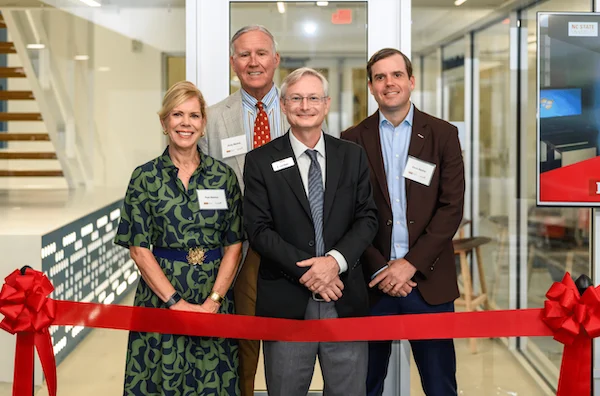












The aerospace manufacturing landscape reached a significant milestone on May 28, 2026, as Hexcel Corporation, a global leader in advanced composite technology, officially broke ground on its new Hexcel Applications Center. Located at Wichita State University’s National Institute for Aviation Research (NIAR), specifically within the Advanced Technologies Lab for Aerospace Systems (ATLAS), this facility represents a major expansion of a long-standing partnership aimed at revolutionizing the way composite materials are integrated into modern aircraft and defense systems. The ceremony, attended by industrial leaders, academic researchers, and high-ranking government officials, underscored a collective drive to transition advanced material science from the laboratory environment to large-scale, automated production lines.
The new Hexcel Applications Center is designed to be a focal point for high-rate manufacturing technology. By situating the center within the NIAR ecosystem, Hexcel aims to bridge the gap between material innovation and structural application. The facility will serve as a collaborative hub where engineers from both the private sector and academia can work side-by-side to solve the complex challenges of automated processing, thermoplastic integration, and the digital thread in manufacturing.
A Strategic Alliance for Next-Generation Manufacturing
The collaboration between Hexcel and NIAR is built upon a foundation of complementary expertise. Hexcel Corporation is renowned for its development of high-performance carbon fibers, honeycomb core, and resin systems that are foundational to the aerospace industry. Conversely, NIAR has established itself as a global authority in automated manufacturing, materials characterization, and full-scale structural testing.
Tom Gentile, Chairman, Chief Executive Officer, and President of Hexcel Corporation, emphasized the strategic importance of this investment during the groundbreaking ceremony. He noted that the center represents a pivotal evolution in how Hexcel supports its aerospace and defense clientele. According to Gentile, the goal is to provide a comprehensive "ecosystem" that does not merely offer materials but delivers practical, manufacturable solutions. This shift toward "structural realization" is critical as the industry moves toward higher production rates for commercial narrow-body aircraft and the emerging Urban Air Mobility (UAM) sector.
John Tomblin, WSU Executive Vice President of Research and Industry and Defense Programs and NIAR Executive Director, echoed these sentiments. He highlighted that the center would significantly enhance the resources available to aerospace and defense customers, allowing them to develop, scale, and validate advanced composite solutions using next-generation manufacturing technology. The integration of Hexcel’s material science with NIAR’s automated fiber placement (AFP) and thermoplastic processing capabilities is expected to reduce the time-to-market for new aerospace platforms.
The Three Pillars of Hexcel’s Development Pathway
The Hexcel Applications Center in Wichita is not an isolated project; rather, it is the middle link in a sophisticated, three-tiered development chain that Hexcel has established across the United States. This coordinated approach ensures that a concept can move from a molecular level to a flight-ready structure through a seamless internal pipeline.
-
Material Innovation (Salt Lake City, Utah): The process begins at Hexcel’s Applications Lab in Salt Lake City. This facility is the "brain" of the operation, focusing on the fundamental chemistry of resins and the mechanical properties of carbon fibers. Here, researchers focus on early-stage innovation and non-automated composite activities, ensuring that the raw materials meet the stringent safety and performance standards of the aerospace industry.
-
Automated Processing (Wichita, Kansas): The work performed in Utah feeds directly into the new Hexcel Applications Center at NIAR. Wichita serves as the "engine room" where these materials are tested for manufacturability. Utilizing the ATLAS lab’s suite of multi-axis robots and automated layup machines, engineers determine how Hexcel’s materials behave when processed at high speeds. This phase is crucial for identifying potential defects in automated production before a manufacturer commits to a multi-billion dollar assembly line.
-
Structural Realization and Validation (Kent, Washington): The final stage of the development pathway takes place at Hexcel’s facility in Kent, Washington. This site specializes in the production and evaluation of full-scale structural articles. Once a material and its automated process have been refined in Wichita, the Kent facility builds and tests actual aircraft components—such as wing spars or fuselage sections—to validate their structural integrity under simulated flight loads.
Strengthening the "Air Capital of the World"
The decision to build the Applications Center in Wichita reinforces the city’s reputation as the "Air Capital of the World." Kansas has a storied history in aviation, serving as the birthplace of companies like Cessna, Beechcraft, and Stearman. Today, the region continues to lead in aerospace exports and research, thanks in large part to the presence of Wichita State University and NIAR.

U.S. Senator Jerry Moran, a vocal advocate for the Kansas aerospace corridor, attended the groundbreaking and praised the collaboration as a win for both the state and national security. Moran noted that the investment underscores the significant role Kansans play in shaping the future of aerospace. He highlighted that the synergy between Hexcel and NIAR would provide a competitive edge for the American workforce, ensuring that the United States remains at the forefront of defense manufacturing in an increasingly contested global market.
Economic data supports the importance of this sector. As of 2026, the aerospace industry in Kansas accounts for a significant portion of the state’s manufacturing GDP, with thousands of high-tech jobs tied directly to composite research and production. The addition of the Hexcel Applications Center is expected to create new opportunities for graduate students and researchers at WSU, providing them with hands-on experience with the same materials and machines used by Tier 1 aerospace suppliers.
Technical Implications and Industry Analysis
The aerospace industry is currently undergoing a paradigm shift. Traditional aluminum structures are increasingly being replaced by carbon-fiber-reinforced polymers (CFRP) to reduce weight and improve fuel efficiency. However, the manual layup of composite materials is a slow and labor-intensive process. To meet the demand for thousands of new aircraft over the next decade, manufacturers must transition to fully automated systems.
The Hexcel Applications Center will focus heavily on "high-rate" composites. This includes the development of thermoplastic composites, which can be melted and reformed, allowing for faster processing times and easier recycling compared to traditional thermoset composites. Furthermore, the center will explore the use of "Digital Twins"—virtual replicas of the manufacturing process that allow engineers to predict and correct errors in a digital environment before a single piece of carbon fiber is cut.
Industry analysts suggest that the Hexcel-NIAR partnership is a response to the growing complexity of defense projects, such as the Collaborative Combat Aircraft (CCA) programs and next-generation rotorcraft. These platforms require rapid prototyping and the ability to scale production quickly. By having a dedicated center in Wichita, Hexcel can provide its defense customers with a "sandbox" to test new designs without disrupting their primary production lines.
Chronology of the Hexcel-NIAR Relationship
The groundbreaking on May 28, 2026, is the culmination of years of incremental cooperation between the two entities:
- 2010s: Hexcel begins utilizing NIAR’s testing labs for material characterization and FAA certification programs.
- 2019: NIAR launches the ATLAS lab, focusing on automated manufacturing. Hexcel becomes an early industrial partner, providing materials for AFP research.
- 2023: Strategic discussions begin regarding a dedicated Hexcel facility on the WSU campus to consolidate engineering talent.
- 2025: Formal announcement of the Hexcel Applications Center project, following a series of successful joint research grants funded by the Department of Defense.
- May 2026: Groundbreaking ceremony held in Wichita, Kansas.
- Late 2027 (Projected): Completion of construction and installation of specialized automated equipment.
Broader Impact on Global Aerospace
The implications of this center extend far beyond the borders of Kansas. As Boeing, Airbus, and Lockheed Martin look for ways to make aircraft more sustainable and cost-effective, the innovations coming out of the Hexcel Applications Center will likely set new industry standards.
The focus on "manufacturable solutions" addresses one of the greatest pain points in aerospace: the "valley of death" between a brilliant material discovery and its actual use in a production aircraft. By integrating the material supplier (Hexcel) directly with the manufacturing research institute (NIAR), the industry is effectively collapsing the supply chain, allowing for real-time feedback loops that improve both the material and the machine.
Furthermore, the center will play a vital role in workforce development. As the aerospace industry faces a shortage of skilled technicians and engineers familiar with automated composites, the Hexcel Applications Center will serve as a training ground. WSU students will have the unique opportunity to work on industry-funded projects, ensuring that the next generation of aerospace professionals is equipped with the skills necessary to operate the factories of the future.
In conclusion, the groundbreaking of the Hexcel Applications Center at Wichita State University’s NIAR marks a transformative moment for the composites industry. By aligning material science, automated processing, and structural validation, Hexcel and NIAR are creating a powerful engine for innovation. This facility will not only solidify Wichita’s status as a global aerospace hub but will also provide the technological breakthroughs required to define the next century of flight. As construction begins, the industry watches closely, anticipating the practical, scalable solutions that will emerge from this unique collaborative environment.