










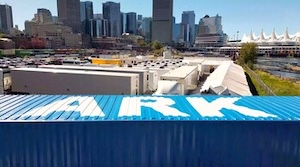
Denovia Inc., a pioneer in next-generation chemical recycling technology based in Vancouver, British Columbia, has officially entered the next phase of commercialization for its containerized demonstration unit, "The Ark." This strategic advancement, announced on June 5, 2026, represents a critical shift from proof-of-concept to industrial-scale application for a technology designed to tackle some of the world’s most recalcitrant waste streams. The Ark, currently operating in Vancouver, serves as a real-world showcase for Denovia’s proprietary depolymerization process, which aims to redefine the economics and logistics of the circular economy by converting contaminated plastic and textile waste into high-purity, virgin-grade chemical building blocks.
As the global manufacturing sector faces mounting pressure to transition away from linear "take-make-waste" models, Denovia’s platform offers a decentralized solution to the logistical bottlenecks that have historically hindered advanced recycling. By utilizing a modular, containerized design, The Ark demonstrates that high-tech chemical recycling does not require massive, multi-billion-dollar centralized facilities to be effective. Instead, Denovia envisions a network of compact, rapidly deployable systems situated at the heart of waste generation—near ports, municipal sorting centers, and industrial manufacturing hubs.
Technical Breakthroughs in Depolymerization
At the core of The Ark’s success is Denovia’s proprietary depolymerization technology. Unlike traditional mechanical recycling, which often results in "downcycling" (where the quality of the plastic degrades with each cycle), Denovia’s chemical process breaks polymers down into their original molecular components. This allows for the creation of "virgin-grade" materials that are indistinguishable from those derived from fossil fuels.
A defining characteristic of this technology is its ability to operate under mild conditions. Traditional chemical recycling methods, such as pyrolysis, often require extreme temperatures and high energy inputs, which can diminish the environmental benefits of the process. Denovia’s system, however, achieves high-efficiency conversion at lower temperatures and pressures. This not only reduces the carbon footprint of the recycling process itself but also lowers operational costs, making the recycling of low-value waste streams commercially viable.
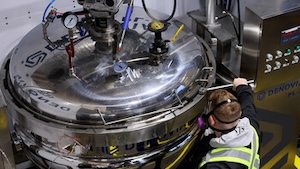
Recent independent validation has provided a quantitative benchmark for the platform’s efficacy. Tests have confirmed that the system can achieve up to 98.3% purity of terephthalic acid (TPA) in its crystalline phase when processing mixed and contaminated textile waste. TPA is a fundamental precursor for the production of polyester (PET), one of the most widely used synthetic fibers in the global fashion and packaging industries. Reaching this level of purity from contaminated feedstock is a significant technical milestone, as it ensures the output can be reintroduced directly into existing manufacturing supply chains without requiring further intensive purification.
Chronology of Development and Strategic Milestones
The current commercialization phase of The Ark is the culmination of a multi-year roadmap focused on scaling Denovia’s technological footprint. The company has maintained a steady pace of development, marked by several key milestones over the past eighteen months:
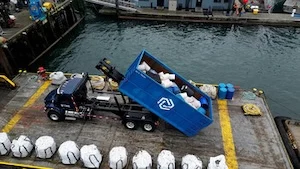
- January 2025: Launch of the PL-2 Machine. Denovia successfully deployed its PL-2 machine at Tymac’s facilities within the Port of Vancouver. This deployment focused on demonstrating the technology’s capability in a high-throughput industrial environment, specifically targeting marine and industrial plastic waste arriving at one of North America’s busiest ports.
- October 2025: International Expansion via Resident Holdings. Denovia entered into a strategic partnership with Resident Holdings to explore deployment opportunities across the Philippines. This move highlighted the company’s intent to address waste management in regions with high plastic leakage and underdeveloped recycling infrastructure, proving the modular system’s adaptability to diverse geographical and economic contexts.
- June 2026: Commercial Scaling of The Ark. The current announcement marks the transition of the Vancouver-based Ark unit from a demonstration phase into a commercial-ready platform. This phase involves inviting global investors, waste management leaders, and industrial partners to witness the system in operation as Denovia prepares for wide-scale equipment deployment.
The Economic and Environmental Context
The urgency of Denovia’s mission is underscored by sobering statistics regarding global waste. According to data from the United Nations Environment Programme (UNEP), the world generates approximately 92 million tonnes of textile waste annually. The majority of this waste is either landfilled or incinerated, as the complexity of blended fabrics (such as poly-cotton mixes) makes them nearly impossible to process through mechanical means.
Furthermore, the Organisation for Economic Co-operation and Development (OECD) reports that global plastic waste more than doubled between 2000 and 2019, rising from 156 million tonnes to 353 million tonnes. Despite global efforts to increase recycling rates, only a small fraction of this material is successfully recovered, with processing losses and contamination rendering much of it "unrecyclable" by current standards.
Denovia views these figures not merely as an environmental catastrophe but as a "trillion-dollar materials opportunity." By unlocking the value trapped in contaminated feedstocks—such as ocean-bound plastics, multi-layer packaging, and post-consumer polyester garments—the company is positioning itself at the intersection of the $500 billion waste management industry and the multi-trillion-dollar advanced materials market.

Strategic Shift Toward Decentralized Infrastructure
One of the primary barriers to the adoption of advanced recycling has been the "logistics tax." In a centralized model, waste must be collected, sorted, baled, and transported over long distances to a massive processing plant. For low-value plastics, the cost of transportation often exceeds the value of the recovered material.
Denovia’s CEO, Nick Spina, emphasizes that the Ark was developed to bypass this structural inefficiency. "The world has a waste problem not because waste has no value, but because the technology has not existed to unlock that value at scale," Spina stated. "The Ark represents a major step in proving that our technology can work in real-world environments and move toward commercial deployment."
The modular nature of the Ark allows for "point-of-origin" recycling. For example, a garment manufacturer could install a Denovia unit on-site to process factory offcuts and returns, immediately turning waste back into raw materials for new textiles. Similarly, municipalities could integrate these units into existing sorting facilities to process plastics that are currently rejected and sent to landfills. This "plug-and-play" approach significantly reduces the carbon intensity of the circular economy by eliminating unnecessary transportation.
Broader Industry Implications and Regulatory Drivers
The timing of Denovia’s commercialization coincides with a global shift in the regulatory landscape. Governments in Europe and North America are increasingly implementing Extended Producer Responsibility (EPR) schemes, which hold manufacturers financially accountable for the end-of-life management of their products. Additionally, many jurisdictions are mandating minimum recycled content in new products, particularly in packaging and textiles.
Consumer-facing brands are also feeling the pressure. Major players in the apparel and beverage industries have made public commitments to achieve 100% circularity by 2030 or 2040. However, the supply of high-quality recycled polymers is currently insufficient to meet these goals. Technologies like Denovia’s are viewed by industry analysts as the "missing link" that can bridge the gap between corporate sustainability targets and the physical reality of waste supply chains.
The ability to process contaminated feedstocks is particularly vital for the fashion industry. Most recycled polyester currently comes from clear PET bottles (rPET), but the fashion industry is under pressure to move toward "fiber-to-fiber" recycling. Denovia’s ability to take a used polyester shirt—complete with dyes, buttons, and zippers—and return it to a high-purity chemical state is exactly the type of innovation required for true textile circularity.
Future Outlook and Financing
As Denovia enters this next phase, the company is actively advancing financing activities to support its aggressive expansion goals. The capital will be used to fund the manufacturing of additional Ark units, expand the company’s engineering teams, and solidify strategic partnerships with global waste feedstock suppliers.
The company’s trajectory suggests a move toward a "Technology-as-a-Service" (TaaS) or licensing model, where Denovia provides the hardware and proprietary chemical catalysts to waste operators and industrial partners worldwide. By lowering the barrier to entry for advanced recycling, Denovia aims to catalyze a global network of chemical recycling nodes.
With the Ark now proven in a commercial environment, the focus shifts to global deployment. From the Port of Vancouver to the islands of the Philippines, the demand for scalable, efficient, and high-purity recycling solutions is at an all-time high. Denovia’s progress suggests that the future of waste management may not lie in larger landfills, but in smarter, smaller, and more mobile technology capable of turning yesterday’s waste into tomorrow’s essential materials.