




The intersection of historical legacy and contemporary urban identity served as the conceptual cornerstone for Raul Lopez as he prepared to unveil his latest collection for Luar during New York Fashion Week. Entitled Christopher Street Columbus, the Spring/Summer 2027 presentation stood as a monumental moment not only for the brand but for the broader landscape of American fashion, which increasingly seeks to deconstruct the complex narratives of colonization, migration, and modern urban survival. Staged outdoors at the iconic Unisphere in Flushing Meadows-Corona Park, Queens, the show bridged centuries of history with the pulsating heartbeat of New York City street culture, establishing a vivid dialogue between the colonial past and the marginalized present.
Behind the scenes, prior to the models stepping onto the sprawling concrete runway surrounding the stainless-steel globe, Lopez offered a glimpse into his creative genesis. His moodboard pinned disparate yet spiritually connected references side by side: a traditional historical portrait of Christopher Columbus alongside a candid snapshot of an anonymous older gentleman Lopez had recently observed strolling through the Flatiron District. The latter individual, entirely unaware of his sudden elevation to high-fashion muse, catalyzed a spark in the designer. "I was like, ‘This is it,’" Lopez recalled, noting the immediate clarity that confirmed he was onto a profound thematic breakthrough. This juxtaposition of the mundane and the monumental set the stage for an exploration of duality that would dictate every tailored seam, historical silhouette, and subversive accessory in the collection.
Deconstructing The Dual Christophers
At the heart of the Luar SS27 collection lies an intentional tension between two distinct figures bearing the name Christopher, both of which have profoundly shaped the designer’s personal and ancestral consciousness. The first is Christopher Street, the historic epicenter of queer liberation in Greenwich Village where Lopez came of age, navigating the precarious thresholds of belonging and alienation. The second is Christopher Columbus, the controversial navigator whom the Dominican-born designer confesses an obsession with, viewing him as the harbinger of a historical narrative authored entirely without the consent or input of Caribbean indigenous peoples.
"This collection sits in the tension between those two inheritances: the street and the empire. The lived and the imposed," Lopez articulated in the official show notes. By fusing these two ideological poles, Lopez established a framework for examining how historical forces ripple downward into the daily realities of contemporary marginalized populations. The legacy of empire—represented by European expansionism and institutional power—collides directly with the street, a space of grassroots community formation, underground culture, and defiant self-expression.
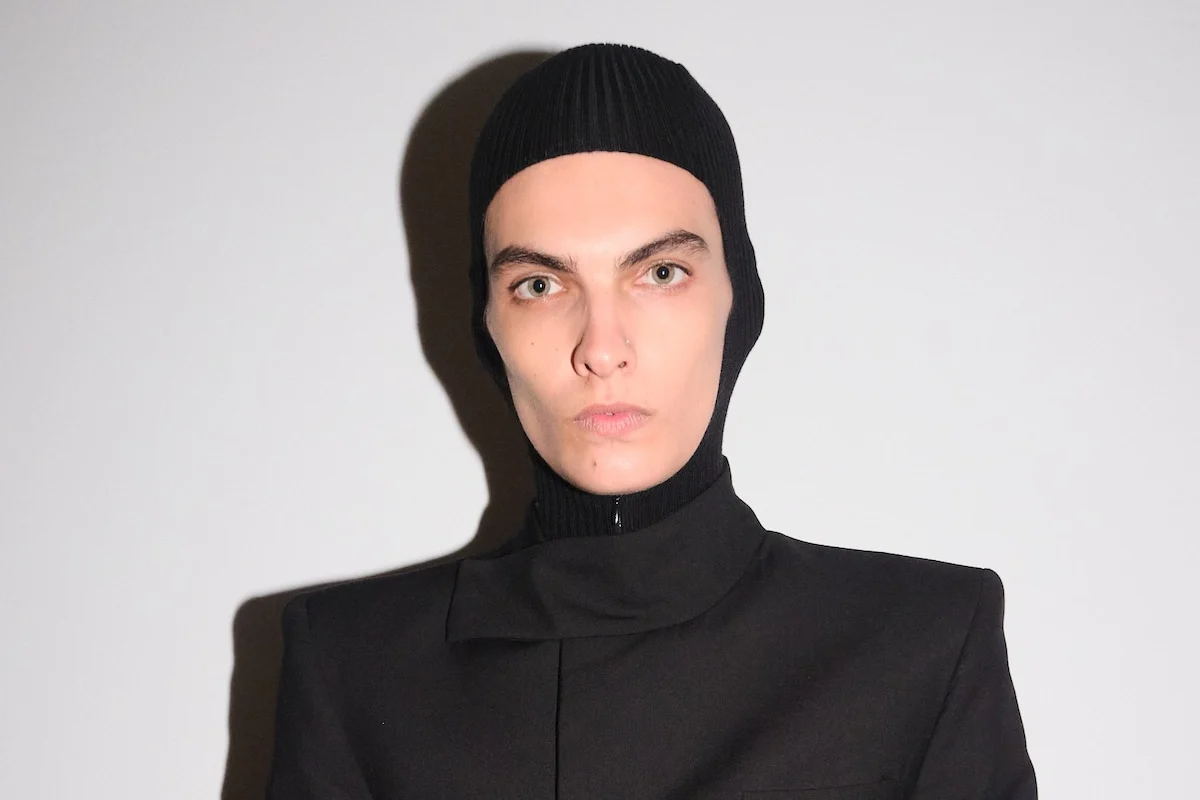
The runway presentation materialized this collision through an eclectic, fearless mashup of sartorial epochs. Aged leather biker jackets bearing explicit punk elements were juxtaposed with 15th- and 16th-century European silhouettes. Flamboyant lace ruffle sleeves billowed alongside razor-sharp modern tailoring, while historical bloomer pants met dramatic feathered hats reminiscent of bygone eras of exploration and aristocracy.
Furthermore, Lopez anchored the collection deeply in his Dominican heritage by weaving subtle yet powerful references to cacao throughout the garments. A standout piece, the "rotted cacao" coat, alongside intricate cacao silk prints, emerged from historical research detailing how jacquard cacao beans once functioned as an official form of currency in the Dominican Republic. By transforming a historical commodity of colonial extraction into high-fashion luxury, Lopez reclaimed the narrative of trade and labor, turning agricultural history into a symbol of resilience and wealth.
The Conceptual Metaphor Of The Queens Vampire
To conceptualize the individuals wearing these garments, Lopez conjured a vivid, almost cinematic persona for his models: vampires who arrived on the ships with Columbus, but instead of vanishing into myth, adapted to the modern metropolis. These figures went to school in Queens, hung out in downtown Manhattan clubs, and continue to navigate the boroughs of New York City to this day.
This conceptual narrative mirrors Lopez’s own biography. As an alumnus of Flushing High School, Lopez spent his formative years traversing the cultural divides of New York City. Reflecting on his adolescence, Lopez often questions his own relationship with the past. "Sometimes I’m like, ‘Am I a vampire?’ Because why do I remember and think so much of that era? It’s kind of weird," he mused.
Growing up, Lopez experienced a profound sense of displacement. When he frequented Christopher Street, he never felt he entirely fit into the dominant queer enclaves, yet he felt equally unmoored in his own working-class neighborhood. Rather than assimilating into either environment, Lopez weaponized fashion as an instrument of psychological defense and self-actualization. "I figured out a way to dress myself to provoke people, make people uncomfortable and reclaim that too," he explained, describing a defiant personal philosophy that translates directly into the aggressive, boundary-pushing silhouettes of the Luar brand. "Like, ‘Oh, so you think I’m crazy?’"
A Homecoming At The Unisphere
If the models inhabiting the Christopher Street Columbus collection were indeed modern vampires, the choice of venue served as their ultimate homecoming. Staging the show at the Unisphere in Flushing Meadows-Corona Park carried immense personal and symbolic significance for Lopez. Located mere blocks from his alma mater, the park is a space the designer has attempted to secure for a runway presentation for years.
"I think it was just the universe waiting for this collection," Lopez noted, clearly energized by the realization of a long-held ambition. "I’m so excited to give everyone the world."
The Unisphere—a monumental stainless-steel representation of the Earth built for the 1964–1965 New York World’s Fair—provided a fitting backdrop for a collection dealing explicitly with globalism, empire, and geography. As models circled the globe structure, the convergence of local Queens history and international fashion commentary became palpable. It underscored how far Lopez has traveled within the industry while remaining fiercely tethered to the geographic coordinates that forged his creative identity.
Background Context Of New York Fashion Week And Luar’s Trajectory
To understand the weight of Luar’s SS27 presentation, one must examine the brand’s trajectory within the broader ecosystem of New York Fashion Week (NYFW). Over the past several seasons, Luar has transitioned from an underground cult favorite into a critical darling and a commercial force, largely propelled by Lopez’s uncanny ability to capture the zeitgeist of urban luxury. Known widely for creating the ubiquitous "Ana" bag—which achieved near-viral status among fashion editors, celebrities, and downtown tastemakers—Lopez has consistently used his platform to champion marginalized identities, particularly queer people of color.
NYFW, historically criticized for exhibiting a lack of diverse cultural representation and systemic insularity, has increasingly relied on designers like Lopez to inject genuine socio-political discourse into the official calendar. While many heritage American brands lean into nostalgic Americana or commercial sportswear, Luar consistently chooses to interrogate the darker, more complex facets of American and colonial history. By framing his collections around the psychological toll of assimilation and the rich tapestry of immigrant experiences, Lopez elevates fashion from a mere seasonal retail cycle into an active medium of cultural critique.
Industry Response And Critical Reception
The immediate aftermath of the Christopher Street Columbus show saw widespread critical acclaim across major fashion publications, trade journals, and social media platforms. Critics praised Lopez’s fearless approach to textile manipulation and his refusal to pander to minimalist trends. The historical pastiche—combining the austerity of European court dress with the rebellious hardware of punk subculture—was hailed as a masterclass in styling and narrative cohesion.
Cultural commentators particularly lauded the designer’s integration of Dominican agricultural history into the high-fashion lexicon. By spotlighting cacao as both a historical currency and a modern textile print, Lopez forced an industry often detached from the origins of raw materials to confront the legacies of global trade. Furthermore, the casting of the show received high marks for its inclusivity, reflecting the diverse spectrum of bodies, ages, and gender presentations that define contemporary urban life.
Retail analysts observing the presentation noted that while the runway pieces leaned heavily into avant-garde theatricality, the underlying accessories and outerwear concepts hold substantial commercial viability. Luar has successfully built a business model that bridges accessible statement pieces—such as its celebrated leather goods—with uncompromising artistic vision. The integration of structured tailoring and wearable street-luxury items within the SS27 lineup indicates that the brand is well-positioned to capitalize on the critical momentum generated by the Flushing Meadows presentation.
Broader Impact And Implications For The Future Of Fashion
The implications of Raul Lopez’s Christopher Street Columbus collection extend far beyond the immediate success of a seasonal runway show. As the global fashion industry grapples with questions of sustainability, cultural appropriation, and decolonization, Luar offers a blueprint for how designers from diaspora backgrounds can engage with painful historical narratives without sacrificing artistic integrity or commercial appeal.
By positioning the immigrant as an immortal observer—a "vampire" traversing the centuries from the dawn of colonization to the concrete canyons of modern Queens—Lopez destabilizes traditional chronological timelines. He suggests that the past is never truly past; it walks among us, dressed in a mixture of antique lace, rotted cacao prints, and battered leather biker jackets.
As Luar continues to expand its global footprint, the SS27 collection cements Raul Lopez’s status as one of the most visionary designers working in contemporary American fashion. By refusing to separate the elegance of the runway from the grit of the sidewalk, Lopez has once again proven that fashion at its highest level is not merely about clothing the body, but about reckoning with history, reclaiming space, and telling the stories that empires tried to leave unwritten.