










Nearly a year prior to this report, a conversation with Jason Lu, the visionary founder of 1776 Atelier, offered a glimpse into the burgeoning aspirations of a new American watchmaking brand. Lu articulated a vision rooted in a profound passion for horology, coupled with a determined pursuit of domestic manufacturing without succumbing to prohibitive pricing. The initial offerings, the Mount Vernon and Monticello timepieces, represented foundational steps toward this ambitious goal. However, the latest creation from 1776 Atelier, the Montpelier, signifies a substantial leap forward, meticulously crafted and, in the opinion of many observers, aesthetically captivating.

Evolution of a Vision: From Monticello to Montpelier
The Montpelier, unveiled in October 2025, is not merely a new model but an evolution born from the preceding Monticello. Lu himself acknowledged the Monticello’s somewhat rudimentary execution, viewing it as a platform that could be refined to better align with his brand’s core philosophy. This internal reassessment coincided with a pivotal development: the acquisition of a co-ownership stake in 1776 Atelier by Zach Smith, a respected watchmaker and proprietor of precision component manufacturer Hour Precision. This strategic partnership, combined with Lu’s ongoing enhancement of his own watchmaking expertise, has positioned 1776 Atelier as one of the most vertically integrated independent watch manufacturers in the United States. This synergy has enabled the Montpelier to achieve a significantly elevated level of refinement compared to its predecessor, with an unprecedented proportion of its production now occurring domestically.

This strategic integration is crucial in the context of a revitalizing American watchmaking industry. For decades, the U.S. has lagged behind Switzerland and Japan in large-scale watch production. However, a new wave of independent brands, supported by advancements in manufacturing technology and a growing appreciation for artisanal craftsmanship, are making significant inroads. The Montpelier’s increased reliance on U.S.-based production aligns with broader trends aiming to bolster domestic manufacturing capabilities across various sectors.

Case Design: A Harmonious Blend of Form and Finish
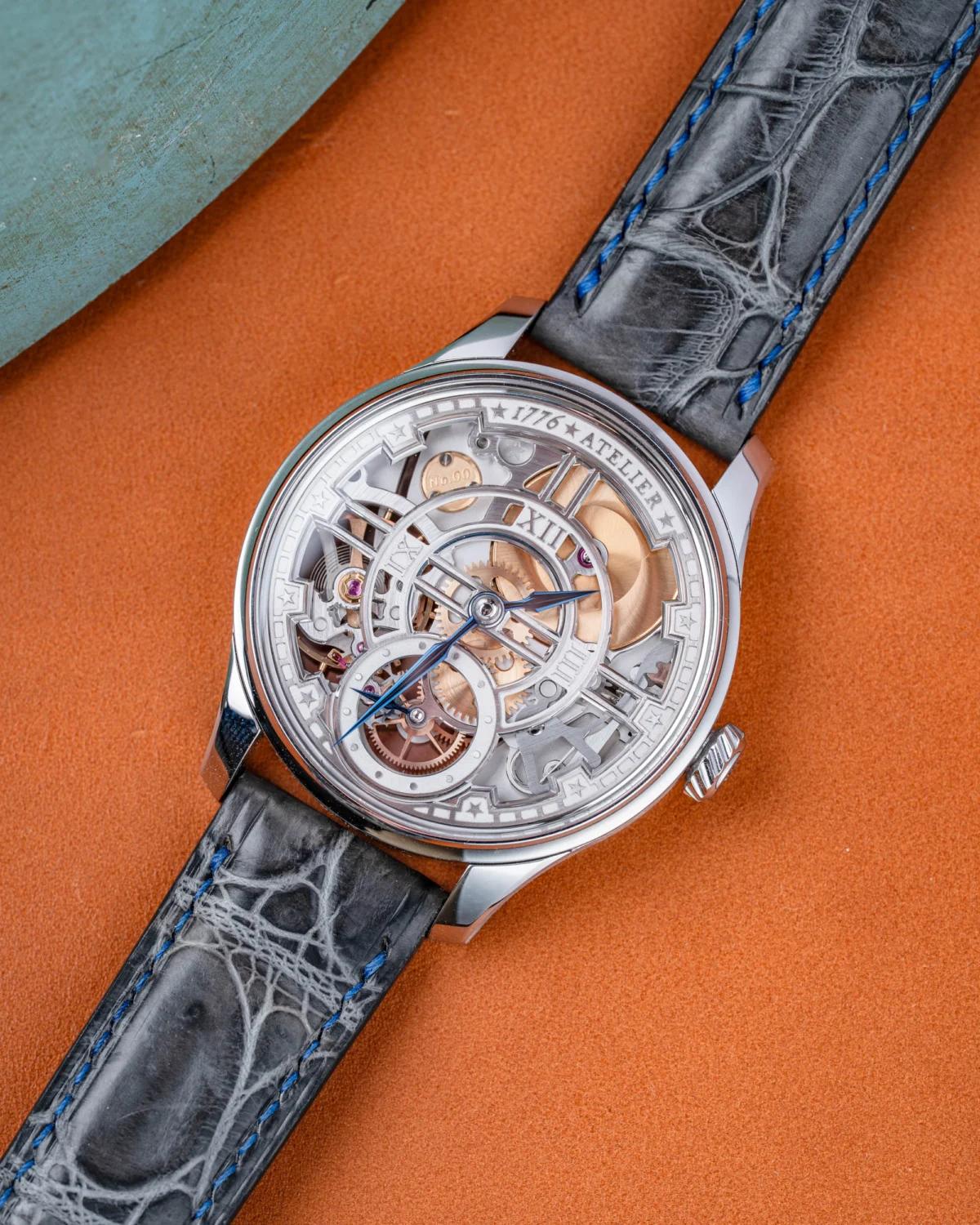
A significant area of critique for the earlier Mount Vernon model was its fully polished case, which, according to reviewers, diminished the impact of its design transitions. The Montpelier addresses this by introducing an entirely new 41.5mm stainless steel case. This redesigned case features a horizontally brushed mid-case, juxtaposed against sharply polished chamfers and lugs that exhibit a graceful, generous curve. This deliberate division of surfaces enhances the perception of depth and precision, allowing the transitions between finishes to stand out. The addition of a polished, concave bezel further accentuates the watch’s high-end appeal.

While the majority of the Montpelier’s components are produced in the U.S., the case itself is manufactured in Germany by RP-Urgehause. This exception underscores the global supply chain complexities inherent in modern manufacturing. Measuring 49.5mm from lug to lug and a slim 10.2mm in thickness (including the domed sapphire crystal), the Montpelier proves to be a comfortable wear, even on a 7-inch wrist, as confirmed by wear trials. The inclusion of 50 meters of water resistance, facilitated in part by a spiral-fluted crown, is a welcome feature, surpassing the typical 30-meter rating often found on comparable high-craft watches. This enhanced water resistance provides an added layer of practicality and peace of mind for the wearer.

Straps and Versatility: Alligator Elegance Meets Rubber Practicality
The Montpelier is presented with two distinct strap options, catering to different aesthetic preferences and functional needs. The primary configuration features a supple, Florida-made grey alligator strap, accented with contrasting blue stitching and a buckle meticulously machined and finished in-house. This detail alone highlights the brand’s commitment to domestic craftsmanship, extending even to smaller components like the buckle.

For those seeking a sportier aesthetic or increased durability, a cut-to-size FKM rubber strap is also provided. This strap is equipped with a spring-loaded butterfly clasp, a mechanism that has gained recent popularity for its ease of use and comfortable wear. Initial apprehension about cutting the rubber strap to size was quickly dispelled by the clasp’s intuitive on-and-off functionality and its ability to adapt to minor wrist volume fluctuations throughout the day. The blue hue and textured finish of the rubber strap were found to complement the watch’s overall design effectively, demonstrating a thoughtful approach to versatility.

The Dial: A Masterpiece of Craftsmanship and Legibility
The dial of the Montpelier is a testament to the brand’s dedication to artisanal finishing, reportedly requiring over 40 hours of meticulous work to complete. The process begins with milling and initial finishing at Hour Precision in Ohio, culminating in final detailing by Lu himself in Texas. A striking aspect of the dial is its open-worked nature, revealing the intricate mechanics beneath. The brand highlights that the dial features 62 internal angles, a detail that, while impressive from a technical standpoint, ultimately serves the overall aesthetic appeal.

Despite the complexity of the open-worked design, legibility remains paramount. The hands are rendered in a deep blue, achieved through a precise heating process. Each two-part hand, consisting of the hand itself and its bushing, undergoes several days of machining and hand-finishing. This deep blue hue provides a strong contrast against the galvanized brass dial, ensuring excellent readability in well-lit environments. While the dial lacks luminescent material, a conscious decision that aligns with the watch’s refined character, its inherent design ensures clarity for the wearer.

A Symphony of Movement and Finishing
The dial also offers a captivating view of the Caliber 0917.1787 movement, a proprietary engine developed by 1776 Atelier. While its architecture is based on the renowned Unitas 6498, the Montpelier’s movement represents a significant departure from its predecessor, which utilized a standard ébauche. The Montpelier’s caliber is custom-sized, and critically, almost every component is manufactured in-house. This includes the bridges and plates, fashioned from U.S.-sourced brass, mirroring the material of the dial.

This commitment to in-house production is extensive, with the only components not entirely manufactured by 1776 Atelier being the case, straps, jewels, mainspring, and the balance assembly (though plans for an in-house free-sprung balance with a hairspring are in development). The brass used undergoes a rigorous milling process, achieving a flatness of 2 microns on a refurbished Tiffany & Co. grinder – a testament to the meticulous attention to detail.

The movement’s finishing is equally impressive. Notable features include double solarized crown and ratchet wheels, solarized borders around various apertures, and a meticulously arranged chain of jewels. The regulating pointer has been fully customized, and the escape wheel exhibits solarization on the dial side and black polishing on the movement side. The six-spoke wheels are also manufactured in-house, featuring hand-finished angles and surfaces, while all screws are produced internally and subjected to black polishing. This level of artisanal finishing is typically found in timepieces at significantly higher price points.

Performance and Power Reserve
The 1776 Atelier Caliber 0917.1787 operates at a frequency of 18,000 vibrations per hour (vph) and provides a power reserve of 48 hours. While these specifications are solid and provide reliable performance, the true value lies in the execution of the movement’s finishing and the brand’s dedication to domestic manufacturing. The movement’s beauty, as it beats within the watch, is a primary measure of its success, alongside its functional accuracy.

Design Nuances and Historical Homages
Subtle design elements on the dial serve as nods to American history. Thirteen stars are strategically placed: 11 marking the hours and two flanking the brand name at the 12 o’clock position, a clear tribute to the original 13 colonies. These stars, linked to the outer flange by double bars, surround a central ring that denotes cardinal hours with Roman numerals. A small running seconds sub-dial is positioned at the 6 o’clock mark.

Each Montpelier watch is individually numbered on a disc visible through the dial at the 10:30 position. While not a limited edition in the traditional sense, this numbering suggests a controlled production run, with the brand likely anticipating moving to a new model after producing no more than 99 units of the current iteration. This approach allows for focused craftsmanship and ensures a degree of exclusivity for each timepiece.

Market Positioning and Value Proposition
The 1776 Atelier Montpelier is priced at $17,800 USD. Objectively, this places it in the luxury watch segment. However, a closer examination of its craftsmanship, the extensive in-house production, and its unique design reveals a compelling value proposition. The brand is positioning itself alongside established American independent watchmakers such as Keaton Myrick, J.N. Shapiro, and RGM. These brands, while also celebrated for their artisanal approach and often utilizing movements with similar architectural foundations, typically command higher price tags. For instance, comparable models from these esteemed manufacturers often start at $26,000 USD.

The Montpelier distinguishes itself with a uniquely captivating design and an aggressive pricing strategy that undercuts its American competitors by a significant margin, approaching $10,000. This makes the Montpelier an attractive option for collectors seeking exceptional American-made horology without the premium often associated with the most exclusive brands. The strides made by 1776 Atelier with the Montpelier demonstrate a clear commitment to pushing the boundaries of domestic watchmaking, offering a distinctive blend of artistry, history, and performance at a competitive price point.

For further information and to explore the collection, interested parties are encouraged to visit the official 1776 Atelier website.