








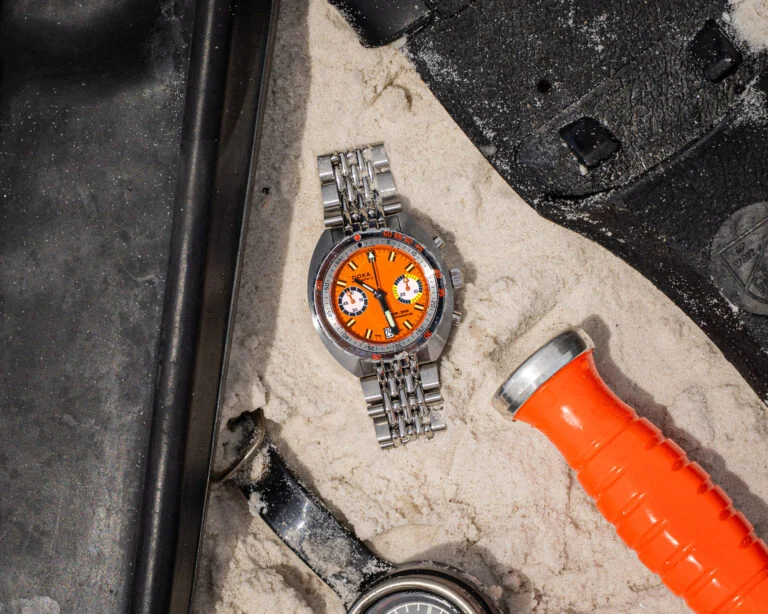
In the contemporary landscape of horology, the "go-anywhere, do-anything" (GADA) watch has emerged as the definitive archetype for the modern collector. These timepieces are marketed as the singular solution for any environment, from the high-stakes boardroom to the leisure of a poolside afternoon. However, the Doxa SUB 200 T-Graph II intentionally eschews this design philosophy. It is a specialized instrument, born of a lineage that prioritizes rugged subaquatic performance over versatile aesthetics. Its recent re-emergence into the standard production catalog marks a significant milestone for Doxa, bridging the gap between historical reverence and modern manufacturing capabilities.

The Historical Genesis of the T-Graph
To understand the significance of the T-Graph II, one must look back to 1969. During this era, the diving industry was undergoing a rapid technological evolution, transitioning from experimental hobbyist equipment to standardized professional gear. Doxa, collaborating with the Synchron Group, sought to provide divers with a "big-bore" chronograph capable of timing decompression stops and bottom times with absolute reliability.

The original production run of the T-Graph was notably limited, with an estimated 300 units manufactured across three iconic colorways: the Professional (orange), the Sharkhunter (black), and the Searambler (silver). These watches utilized movements sourced from Eberhard, a fellow member of the Synchron Group, cementing the T-Graph as a tool-first timepiece. For decades, these original models remained among the most sought-after rarities in vintage diving watch circles, with auction prices reflecting their scarcity and historical importance.

Field Testing: The Florida Expedition
The recent launch of the T-Graph II was underscored by a multi-day field test conducted in Panama City Beach, Florida. This expedition served as a practical evaluation of the watch’s specifications in real-world conditions. Organized in collaboration with The Watch Preserve—a Fort Worth-based horological retailer—the test involved members of the Subaquatic Historical Interest and Preservation Society (SHIPS).

The mission objectives were twofold: to test the watch’s functional viability in maritime environments and to pay homage to the deep-sea history of the Florida Panhandle, specifically the legacy of the SEALAB projects. Participants engaged in wreck diving in the Gulf of Mexico, followed by shore dives at St. Andrews State Park. The latter, specifically the jetty area, provided a controlled environment to simulate the conditions for which the original 1960s U.S. Divers Co. gear was designed.

Technical Specifications and Ergonomic Design
The Doxa SUB 200 T-Graph II maintains a 42mm stainless steel case, which provides a balance between presence and utility. Despite its robust appearance, the watch is engineered with a short 44.5mm lug-to-lug measurement, ensuring that the watch remains accessible for a wide range of wrist sizes, including smaller 6.5-inch wrists.

Key technical attributes include:

- Water Resistance: Rated to 200 meters, meeting the standard professional requirement for recreational and light technical diving.
- Crown and Pushers: The watch features a reliable screw-down crown; however, it is critical to note that the chronograph pushers are not screw-down and are not rated for actuation while submerged. This is a design constraint that differentiates the T-Graph from modern high-pressure tactical chronographs.
- Dimensions: With a thickness of 14.6mm, the watch maintains a substantial profile that is characteristic of mid-century tool watches, yet it is optimized to be worn comfortably under modern diving equipment.
Comparative Analysis of Design Variants
The expedition allowed for a rare side-by-side comparison of the Professional and Sharkhunter variants. The Sharkhunter, in particular, generated significant interest for its aesthetic adherence to vintage references. Doxa’s decision to utilize the "Whiteshark" handset on the Sharkhunter model—instead of the high-visibility orange minute hand found on many contemporary models—demonstrates a commitment to historical accuracy that resonates with purists.

The inclusion of the "beads-of-rice" bracelet is a nod to the original 1969 reference. This bracelet design remains highly regarded in the watch community for its inherent flexibility and comfort, qualities that were essential for divers wearing thick exposure suits that compress at depth.

Critical Assessment: The Modern Bracelet and Clasp System
While the T-Graph II succeeds in aesthetic and structural integrity, the current iteration of the bracelet clasp has drawn technical critique. The modern design utilizes a push-button extension system that, while convenient for minor adjustments, lacks the mechanical robustness of the vintage ratcheting systems.

During the St. Andrews State Park shore dives, observers noted that the clasp’s tolerance for sand and grit was suboptimal, with debris occasionally interfering with the engagement of the expansion mechanism. Compared to the classic, simpler flip-out dive extensions found on the 1967 SUB 300 series, the current T-Graph II clasp represents a trade-off between modern "on-the-fly" adjustment convenience and long-term durability in abrasive environments. For professional-grade diving, a more simplified, mechanical clasp remains the industry preference.

The Role of Strategic Partnerships
The involvement of The Watch Preserve and the participation of the Man in the Sea Museum underscore the importance of context in luxury watch marketing. By aligning the T-Graph II with the 60th anniversary of the SEALAB I mission, Doxa is reinforcing its narrative as a brand deeply embedded in the history of human exploration.

This strategy serves to justify the price point—$4,250 on rubber and $4,290 on the bracelet—by framing the watch not merely as a luxury accessory, but as a living artifact of diving history. The secondary market demand for vintage T-Graphs has historically been driven by institutional and private collections; by making the model a standard production piece, Doxa is effectively democratizing access to a design that was previously unattainable for most enthusiasts.

Market Implications and Future Outlook
The introduction of the T-Graph II signals a broader trend within the Swiss watch industry: the "revival" of high-complexity tool watches. As digital dive computers have largely superseded mechanical watches for critical safety timing, the value proposition of a mechanical diving chronograph has shifted from functional necessity to symbolic heritage.

Financial analysts in the horological sector suggest that Doxa’s move to expand the T-Graph line reflects a healthy demand for legacy-driven products. By maintaining the 200m depth rating and the 42mm geometry, Doxa is catering to a demographic that values mechanical authenticity. However, the brand faces a potential challenge in balancing its "tool watch" identity with the expectations of luxury consumers who may prioritize finish and clasp refinement over raw, utilitarian construction.

Concluding Observations
The Doxa SUB 200 T-Graph II is an unapologetic, specialized instrument. It is not designed to be a "one-and-done" collection piece for the average consumer; rather, it is a purposeful choice for those who value the specific aesthetic and historical narrative of the 1960s diving era.

While the debate regarding the modern clasp system is valid, the watch’s core performance metrics and its faithful recreation of the 1969 design make it a standout in the current market. Whether one chooses the Professional or the Sharkhunter, the T-Graph II functions as a bridge to a bygone era of exploration. It serves as a reminder that the most enduring designs in horology are those that were created with a singular, uncompromising purpose—in this case, the pursuit of reliable timekeeping in the unforgiving environment of the deep ocean. As production continues, the long-term performance of the movement and the wear-resistance of the bracelet components will be the final metrics by which this revival is judged by the professional diving community.