










The international technology group ANDRITZ has announced its comprehensive participation in INDEX26, the world’s leading nonwovens exhibition, scheduled to take place at Palexpo in Geneva, Switzerland, from May 19 to 22, 2026. Occupying a prominent position in Hall 2, Booth 2114, the Graz-based engineering giant will unveil a suite of advanced production technologies designed to address the urgent global demand for sustainability, circularity, and digital efficiency within the nonwovens and textile industries. The presentation will focus on several core pillars, including absorbent hygiene product (AHP) converting, sustainable wipes production through Wetlace™ technology, man-made cellulosic fiber (MMCF) processes, and high-performance mechanical recycling systems.
Global Context: The Nonwovens Industry in 2026
The timing of INDEX26 comes at a critical juncture for the global nonwovens market. As environmental regulations tighten across Europe, North America, and Asia, manufacturers are under increasing pressure to transition away from single-use plastics and toward biodegradable or recyclable alternatives. Market analysts project that the global nonwovens market will continue to grow at a compound annual growth rate (CAGR) of over 5% through 2030, driven largely by the hygiene, medical, and filtration sectors. However, this growth is being redefined by the "Green Deal" initiatives and the push for a circular economy, making ANDRITZ’s focus on sustainable fiber processes and textile recycling particularly timely.
INDEX26 serves as the premier triennial gathering for the industry, attracting over 13,000 visitors from more than 100 countries. For ANDRITZ, the event provides a platform to demonstrate how integrated technology—ranging from raw fiber preparation to finished product converting—can reduce the carbon footprint of industrial manufacturing while maintaining high-speed production efficiency.
Revolutionizing Hygiene Production through Circularity and SAP Management
A primary highlight of the ANDRITZ exhibit will be its redefined approach to the hygiene industry. The group is set to showcase a full spectrum of advanced AHP converting and recycling solutions. This includes high-quality converting lines for adult incontinence products, feminine care, and baby diapers. A significant challenge in the hygiene sector has historically been the management of waste, particularly the complex mixture of superabsorbent polymers (SAP), fluff pulp, and various plastics used in modern diapers.
To address this, ANDRITZ will present its integrated diaper recycling system, a collaborative engineering feat between ANDRITZ Diatec (specialists in hygiene converting) and ANDRITZ Laroche (experts in fiber recycling). This system is designed to take production waste and efficiently separate its components. By reclaiming SAP and fluff pulp, manufacturers can reintroduce these valuable raw materials into the production cycle, significantly reducing landfill contributions and raw material costs.
Furthermore, the next-generation adult care lines from ANDRITZ are engineered for superior SAP management. These lines utilize advanced dosing systems to ensure precise placement of polymers, which not only improves the performance and thinness of the final product but also minimizes waste. The inclusion of operator-friendly interfaces and modular full-servo systems in their ultrasonic lamination technology underscores a commitment to high-precision, low-waste manufacturing.
Sustainable Wipes and the Evolution of Wetlace™ Technology
The wipes market has faced intense scrutiny due to the prevalence of plastic-based materials in flushable and non-flushable products. At INDEX26, ANDRITZ will highlight its Wetlace™ and Wetlace™ CP (Carded-Pulp) technologies, which offer an economically viable path toward 100% plastic-free wipes.
The ANDRITZ neXline wetlace hybrid pro line is a centerpiece of this effort. This technology combines wetlaid and spunlace processes, allowing for the production of wipes using natural fibers such as wood pulp, viscose, and lyocell. By leveraging these renewable resources, manufacturers can produce wipes that are not only biodegradable and compostable but also possess the high strength and absorbency required for industrial and personal care applications.
Addressing the regulatory push for dispersibility, ANDRITZ will also showcase solutions for flushable wipes that meet the stringent "Fine 4" guidelines for dispersibility. These products are designed to break down rapidly in sewer systems, preventing the "fatberg" phenomenon that plagues urban infrastructure. The company’s ability to offer upgrades for existing conventional spunlace lines into wetlace-capable systems provides a cost-effective transition for producers looking to modernize their portfolios.
Strategic Expansion into Lyocell and MMCF Production
As the textile industry seeks alternatives to cotton (which is water-intensive) and polyester (which is petroleum-based), Man-Made Cellulosic Fibers (MMCF) like Lyocell have emerged as a frontrunner. ANDRITZ is positioning itself as a complete solution provider for the Lyocell market, covering the entire scope from specialized engineering to equipment manufacturing.
The Lyocell process is a "closed-loop" system that uses a non-toxic solvent to turn wood pulp into high-quality fiber. ANDRITZ’s contribution includes specialized equipment such as flash dryers and sophisticated pulp preparation systems. Drawing on decades of expertise in the pulp and paper industry, the group is now offering audits and capacity upgrades for existing MMCF plants. This vertical integration allows ANDRITZ to support the textile industry’s shift toward bio-based materials, providing a technological bridge between sustainable forestry and high-fashion or industrial textiles.
Technical Milestones: The X-Pro™ Crosslapper and ProWin™ System
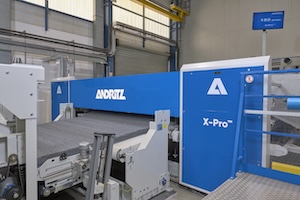
In the realm of mechanical performance, ANDRITZ will introduce the X-Pro™ crosslapper, setting a new benchmark for speed and uniformity in web formation. Crosslapping is a critical stage in needlepunch and spunlace production, where the uniformity of the fiber web determines the quality of the final fabric.
The X-Pro™ is designed to integrate seamlessly with the ProWin™ web weight regulation system. This combination allows for real-time adjustments to fiber distribution, compensating for the "heavy edges" that typically occur during high-speed production. The result is a more uniform fabric with less fiber waste. Notably, ANDRITZ is offering the X-Pro™ not only for new installations but also as a retrofit solution, allowing older factories to achieve modern performance standards without the capital expenditure of a completely new line.

Digitalization and the Metris Platform
A significant portion of the ANDRITZ booth will be dedicated to "Smart Plant" solutions under the Metris brand. As Industry 4.0 becomes the standard, the Metris digitalization platform offers nonwoven producers a comprehensive toolset for optimization.
Key features of the Metris platform include:
- Process Simulation: Utilizing digital twins to predict how changes in raw materials or machine settings will affect the final product.
- AI-Driven Optimization: Using Artificial Intelligence to identify inefficiencies in energy consumption or fiber usage.
- Advanced Control Expert (ACE): Automated systems that maintain production stability beyond the capabilities of manual operation.
- Condition Monitoring: Using smart sensors to predict mechanical failures before they occur, thereby reducing unplanned downtime.
At INDEX26, live demonstrations will show how these digital tools provide transparency across the entire production chain, enabling data-driven decision-making that enhances both profitability and sustainability.
Chronology of Innovation and Event Schedule
The road to INDEX26 for ANDRITZ involves a strategic timeline of engagement with partners and clients.
- May 11 – May 29, 2026: ANDRITZ France will host specialized trials at its Montbonnot Technical Center. Located just two hours from Geneva, this facility allows customers to conduct pilot runs of spunlace, Airlace™, and Wetlace™ processes using their own raw materials. This window provides an opportunity for R&D teams to validate new product concepts in a controlled, industrial-scale environment.
- May 19, 2026: Official opening of INDEX26 at Palexpo, Geneva. ANDRITZ will commence its live presentation series at Booth 2114.
- May 20-21, 2026: Technical seminars and deep-dive sessions at the booth, focusing on AHP recycling and the transition to MMCF fibers.
- May 22, 2026: Conclusion of the event, followed by the publication of industry impact reports and the commencement of project implementation phases based on exhibition breakthroughs.
Analysis of Industry Implications and Official Response
Industry experts view ANDRITZ’s focus at INDEX26 as a direct response to the "circularity gap" in the textile and nonwovens sector. While the industry has historically focused on production speed, the 2026 showcase highlights a shift toward "Life-Cycle Management." This is exemplified by the ANDRITZ Synergy™ service agreements, which move away from traditional maintenance toward a partnership model that ensures long-term asset value and energy efficiency.
While official statements from the Group emphasize technological leadership, the underlying message is one of environmental stewardship. "Our goal is to provide the tools that allow the industry to grow without compromising ecological integrity," noted a representative from the ANDRITZ Nonwoven & Textile team. "By integrating recycling directly into the production line and optimizing fiber use through digital intelligence, we are making the circular economy a practical reality for our customers."
The broader implications for the market are clear: the next generation of nonwoven production will be defined by its ability to handle diverse, sustainable feedstocks while maintaining the high-speed output required for global hygiene and medical demands. As companies like ANDRITZ provide the machinery for this transition, the industry moves closer to a future where "waste" is no longer an output, but a valuable input for the next production cycle.