





The 2026 Metropolitan Museum of Art’s Costume Institute Gala, widely regarded as the most significant night in the global fashion calendar, witnessed a defining moment as Beyoncé Knowles-Carter made a highly anticipated appearance on the red carpet. Returning to the event after a period of relative absence from traditional media circuits, the artist showcased a custom ensemble designed by Olivier Rousteing. The appearance was notable not only for the garment’s intricate technical execution but also for the timing of her arrival, which deviated from the standard schedule observed by the evening’s co-chairs and principal guests.
The 2026 Theme and Design Philosophy
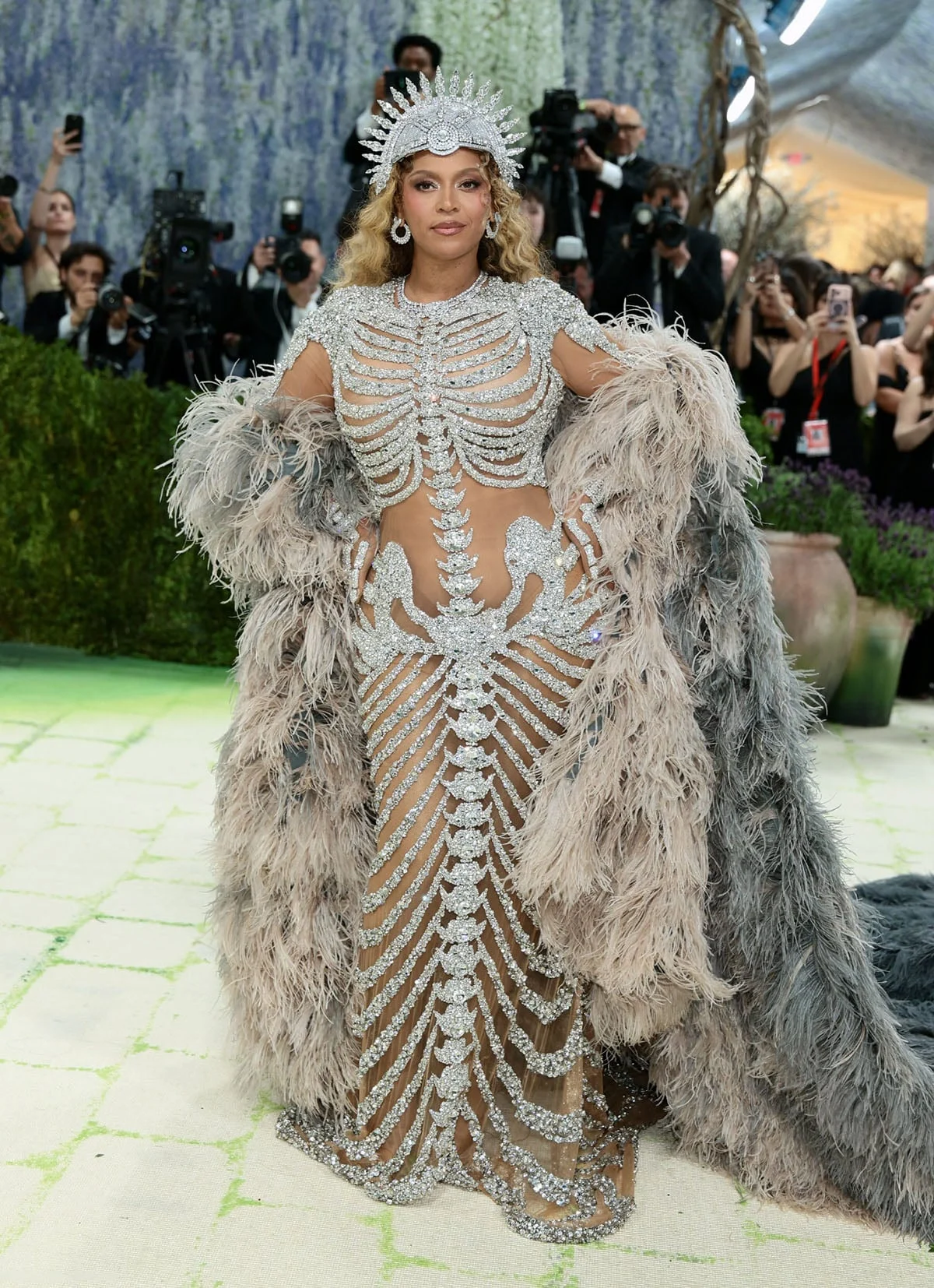
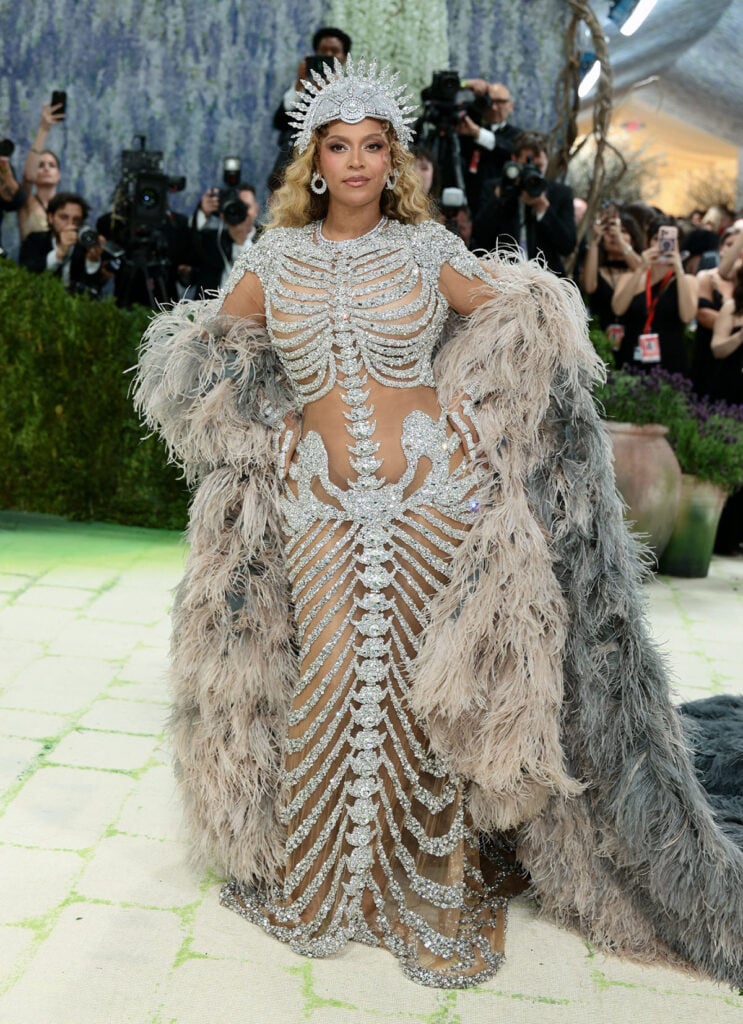
The theme for the 2026 Met Gala, "Costume Art," sought to explore the boundary between wearable garments and sculpture, encouraging designers to treat the human form as a structural canvas. Beyoncé’s choice of attire served as a literal interpretation of this concept. The gown featured a sheer, flesh-toned base that acted as a secondary skin, upon which a complex network of crystal embellishments was meticulously mapped.
The crystal work was engineered to replicate a skeletal structure, tracing the ribs, spine, and phalanges with anatomical precision. This design extended from the neckline down to the fingertips, where the crystals formed shimmering gloves. By highlighting the internal framework of the body on its exterior, Rousteing and Beyoncé presented a dialogue on vulnerability and strength—a recurring motif in the artist’s recent visual narratives. The use of crystals against a translucent fabric created a high-gloss finish that responded dynamically to the flash photography of the press line, ensuring the "skeletal" illusion remained vivid from every angle.
Technical Construction and the Dramatic Train
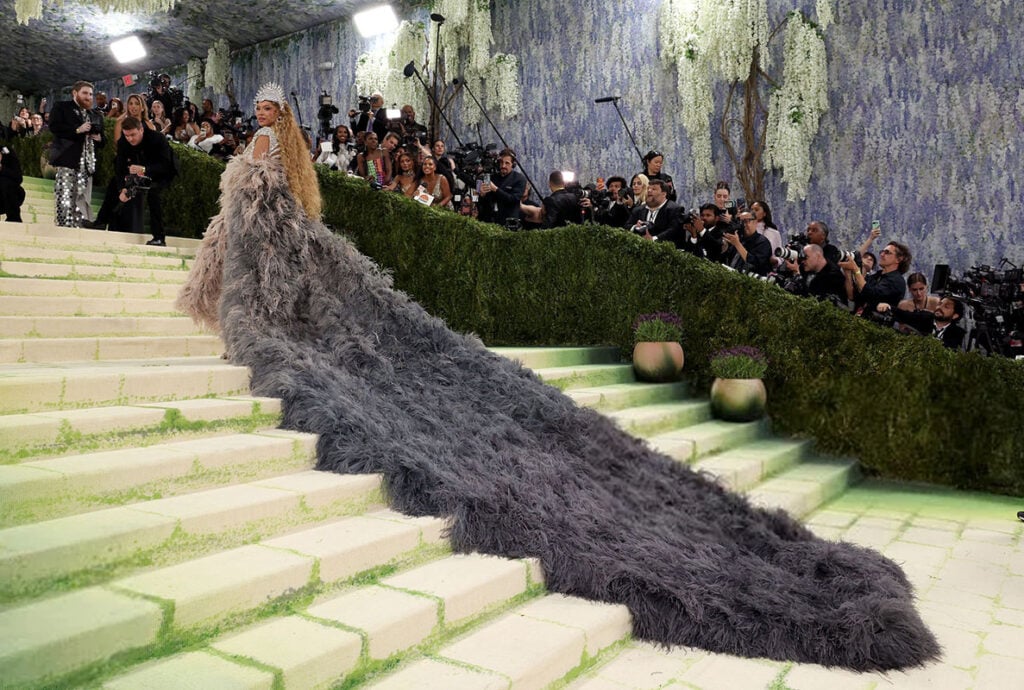
Beyond the anatomical bodice, the ensemble incorporated a sweeping, feathered train that served as the garment’s primary structural anchor. The train, comprised of thousands of hand-applied feathers in varying shades of cream and white, extended several meters behind the artist. This element shifted the silhouette from a focused, intricate study of the human frame to an expansive piece of performance art.
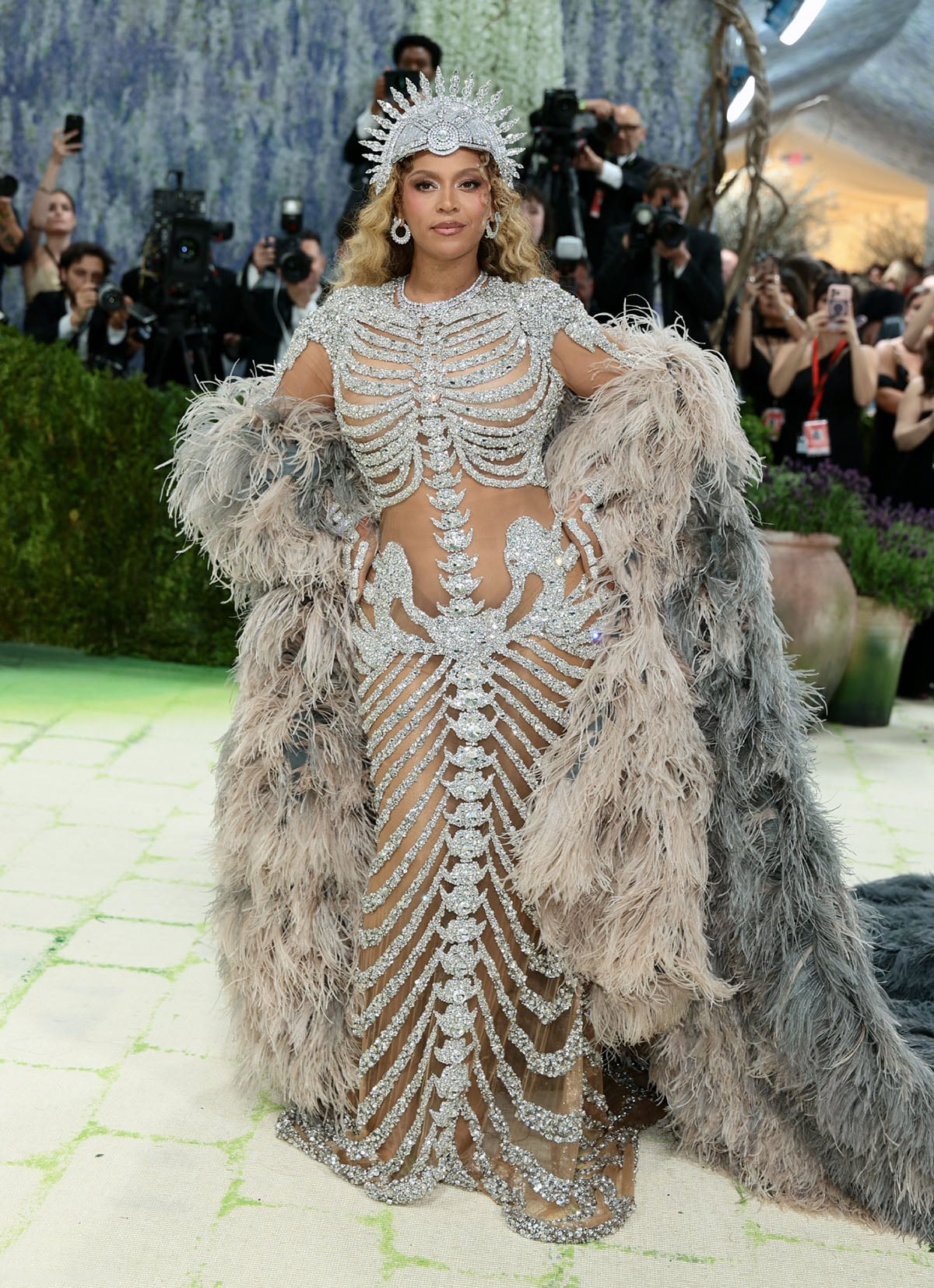
The sheer scale of the train necessitated a carefully choreographed movement across the Metropolitan Museum’s iconic steps. According to logistical reports from the event, the physical requirements of managing such a voluminous attachment contributed to Beyoncé’s delayed arrival. While most high-profile guests arrive within a specific window to allow for a group photograph of the gala’s leadership, the artist’s entrance occurred after the initial rush, allowing her the spatial freedom required to fully display the train’s breadth. This maneuver ensured that the visual impact of the Rousteing creation was not diluted by the presence of other attendees.
Creative Collaboration: Beyoncé and Olivier Rousteing
The 2026 Met Gala look marks another chapter in the long-standing professional relationship between Beyoncé and Olivier Rousteing, the creative director of Balmain. The pair has a history of high-concept collaborations, most notably the "Renaissance Couture" collection, which was co-designed by the two and inspired by the artist’s seventh studio album.
Rousteing’s design language often emphasizes power, intricate embroidery, and architectural silhouettes, making him a logical choice for an event centered on "Costume Art." In a statement regarding the collaboration, the design team noted that the goal was to create a piece that felt both ancient and futuristic—a "relic of the future." The skeletal motif was intended to represent the "eternal core" of the artist, stripped of artifice but adorned in light.
Accessories and Styling by Ty Hunter
To complement the high-detail gown, long-time stylist Ty Hunter selected accessories that reinforced the celestial and regal undertones of the look. Beyoncé wore a crown-like headpiece that featured radial spokes, a design choice that drew immediate comparisons to her iconic 2017 Grammy Awards appearance. The headpiece served to elongate her silhouette and provided a majestic framing for her face, balancing the starkness of the skeletal bodice.
The ensemble was further elevated by high jewelry from Chopard. The selection included diamond-encrusted pieces that integrated seamlessly with the crystal mapping of the dress, ensuring that the transition from fabric to jewelry was nearly imperceptible. The styling reflected a move toward a "maximalist-minimalism," where the color palette remained neutral and monochromatic, but the texture and craftsmanship were pushed to their absolute limits.
Chronology of the Evening and Media Strategy
Beyoncé’s arrival at the 2026 Met Gala was the subject of significant speculation in the hours leading up to the event. In recent years, the artist has largely bypassed traditional red-carpet entries, opting instead to share professionally curated photographs of her outfits directly with her audience via social media platforms like Instagram. This shift has allowed her to maintain total control over her visual narrative, bypassing the unpredictability of live press lines.
However, for the 2026 gala, she opted for a traditional walk-through, signaling the importance of the "Costume Art" theme to her current creative phase.
Timeline of the Appearance:
- 18:30 EST: The official red carpet begins; co-chairs and early guests arrive.
- 19:45 EST: Speculation increases as Beyoncé is not seen during the peak arrival window.
- 20:15 EST: Most guests have entered the museum for the dinner portion of the evening.
- 20:35 EST: Beyoncé arrives at the base of the Met steps, accompanied by her security and styling team.
- 20:45 EST: A ten-minute ascent of the stairs commences, allowing photographers to capture the full extension of the feathered train.
- 21:00 EST: The artist enters the Great Hall, concluding the red-carpet portion of the event.
Comparative Analysis of Met Gala Appearances
To understand the significance of the 2026 look, it is necessary to view it within the context of Beyoncé’s Met Gala history. Her evolution on these steps reflects broader shifts in both her career and the fashion industry’s approach to celebrity dressing.
- 2012 (Schiaparelli and Prada: Impossible Conversations): Beyoncé wore a Givenchy Haute Couture gown with a purple feathered train, establishing her preference for dramatic, high-volume exits.
- 2015 (China: Through the Looking Glass): She wore an ultra-sheer, "naked" Givenchy dress adorned with strategically placed crystals. This look became a viral sensation and set a trend for sheer dressing that lasted nearly a decade.
- 2016 (Manus x Machina: Fashion in an Age of Technology): Wearing a latex Givenchy gown, she embraced a more avant-garde, structural aesthetic.
- 2026 (Costume Art): The Olivier Rousteing gown represents a synthesis of her previous styles—the sheerness of 2015, the drama of 2012, and the technical experimentation of 2016—reimagined through a skeletal, anatomical lens.
While the 2015 look was about the "reveal" of the body, the 2026 look was about the "deconstruction" of the body. This shift from provocative sheerness to artistic anatomy suggests a more mature engagement with the theme of the Costume Institute.
Industry Reaction and Cultural Impact
The reaction from fashion historians and industry critics has been largely focused on the garment’s craftsmanship. While some critics noted that the skeletal motif was a polarizing aesthetic choice—edging toward the macabre—others praised it as a masterclass in custom couture. The precision required to align crystals with the wearer’s actual bone structure requires a level of tailoring that is rarely seen outside of museum-grade commissions.
The economic impact of Beyoncé’s appearance is also significant. According to data from Launchmetrics, high-profile celebrity appearances at the Met Gala can generate tens of millions of dollars in Media Impact Value (MIV) for the associated brands. For Olivier Rousteing and Chopard, the 2026 gala provided a global platform that reinforced their status at the pinnacle of the luxury market.
Furthermore, the appearance solidified the Met Gala’s role as the primary venue for "fashion as art." By choosing to walk the carpet in a dress that required extensive logistical support and space, Beyoncé treated the event as a gallery opening rather than a mere social gathering. This reinforces the museum’s objective of elevating fashion to the status of fine art.
Conclusion
Beyoncé’s 2026 Met Gala appearance serves as a testament to her enduring influence on both the music and fashion industries. Through her collaboration with Olivier Rousteing, she successfully navigated a complex theme, delivering a look that was technically ambitious and visually arresting. Despite her recent move toward digital-first reveals, her decision to return to the Met steps underscores the unique cultural power of the live red-carpet moment. As the "Costume Art" exhibition opens to the public, the skeletal crystal gown will likely be remembered as one of the definitive interpretations of the year’s theme, blending the boundaries between the biological form and high-fashion artifice.