











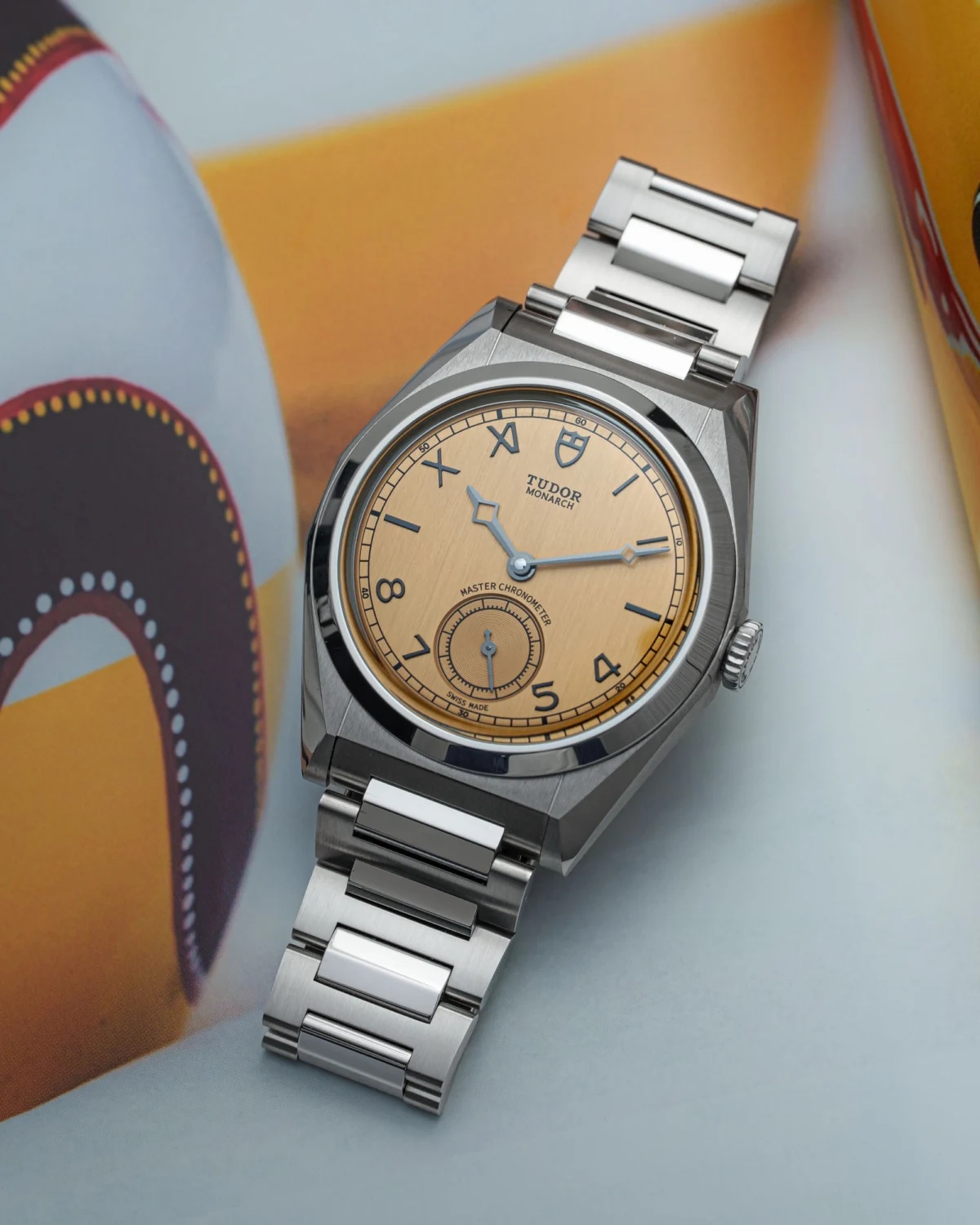
This year marks a significant milestone for Tudor, as the esteemed Swiss watchmaker celebrates its 100th anniversary. While the brand has yet to unveil a singular, grand horological statement befitting such a centenary, its recent releases, particularly at the Watches and Wonders event, have hinted at a thoughtful introspection. In a curious parallel, parent company Rolex also commemorated a century of its iconic Oyster case. Amidst these significant anniversaries, Tudor has introduced the new Tudor Monarch, a completely redesigned iteration of a once-popular collection, signaling a departure from its previous aesthetic while embracing its rich heritage.

The Evolution of the Monarch: From 1990s Mainstay to Modern Icon
The Tudor Monarch holds a special place in the brand’s history, particularly for those familiar with Tudor’s pre-2012 U.S. market absence. During its original tenure, the Monarch was a prominent fixture, characterized by a softer, distinctly 1990s aesthetic, often found in celebrated two-tone configurations. Its disappearance from the catalog coincided with a period where Tudor’s identity was increasingly shaped by its robust dive watches, most notably the Black Bay line, which now accounts for a significant portion of the brand’s offerings.
The relaunch of the Monarch marks a deliberate and striking departure from its predecessor. The contemporary iteration presents an intriguing juxtaposition of a vintage-inspired dial with a decidedly modern case design. This duality is at the core of the new Monarch’s appeal and potential divisiveness.

Case Design: A Bold, Angular Departure
The case of the new Tudor Monarch immediately evokes a sense of contemporary design trends, characterized by sharp, faceted lines. This angular architecture bears a resemblance to other modern watches that have embraced similar geometric aesthetics, creating a distinct visual presence within Tudor’s broader collection. The 39mm diameter is complemented by an 11.9mm thickness, with subtly curved lugs that enhance wearability.
Despite its balanced dimensions, the pronounced facets and sharp edges of the Monarch case are undeniable on the wrist. This design choice eschews the common "wears smaller than it looks" phenomenon, ensuring the watch’s presence is felt. The stainless steel construction is robust, featuring a sapphire crystal, a screw-down crown, and an impressive 100 meters of water resistance, underscoring its versatility beyond its sophisticated appearance.

The accompanying faceted H-link bracelet, maintaining a consistent 20mm width, contributes to the watch’s cohesive design. The integrated endlinks create a seamless transition from case to bracelet, a visual cue often associated with more high-end luxury timepieces. Tudor’s signature T-Fit tool-less microadjustment system, incorporated into the folding clasp, offers practical convenience for wearers seeking the perfect fit. While the sample reviewed exhibited minor tolerances in the endlink fit, it is anticipated that production models will adhere to tighter manufacturing standards.
The Dial: A Vintage Masterclass with a Modern Twist
Arguably the most captivating and potentially contentious element of the new Tudor Monarch is its dial. The "dark champagne" brushed finish is a sophisticated hue, artfully positioned between copper, flesh tones, and a hint of sand. Tudor describes this color as reminiscent of papyrus, a descriptor that aptly captures its warm, aged quality.

This vintage-inspired backdrop is adorned with what are commonly known as "California dials." In this specific configuration, the upper half of the dial features Roman numerals, while the lower half is marked by Arabic numerals. These applied hour markers possess a subtle sheen, catching the light with understated elegance. The hands, in contrast, feature a more matte finish with beveled edges, providing a pleasing textural variation.
A notable aspect of the dial is its complete lack of luminescence. While this might raise concerns for those accustomed to lume-driven legibility in low-light conditions, the Monarch’s design prioritizes its aesthetic over this feature. The choice is deliberate, aligning with a vintage sensibility where luminescent markers were less prevalent or absent altogether.

The handset itself is a standout feature, offering a modern interpretation of classic cathedral hands, reminiscent of the era when Tudor was founded. This design choice harks back to a bygone era of watchmaking, adding a layer of historical depth to the contemporary timepiece. Complementing the main dial elements is a recessed small seconds subdial, executed with an azurage pattern and featuring a hand that echoes the design of the main hour and minute hands. This meticulous attention to detail on the dial elevates the Monarch beyond a mere revival, presenting it as a thoughtfully curated piece of horological art.
Movement and Performance: Master Chronometer Certification
Powering the Tudor Monarch is the in-house Caliber MT5662-2U, a movement that proudly bears the Master Chronometer certification. This dual certification, encompassing both COSC chronometer standards and the rigorous METAS (Swiss Federal Institute of Metrology) standards, attests to the movement’s exceptional accuracy and performance. The watch is guaranteed to perform within a rate of 0 to +5 seconds per day, a testament to Tudor’s commitment to precision engineering.

Operating at a frequency of 28,800 vibrations per hour, the movement offers a substantial power reserve of 65 hours on a full wind. Visible through the sapphire crystal caseback, the movement showcases subtle yet refined finishing, including an 18k gold inlay on the rotor. While Tudor’s focus is not primarily on elaborate decorative techniques for its movements, the MT5662-2U is a testament to the brand’s robust and reliable mechanical engineering, designed for everyday wear and consistent performance.
Context of the Centenary and Future Implications
The introduction of the Tudor Monarch arrives at a pivotal moment for the brand. As Tudor celebrates its 100th anniversary, the Monarch serves as a reflective piece, looking back at its design heritage while boldly stepping into the future. The brand’s decision to revisit and reimagine a past collection, rather than solely focusing on entirely new designs, suggests a strategic approach to honoring its legacy.

The contrast between the vintage-inspired dial and the contemporary case design could be interpreted as a strategic move to appeal to a broader audience. It offers a bridge for enthusiasts who appreciate classic aesthetics but desire the robustness and technical advancements of modern watchmaking. The decision to omit lume, while potentially polarizing, underscores a commitment to historical accuracy and a distinct design philosophy.
The pricing of the Tudor Monarch M2639w1A0U-0001 at $5,875 USD positions it within Tudor’s premium offerings, reflecting the quality of materials, the in-house movement, and the Master Chronometer certification. This price point places it in direct competition with other established luxury brands, further solidifying Tudor’s growing stature in the haute horlogerie landscape.

The Monarch’s reception by collectors and critics will be a significant indicator of Tudor’s strategic direction in its centenary year and beyond. While it may not be the singular, earth-shattering release some might have anticipated for a 100th anniversary, it represents a considered and elegant nod to the brand’s past, infused with the confidence of its present capabilities. The brand’s exploration of its archives, as seen with the Monarch and past releases like the Ranger, suggests a continued commitment to drawing inspiration from its rich history to inform its future creations, ensuring that Tudor remains a relevant and respected name in the watchmaking world for the next century and beyond.