










Vacheron Constantin has deepened its long-standing partnership with the iconic Louvre Museum, a collaboration that began in 2019 with a shared commitment to safeguarding the world’s most treasured antiquities. This esteemed alliance, which extends beyond mere patronage to encompass active support for the museum’s conservation and preservation efforts, has once again culminated in a breathtaking horological series. The Métiers d’Art Tribute to Great Civilisations collection, first unveiled in 2022, has returned with a new quartet of timepieces, each a miniature masterpiece meticulously inspired by the rich artistic heritage of ancient Egypt, Greece, Rome, and the Assyrian Empire. This latest iteration builds upon the success of its predecessor, which drew inspiration from Egypt, Greece, Rome, and Persia, offering a compelling journey through millennia of human ingenuity and artistic expression.
A Legacy of Craftsmanship and Cultural Exchange
The partnership between Vacheron Constantin and the Louvre represents a profound confluence of high watchmaking and world-class art preservation. Since 2019, the Swiss manufacture has provided crucial support to the museum, underscoring a shared belief in the enduring value of cultural heritage. This collaboration is not merely philanthropic; it is a testament to the power of art to transcend time and inspire across disciplines. The Métiers d’Art collection, in particular, serves as a tangible bridge between these two venerable institutions, translating the grandeur of ancient artifacts into the intricate language of haute horlogerie.

The inaugural Métiers d’Art Tribute to Great Civilisations series, launched in 2022, showcased four exceptional watches. These pieces drew their muse from the Louvre’s vast collections, specifically focusing on Egyptian sarcophagi, Greek mosaics, Roman sculptures, and Persian artifacts. The reception was overwhelmingly positive, highlighting the exceptional skill of Vacheron Constantin’s artisans and the enduring appeal of these ancient cultures. This success paved the way for the second chapter, which continues to explore these foundational civilizations, this time broadening the scope to include the powerful Assyrian Empire, a civilization that once commanded vast territories and left an indelible mark on history.
Intricate Artistry Adorning the Wrist
The latest collection is a dazzling display of Vacheron Constantin’s mastery in artisanal crafts, techniques that have been honed and passed down through generations, mirroring the very longevity of the civilizations they honor. Each watch dial is a canvas upon which an astonishing array of decorative arts are brought to life. This includes the meticulous carving of stones, the creation of micro-mosaics composed of minuscule tesserae, the delicate art of cloisonné marquetry, the subtle shimmer of gilded gold leaf, and the nuanced application of three distinct enameling techniques.
The artisans at Vacheron Constantin have, with unparalleled precision, resurrected the decorative crafts that flourished during the zenith of these ancient cultures. A prime example of this dedication can be observed in the friezes that encircle each timepiece. These decorative elements are akin to intricate puzzles, assembled from individually painted sections set within an engraved gold frame. The meticulous placement of precisely cut gemstones and cameos further enhances their visual richness. These elaborate friezes are not merely ornamental; they cleverly conceal four apertures positioned at the corners of each dial, discreetly displaying the hours, minutes, day, and date without disrupting the artistic narrative. This ingenious integration of functionality within an artistic framework is a hallmark of Vacheron Constantin’s approach to its most exclusive creations.

The Calibre 2460 G4: A Foundation for Artistic Expression
To achieve the seemingly seamless integration of the timekeeping functions, Vacheron Constantin has employed its in-house automatic movement, the Calibre 2460 G4. This movement, reserved for the brand’s most artistic endeavors, is a critical component that allows the artistry to take center stage. It features a power reserve of 40 hours and a beat rate of 28,800 vibrations per hour. Crucially, the Calibre 2460 G4 displays the time across four rotating discs, a design choice that liberates the central area of the dial, providing an expansive and unobstructed space for the elaborate artwork. This deliberate omission of traditional hands ensures that the viewer’s attention remains solely on the magnificent dial.
The cases of these exceptional watches are crafted from 42mm of either white or pink 18-karat gold. The rotor, a significant element of the movement visible through an exhibition case back, is cast from 916/1000 gold. It is not merely functional but also a canvas for intricate artistry. Each rotor showcases a highly detailed engraving of the Louvre’s eastern facade, a subtle yet powerful nod to the partnership and the museum’s architectural grandeur. This attention to detail, extending even to the movement’s components, underscores Vacheron Constantin’s commitment to creating timepieces where every element, from the visible to the hidden, contributes to the overall masterpiece.
A Deep Dive into the New Collection’s Inspirations
The process of translating monumental sculptures and ancient artifacts into the constrained space of a watch dial is a formidable challenge. To truly honor both the art and the Louvre’s legacy, Vacheron Constantin has gone to extraordinary lengths, including sourcing materials and stones from origins that echo those of the original artworks. The creative journey began with the collaborative efforts of Louvre and Vacheron Constantin staff, who meticulously created 3D models of the chosen artworks. This allowed for precise determination of the ideal angles and proportions to best capture the play of light and shadow, essential for rendering the three-dimensional forms on a two-dimensional dial. The complexity of the chosen artwork directly influenced the time required for its realization, with each dial demanding between 120 and 220 hours of dedicated craftsmanship.

The Majesty of Ancient Egypt: The Bust of Akhenaten
One of the standout pieces in the new collection pays homage to Ancient Egypt through the iconic Bust of Akhenaten. This powerful representation of Pharaoh Amenhotep IV, who reigned from approximately 1355 to 1337 BCE and later renamed himself Akhenaten in devotion to the sun god Aten, was originally displayed atop a pillar at the temple of Karnak. The Vacheron Constantin interpretation captures Akhenaten’s visage in profile, gazing towards his name inscribed in hieroglyphics. Remarkably, both the bust and the cartouche are carved from sandstone sourced from the same quarries as the original artifact, which was first unearthed in the 19th century.
The surrounding frieze is an intricate composition of tiny carved pieces of red mother-of-pearl, chrysoprase, opaline, and sodalite. This detailed mosaic is inspired by the “Collar of Nakhti,” an ancient Egyptian beaded necklace, further immersing the wearer in the cultural context of the piece. The selection of Akhenaten reflects a period of significant religious and artistic upheaval in ancient Egypt, a testament to the dynamic nature of this ancient civilization.
The Power of the Assyrian Empire: The Lamassu of Khorsabad
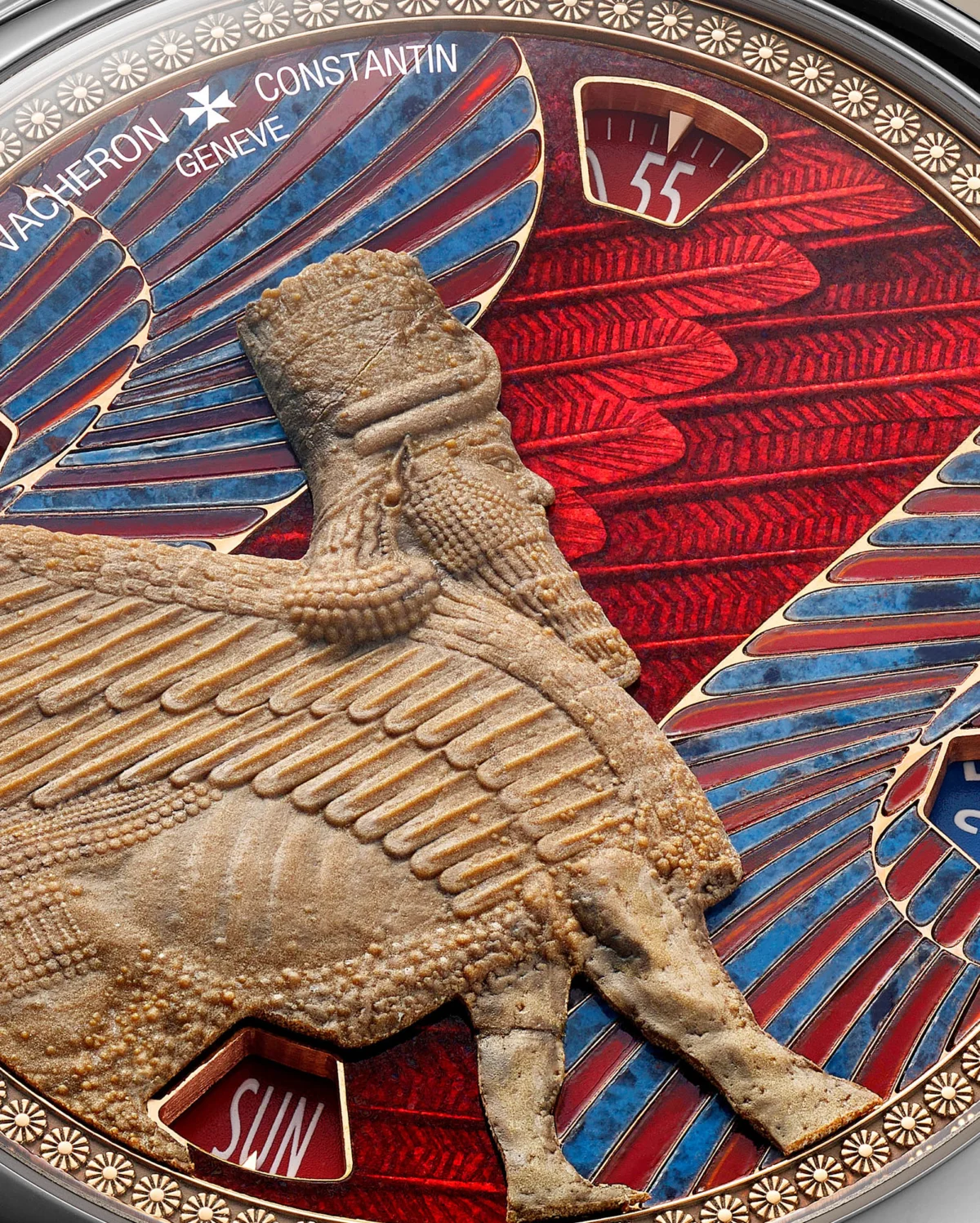
The Neo-Assyrian Empire, at its zenith, was a formidable force, its dominion stretching from Egypt in the west to modern-day Turkey in the north and Iran in the east. A potent symbol of its immense power was the Lamassu, colossal winged bulls with human faces, standing at five meters tall, which guarded the grand palace of Khorsabad. These mythical creatures, believed to be protective deities, now stand sentinel within the Louvre’s Palace of Sargon II.

Vacheron Constantin’s tribute to this powerful empire features the Lamassu rendered in Italian limestone. It is set against a vibrant backdrop of red agate and light dumortierite stones, creating a striking visual contrast. The intricate feather pattern that divides the dial is not applied but meticulously engraved directly onto the 18-karat gold baseplate. This is then layered with translucent red enamel, adding depth and a sense of regal splendor. The choice of the Lamassu highlights the Assyrian Empire’s sophisticated artistry and its complex belief system, where monumental sculpture served both aesthetic and symbolic purposes.
The Golden Age of Athens: The Velletri Pallas
Ancient Greece, a cradle of Western civilization, is represented in this collection by the Velletri Pallas. This celebrated marble statue depicts the goddess Athena with her right arm extended, her left hand offered as a gesture of wisdom to her followers. Discovered in Italy in 1797, the statue is a Roman copy of a lost Greek bronze, believed to have been sculpted around 430 BCE. Vacheron Constantin’s choice of this particular artwork signifies the Golden Age of Athens, an era that laid the philosophical and intellectual foundations of Western thought, and the time of luminaries such as Socrates, Pericles, and Euripides.
The representation of Athena on the watch dial is carved from hand-patinated marble sourced from the Greek island of Paros, renowned for its exquisite marble. She is presented against a backdrop of horses, intricately formed from onyx and mookaite, adding a dynamic element to the composition. The artistry involved in capturing the subtle contours of the marble and the flowing lines of the horses speaks volumes about the watchmakers’ dedication to historical accuracy and aesthetic fidelity.

The Grandeur of Imperial Rome: The Statue of the Tiber
The enduring legacy of Imperial Rome is embodied in the Statue of the Tiber, a significant representation of the life-giving river that was central to the city’s founding and prosperity. The sculpture depicts the Tiber as a bearded river god, holding an oar in his left hand and a cornucopia in his right. Below him, the legendary twins Romulus and Remus are shown suckling from the she-wolf, a scene that encapsulates the myth of Rome’s origin.
In Vacheron Constantin’s horological interpretation, the Tiber gazes upward, drawing attention to a mosaic of his cornucopia, meticulously crafted from fragments of jasper, chrysocolla, and opaline. The river god himself is sculpted with remarkable detail in Italian marble, capturing the gravitas and power attributed to him in Roman mythology. A sophisticated ring of mother-of-pearl half-moons encircles the dial, adding a celestial touch that complements the earthly significance of the river god and the founding myth. This representation underscores the Roman Empire’s deep connection to its geography and its rich tapestry of foundational legends.
Limited Production and Enduring Significance
Echoing the exclusivity of the 2022 series, which saw only five examples of each watch produced, the new Métiers d’Art Tribute to Great Civilisations collection will be limited to just fifteen examples of each of the four new timepieces. This extremely limited production run ensures that these watches remain highly sought-after collector’s items, embodying the pinnacle of artisanal watchmaking and artistic commemoration. The pricing for these exquisite timepieces has not yet been announced, but given their complexity, rarity, and the caliber of the brands involved, they are expected to command significant value in the luxury watch market.

This collection is more than just a display of horological prowess; it is a narrative unfolding on the wrist, a tangible link to the ancient world that continues to shape our present. Each watch encapsulates thousands of years of history, conveying tales of turmoil, conquest, and the enduring wills of emperors and pharaohs. Vacheron Constantin’s continued collaboration with the Louvre not only supports the preservation of invaluable artifacts but also breathes new life into these ancient stories, ensuring their resonance for generations to come. The Métiers d’Art Tribute to Great Civilisations stands as a testament to the enduring power of art and craftsmanship to connect us to our shared human heritage.