








The global cycling apparel market witnessed a significant technological leap on April 14, 2026, as Santini Cycling and Polartec, a premium brand under the Milliken & Company umbrella, announced the official launch of the AERO RACE jersey. Representing a sophisticated fusion of aerodynamic engineering and sustainable material science, the jersey is the first commercial application of a new textile category: polyester derived from captured industrial carbon emissions. This partnership, centered in Spartanburg, South Carolina, positions Santini as the exclusive brand in the European and North American markets to adopt this specific iteration of Polartec Power Dry with Recycled Carbon technology for the 2026 season.
The introduction of the AERO RACE jersey marks a departure from traditional recycled textiles, which typically rely on post-consumer plastic bottles (rPET). Instead, this garment utilizes carbon capture technology to intercept industrial CO2 emissions before they enter the atmosphere, converting them into high-performance polyester yarns. This "biochemical" approach to textile production suggests a new frontier for the industry, where the manufacturing of technical gear actively contributes to the reduction of greenhouse gases.
The Evolution of Carbon Capture in Technical Apparel
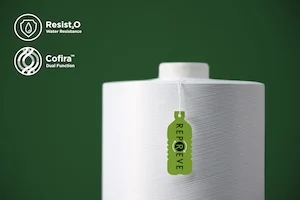
The core of the AERO RACE jersey is the Polartec Power Dry with Recycled Carbon fabric. This material is the result of years of research and development aimed at decoupling textile production from virgin petroleum sources and even moving beyond the limitations of mechanical recycling. The process involves capturing carbon-rich gases emitted by industrial facilities—such as steel mills or chemical plants—and using specialized microorganisms to ferment these gases into ethanol, which is then processed into the building blocks of polyester.
The resulting fabric is engineered at a weight of 128 g/m², optimized for the high-output demands of professional and competitive cycling. Crucially, the yarns utilized in this jersey consist of 91% recycled carbon content by weight. This high concentration of captured carbon material demonstrates a significant advancement in the scalability of carbon-to-textile manufacturing. By utilizing this technology, Santini and Polartec have successfully reduced the carbon footprint of the AERO RACE jersey by up to 66% when compared to equivalent garments manufactured from virgin polyester. This calculation accounts for the carbon-intensive nature of traditional polymer extraction versus the carbon-negative potential of emission sequestration.
Aerodynamic Precision and Wind Tunnel Validation
While the sustainability credentials of the AERO RACE jersey are a primary focus, the garment was developed with a dual mandate: environmental responsibility and elite-level speed. To achieve the latter, the design underwent extensive testing and refinement within controlled wind tunnel environments. The objective was to minimize the aerodynamic drag that accounts for the majority of a cyclist’s resistance at speeds exceeding 30 km/h.
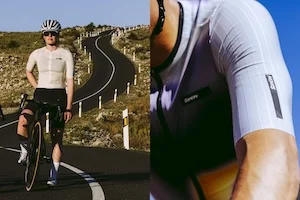
The jersey features a "second-skin" fit, achieved through the strategic placement of rear panels that contour to the rider’s anatomy in an aggressive, tucked position. However, the most notable aerodynamic feature is found in the construction of the sleeves. Utilizing a specialized striped structure, the sleeves are designed to facilitate "Vortex Generation."
In fluid dynamics, a vortex generator is a surface that creates a small, controlled turbulence in the boundary layer of air moving over an object. By inducing this turbulence, the air "sticks" to the surface of the rider’s arms longer, delaying flow separation and reducing the size of the low-pressure wake behind the cyclist. This reduction in wake size translates directly into lower aerodynamic drag, providing a measurable performance advantage during time trials and high-speed breakaways.
Technical Specifications and Rider Comfort
Beyond its aerodynamic and environmental profile, the AERO RACE jersey is designed to address the physiological needs of the athlete. The Polartec Power Dry construction is inherently bi-component, meaning it uses different yarns on either side of the fabric. This creates two different surfaces: one that is optimized to move moisture away from the skin and another that dries quickly on the exterior.
The 128 g/m² weight provides a lightweight feel that is essential for thermal regulation during intense climbs or in high-temperature racing conditions. The jersey’s functional details include:
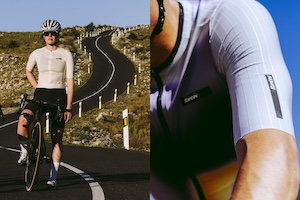
- Integrated Stability: A full elastic hem equipped with a silicone internal grip ensures the jersey remains in place, preventing "bunching" which can compromise both comfort and aerodynamics.
- Raw-Cut Sleeves: To eliminate the pressure points and drag associated with traditional stitched hems, the sleeves feature a raw-cut finish, further smoothing the transition between the fabric and the skin.
- Storage and Utility: Three reinforced rear pockets provide ample space for nutrition, tools, and extra layers, designed to remain flat against the back when empty to maintain the garment’s aero profile.
A Strategic Partnership: Santini and Polartec
The collaboration between Santini Cycling and Polartec is rooted in a long-term shared vision for the future of the apparel industry. Santini, an Italian brand with a heritage dating back to 1965, has long been a fixture in the professional peloton, serving as the official outfitter for the UCI World Championships and the Tour de France. Polartec, as the inventor of the original synthetic fleece, has spent decades at the forefront of fabric innovation.
Ramesh Kesh, Senior Vice President of Polartec and Apparel Innovation, emphasized that the AERO RACE jersey is a proof of concept for the broader industry. "For decades, Polartec has demonstrated that innovation and responsibility are shared objectives," Kesh stated. "Our ability to transform captured carbon into performance-driven fabrics shows how we can reimagine materials to reduce impact while empowering athletes to perform without distraction."
Karen Beattie, Director of Product Management at Polartec, noted that the project required a re-engineering of the traditional textile supply chain. "The Santini AERO RACE jersey represents what’s possible when advanced material science meets real-world performance demands," Beattie said. "Polartec Power Dry with Recycled Carbon has enabled us to engineer a process that turns captured carbon into a cutting-edge fabric that performs at the highest level to support both the athletes and the planet."
From the perspective of Santini’s creative direction, the challenge was ensuring that the new material did not sacrifice the tactile and elastic qualities required for high-end cycling wear. Fergus Niland, Creative Director at Santini, highlighted the rigorous testing phase of the project. "Working with Polartec, we have been able to push boundaries and create a high-performance, recycled carbon material that actually works on the bike," Niland explained. "It has been tested by professionals, built for cyclists, and designed to deliver on performance, comfort, and a new standard of responsibility."
Chronology of the 2026 Launch
The timeline leading to the April 14 announcement reflects a multi-year development cycle common in high-tech textile manufacturing:
- 2023-2024: Initial laboratory testing of carbon-captured polyester fibers and the development of the Polartec Power Dry knit structure using these specialized yarns.
- 2025: Prototyping of the AERO RACE jersey and initial wind tunnel sessions in Milan to optimize panel placement and sleeve texture.
- Early 2026: Field testing by professional continental teams under various weather conditions to ensure durability and moisture management.
- April 14, 2026: Official global announcement and commercial release.
Market Implications and the Future of Circularity
The launch of the AERO RACE jersey arrives at a time when the cycling industry is under increasing pressure to address its environmental impact. While cycling is a low-carbon form of transport, the production of carbon fiber frames and synthetic apparel has historically carried a significant ecological cost.
By achieving a 66% reduction in the carbon footprint of its flagship jersey, Santini is setting a benchmark for other premium manufacturers. The exclusivity of the Polartec Power Dry with Recycled Carbon technology for 2026 gives Santini a distinct competitive advantage in the "eco-performance" segment, a rapidly growing niche among affluent, environmentally conscious enthusiasts.
Furthermore, this launch signals a shift in the "circular economy" narrative. While recycling existing plastic is necessary, it is a defensive strategy. Carbon capture and utilization (CCU) is an offensive strategy, actively removing pollutants from the industrial cycle. As this technology matures and costs decrease, it is expected that carbon-captured textiles will expand into other categories, including base layers, thermal jackets, and perhaps eventually, footwear.
The AERO RACE jersey is available in three colorways and features a unisex fit, designed to accommodate a wide range of body types from competitive athletes to performance-focused enthusiasts. As the first commercial application of captured carbon fabric in the cycling world, it stands as a testament to the possibility of a "net-zero" future for professional sports apparel.