









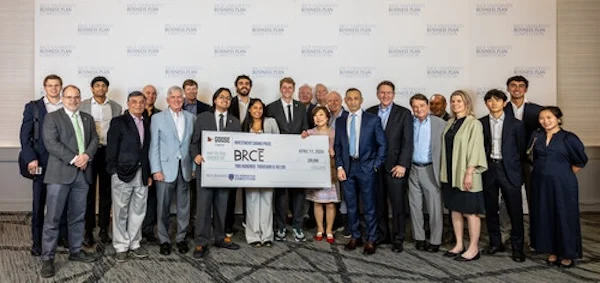
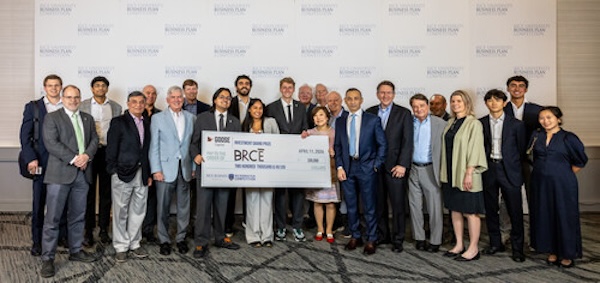
The 26th annual Rice Business Plan Competition (RBPC) concluded with a decisive victory for BRCÆ, a Michigan State University-based material-tech startup that is redefining the capabilities of industrial and performance textiles. Held from April 9 to April 11, 2026, at Rice University and within Houston’s burgeoning Ion District, the competition saw BRCÆ secure 11 distinct awards totaling $611,500 in investment and cash prizes. The startup’s success underscores a growing industrial shift toward advanced polymer composites engineered to survive extreme conditions where traditional textiles historically fail.
BRCÆ’s core innovation lies in its patented Lattice-Grip technology, a material science breakthrough that allows for directional grip and controlled tension at the individual yarn level. Unlike conventional woven materials that are prone to slippage, stretching, and performance degradation under stress, BRCÆ’s polymer composites are engineered for intrinsic stability and high-level fire resistance. By integrating these mechanical properties directly into the architecture of the material, the company offers a solution for sectors ranging from aerospace and defense to high-performance industrial safety equipment.
A Strategic Journey to the Super Bowl of Student Entrepreneurship
The path to the 2026 RBPC was a calculated multi-year effort for the BRCÆ leadership team. Co-founder and CEO Madhav Aggarwal noted that the inspiration for their participation was rooted in the success of a fellow Michigan State University alum who won the competition in 2024. That victory served as a catalyst, prompting the BRCÆ team to enter a series of smaller, regional pitch competitions to refine their business model, validate their technical claims, and sharpen their presentation skills.
This preparatory phase was essential for navigating the RBPC, which is widely regarded as the world’s largest and richest intercollegiate graduate student startup competition. Aggarwal referred to the event as the "Super Bowl of Student Entrepreneurship," a sentiment echoed by the high stakes of the three-day gauntlet. For BRCÆ, the competition followed a recent appearance on the television program "Shark Tank," which had already begun to draw national attention to their Lattice-Grip technology.
The 2026 iteration of the RBPC was particularly competitive, featuring 42 startups selected from a global pool of applicants. These ventures represented 39 universities across four countries, showcasing innovations in energy, cleantech, sustainability, life sciences, healthcare, hard tech, digital enterprise, and consumer products.
Chronology of the 2026 Competition
The three-day event was structured to rigorously vet both the technical viability and the commercial potential of the participating startups.
April 9: The Preliminary Rounds and Elevator Pitches
The competition opened with a high-intensity elevator pitch segment, where founders had 60 seconds to convey their value proposition to a room of hundreds of investors. This was followed by practice rounds where teams received initial feedback from mentors and industry experts. For BRCÆ, this stage was critical in articulating how a textile-based startup could offer the scalability and "moat" typically associated with software or biotech firms.
April 10: Semifinals and the Wildcard Round
The second day shifted to formal 15-minute presentations followed by intensive Q&A sessions. Judges, comprising more than 300 angel investors, venture capitalists, and corporate leaders, scrutinized the startups’ intellectual property portfolios, go-to-market strategies, and financial projections. BRCÆ’s ability to demonstrate "nondilutive momentum"—securing capital without immediately surrendering equity—set them apart during these rounds.
April 11: The Finals and Awards Gala
The final day saw the top seven finalists present on the main stage at Rice University. The judges’ scoring was based on the likelihood that they would personally invest in the company. BRCÆ’s presentation emphasized not just the material science, but the massive total addressable market (TAM) in industrial sectors looking to replace heavy, failure-prone metal or traditional fabric components with lightweight, fire-resistant composites.
Technical Breakdown: The Lattice-Grip Advantage
To understand BRCÆ’s dominance at the 2026 RBPC, one must look at the specific technical failures they aim to solve. Traditional industrial textiles, such as those used in heavy-duty lifting, safety harnesses, and aerospace insulation, often suffer from "creep"—the tendency of a solid material to move slowly or deform permanently under the influence of persistent mechanical stresses.
BRCÆ’s Lattice-Grip technology addresses this through a proprietary geometric interlocking system at the yarn level. By controlling the tension and friction directionally, the material can "lock" in place when under load, preventing the slippage that leads to heat generation and eventual fiber breakage. Furthermore, the polymer composite used is inherently flame-retardant, a significant upgrade over traditional coatings that can wear off or off-gas toxic fumes during a fire event.
This "hard tech" approach appealed to the RBPC judges, who have increasingly favored startups with physical, patent-protected innovations that offer tangible solutions to industrial problems.
Institutional Leadership and the Houston Ecosystem
The 2026 competition was also a milestone for the Rice Alliance for Technology and Entrepreneurship, the host organization. This year marked the final competition under the leadership of Brad Burke, Associate Vice President of Rice Innovation and Executive Director of the Rice Alliance. Burke, who has spent nearly 25 years building the RBPC into a global powerhouse, reflected on the event’s evolution.
"The Rice Business Plan Competition has grown into far more than a competition—it’s a proving ground for founders and a catalyst for real company formation," Burke stated. He emphasized that the event also serves as a pillar for the Houston entrepreneurial ecosystem, particularly with its expansion into the Ion District, a 16-acre innovation hub designed to transition Houston’s economy from a traditional energy focus to a broader tech-driven future.
Catherine Santamaria, Director of the RBPC, highlighted the depth of engagement from the judging panel. "What makes RBPC truly special is the depth of engagement from our judges and partners, who provide meaningful feedback and connections that help founders move their companies forward," she said. The involvement of over 300 investment professionals ensures that even teams that do not win the grand prize often leave with term sheets or strategic partnerships.
Financial Impact and Future Implications
The total prize pool for the 2026 RBPC exceeded $1.3 million in investment and nondilutive cash, supplemented by $110,000 in in-kind value. BRCÆ’s haul of $611,500 represents nearly half of the available liquid capital, providing the startup with significant runway to move from prototype to mass production.
In addition to the cash prizes, BRCÆ and other finalists received the Baker Botts Prize, which provides $75,000 in collective in-kind legal services. This is a critical asset for a material-tech company that must navigate complex international patent laws and manufacturing contracts. The grand prize also included a chief financial officer (CFO) consulting prize worth $40,000, designed to help the student founders transition into professional corporate executives.
The success of BRCÆ at Rice University signals a broader trend in the venture capital landscape. Investors are increasingly looking for "deep tech" or "hard tech" solutions that offer sustainable competitive advantages through material science. As industries globally face stricter safety and environmental regulations, the demand for fire-resistant, high-strength, and lightweight materials like those produced by BRCÆ is expected to surge.
For Michigan State University, BRCÆ’s win reinforces its position as a top-tier institution for engineering and entrepreneurship. For Houston, the continued success and growth of the RBPC demonstrate the city’s ability to attract international talent and serve as a launchpad for the next generation of industrial giants.
As BRCÆ moves forward, the $611,500 in funding will likely be directed toward scaling their manufacturing processes and pursuing certifications required for aerospace and military applications. The 2026 Rice Business Plan Competition has not only provided the capital necessary for this growth but has also validated a new frontier in textile engineering that promises to make extreme industrial environments safer and more efficient.