










The world of watchmaking often draws inspiration from iconic symbols of engineering and design. Among these, the automotive sector holds a particularly strong allure, with many brands seeking to translate the thrill of the open road and the precision of high-performance machines into wristwear. This pursuit, however, presents a delicate balancing act. On one hand, there is the transformative approach, where the spirit and design philosophy of an automobile are subtly woven into a watch’s aesthetic. On the other, there is the more literal interpretation, which directly incorporates a recognizable automotive element. The latter, while potentially impactful, is fraught with peril, often resulting in designs that feel either juvenile or awkwardly integrated. It is within this challenging landscape that the young British brand Stewart Dawson has embarked on a bold endeavor: to capture the essence of the iconic VDO tachometer, a cherished component of early Porsche 911 models, and reimagine it as a functional timepiece. The result, the Stewart Dawson SD 911, is a remarkably refined and balanced creation, demonstrating a keen understanding of both automotive reverence and horological artistry. For the discerning Porsche enthusiast, a group known for their meticulous attention to detail and deep-seated passion, the SD 911 offers an impressive array of authentic details, seamless integration, and tangible quality, making it a compelling companion piece to a classic 911.
The Genesis of a Vision: Reimagining the Porsche Tachometer
The allure of the Porsche 911 is deeply rooted in its enduring design and its visceral driving experience. Since its debut in 1963, the 911 has evolved, yet its core identity has remained remarkably consistent, a testament to Ferdinand Porsche’s original vision. A key element contributing to the dashboard’s iconic character is the VDO tachometer, a prominent circular instrument that served as the driver’s direct connection to the engine’s performance. This instrument, particularly in the late 1960s and early 1970s iterations found in models like the 911S, possessed a distinct aesthetic – functional, legible, and imbued with a sense of raw mechanical power.

Stewart Dawson’s decision to translate this specific automotive artifact into a watch is not merely an aesthetic choice; it is an homage to a particular era of automotive engineering and design. The challenge lay in extracting the essence of the VDO tachometer – its layout, its markings, and its functional purpose – and seamlessly integrating it into a watch case and dial that would be both aesthetically pleasing and practical for everyday wear. This required a deep dive into the original design, understanding not just its visual components but also the context in which it operated. The VDO tachometer in the 1969 911S, for instance, was engineered to provide critical information at a glance during spirited driving, with a redline set at a demanding 7,100 RPM. This context is crucial for appreciating the fidelity of Stewart Dawson’s interpretation.
Case Design: A Blend of Pilot Watch Influence and Unique Automotive Cues
The initial impression of the Stewart Dawson SD 911’s 316L stainless steel case might evoke comparisons to the utilitarian robustness of pilot watches. Measuring a substantial 42.5mm in width and 12mm in thickness, its proportions, straightforward vertical case sides, and an "all-dial" aesthetic certainly carry echoes of aviation instruments designed for clarity and legibility. However, a closer examination reveals a series of distinctive stylistic choices that firmly establish the SD 911 as a unique entity, transcending mere mimicry.
The lugs, for example, are a standout feature. Stewart Dawson has employed an attached lug design that artfully blends the classic tapering of a sports watch with influences drawn from a much earlier design era, predating the Porsche 911 itself. This is evident in their pronounced downward curve and a clear, intentional break at the point where they attach to the case. The finishing on these lugs is particularly noteworthy, showcasing an implied, subtly rounded chamfer where they meet the case side. This detail, in conjunction with the more traditional upper lug chamfer, creates a dynamic interplay of light and shadow, lending an elegant and refined appearance to the watch on the wrist.

Complementing the lugs is a rounded, narrow bezel, which further enhances the perception of refinement and quality. This polished ring frames the dial like a meticulously crafted gauge cluster, drawing the eye to the timekeeping elements within. A unique flourish is added to the vertically brushed 9 o’clock case side: a matte-etched tiger head motif. While the precise connection of this motif to either the Porsche inspiration or the broader Stewart Dawson brand identity remains somewhat enigmatic, it undoubtedly serves as an intriguing and attention-grabbing detail, sparking curiosity and conversation. Turning the watch over, the SD 911 features a solid, coin-edged caseback, a practical touch that contributes to its robust build. Furthermore, the watch boasts a capable water resistance rating of 100 meters, making it suitable for a variety of daily activities.
The Dial: A Masterclass in Automotive Transposition
The true heart of the Stewart Dawson SD 911 lies in its dial, a remarkable reinterpretation of the VDO tachometer that adorned the dashboards of late 1960s and early 1970s Porsche 911S models. While not a slavish, one-to-one replica, the dial achieves an impressive level of fidelity, successfully translating the automotive instrument’s character to the wrist.
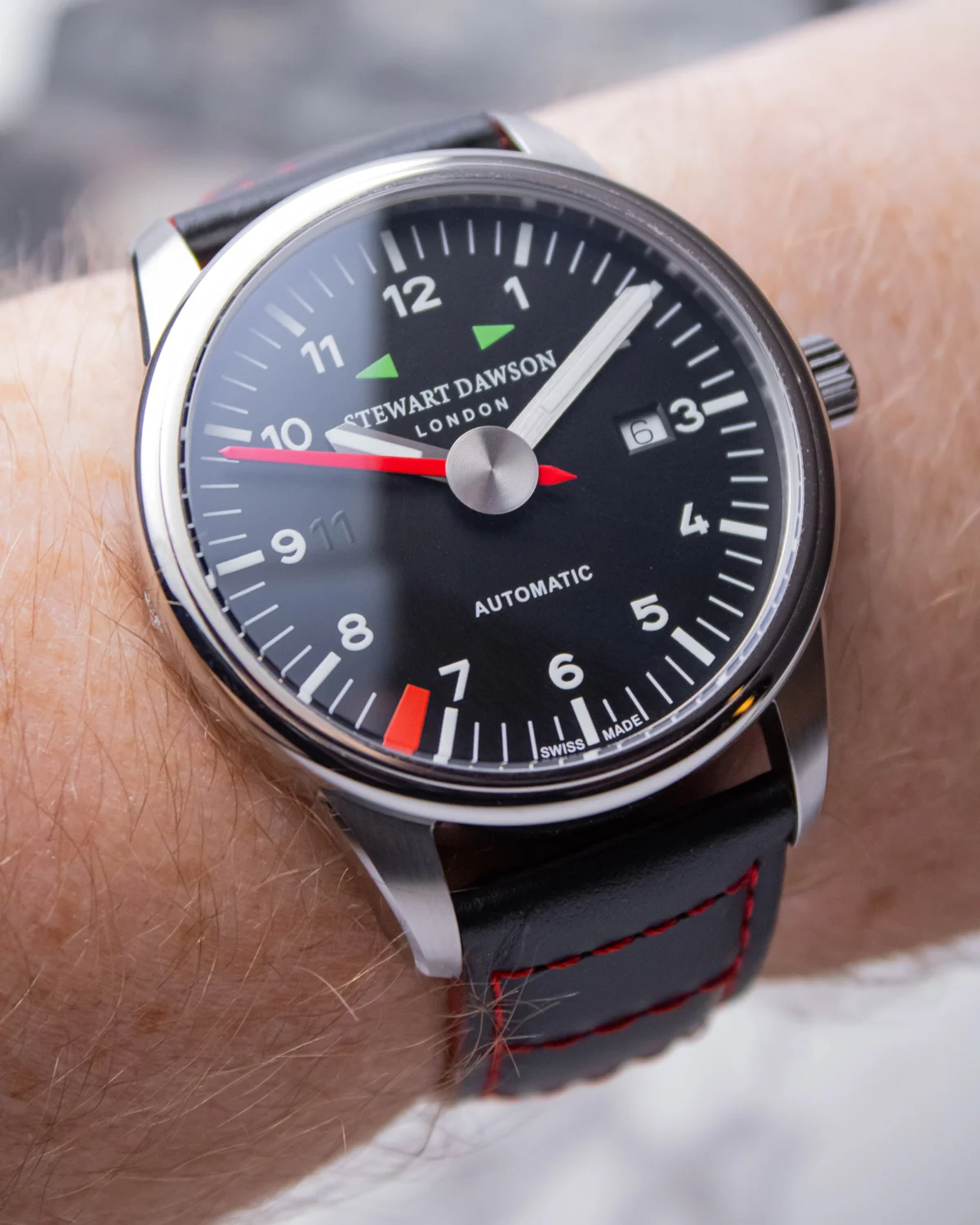
The overall layout prioritizes legibility, a direct inheritance from its dashboard counterpart. The chunky printed minute track, the clean and unadorned Arabic numerals, and the vibrant red needle-style seconds hand are all lifted with remarkable accuracy from the original tachometer. These elements not only serve their intended purpose of indicating elapsed seconds but also function as a clear and effective means of telling time.

However, the SD 911 is far from a sterile reproduction. Stewart Dawson has thoughtfully incorporated several unique Porsche idiosyncrasies that are sure to delight brand aficionados. A prominent example is the "redline" marker. Positioned at the 36-second mark on the dial, this feature deviates from the standard white markings, presenting an oversized, bright red hash mark. This is a direct nod to the 7,100 RPM redline of the 1969 911S, a subtle yet significant detail for those familiar with the car’s performance characteristics.
Another direct link to the original gauge design is the substantial, snailed cap atop the seconds hand. This design element brings the seconds hand into visual harmony with the tachometer needle, reinforcing the automotive theme. More esoteric, yet equally charming, are the two green triangles positioned at the 11 o’clock and 1 o’clock markers. These are interpretations of the 911’s first-generation turn signal indicators, which were originally integrated into the tachometer gauge. This inclusion speaks to the depth of research and attention to detail that Stewart Dawson has invested in this project.
Perhaps the most subtle, yet arguably most ingenious, detail is the number "11" rendered in glossy black next to the 9 o’clock numeral. This represents a stealthy tribute to the Porsche 911 itself, its visibility dependent on the viewing angle, making it a delightful easter egg for those in the know. These carefully integrated elements transform what could have been a stark, utilitarian gauge design into a surprisingly colorful and playful affair. The concessions made to the practicalities of watchmaking are, for the most part, masterfully executed. The broad, brushed pencil hands, generously applied with luminous material, integrate seamlessly into the overall design language. While a no-date execution of this design might have further enhanced its visual purity, the current configuration remains a compelling testament to the brand’s design philosophy.

Mechanical Heart: The Reliable Sellita SW200 Movement
Powering the Stewart Dawson SD 911 is the venerable Sellita SW200 automatic movement. This Swiss-made caliber is a popular choice among independent watch brands, recognized for its dependable construction and solid performance, even if its technological underpinnings are somewhat traditional. The SW200 boasts a 41-hour power reserve and operates at a beat rate of 28,800 vibrations per hour. While it may not represent the absolute cutting edge of horological innovation, its reliability and, crucially, its ease of servicing, make it an eminently practical choice. This ensures that owners of the SD 911 can expect a hassle-free ownership experience, with readily available parts and expertise for maintenance. The widespread adoption of the SW200 across the industry also provides a degree of assurance regarding its long-term viability and robustness.
The Finishing Touch: A Racing-Inspired Strap
To complete the automotive-inspired aesthetic, Stewart Dawson has equipped the SD 911 with a striking black leather strap. This strap features prominent accent stitching, imbuing it with a racy, performance-oriented character. The brand further amplifies this theme with sporty red edge painting and matching hand-stitched red accents. This combination creates a bold statement on the wrist, one that would undoubtedly feel at home in a vintage racing paddock. Beyond its visual appeal, the quality of the leather is exceptional, offering a rich, supple feel that translates into an extremely comfortable wearing experience. The tactile sensation of the strap, combined with its visual dynamism, perfectly complements the watch’s overall design narrative.
Broader Implications and Market Position
The successful transposition of an iconic automotive element into a compelling timepiece is a significant achievement, particularly for a relatively new brand like Stewart Dawson. The SD 911 stands as a testament to the brand’s creative acumen and its commitment to producing watches of exemplary finishing and build quality. In a market often saturated with derivative designs, Stewart Dawson has managed to carve out a niche by offering a product that resonates deeply with a specific passion.

The pricing of the Stewart Dawson SD 911 at $1,490 USD positions it within the accessible luxury segment of the watch market. This price point allows it to compete with a range of offerings, but its unique selling proposition – its direct and faithful homage to a beloved automotive icon – sets it apart. The watch appeals not only to watch enthusiasts but also to a broader demographic of automotive aficionados, particularly those with an affinity for classic Porsche models.
The success of the SD 911 could have several implications for Stewart Dawson. Firstly, it solidifies their reputation as a brand capable of producing well-executed, concept-driven timepieces. Secondly, it opens avenues for further collaborations or inspired designs, potentially drawing from other iconic automotive elements or brands. The meticulous detail and quality evident in the SD 911 suggest that Stewart Dawson is a brand to watch, capable of delivering meaningful and desirable products that bridge the gap between automotive passion and horological appreciation.
The Stewart Dawson SD 911 is available now through the brand’s e-commerce platform. This direct-to-consumer model allows Stewart Dawson to maintain closer control over its pricing and customer relationships, a strategy that can be particularly beneficial for emerging brands. For those seeking a timepiece that is both a functional instrument and a wearable piece of automotive history, the SD 911 presents a compelling and thoughtfully crafted proposition.