











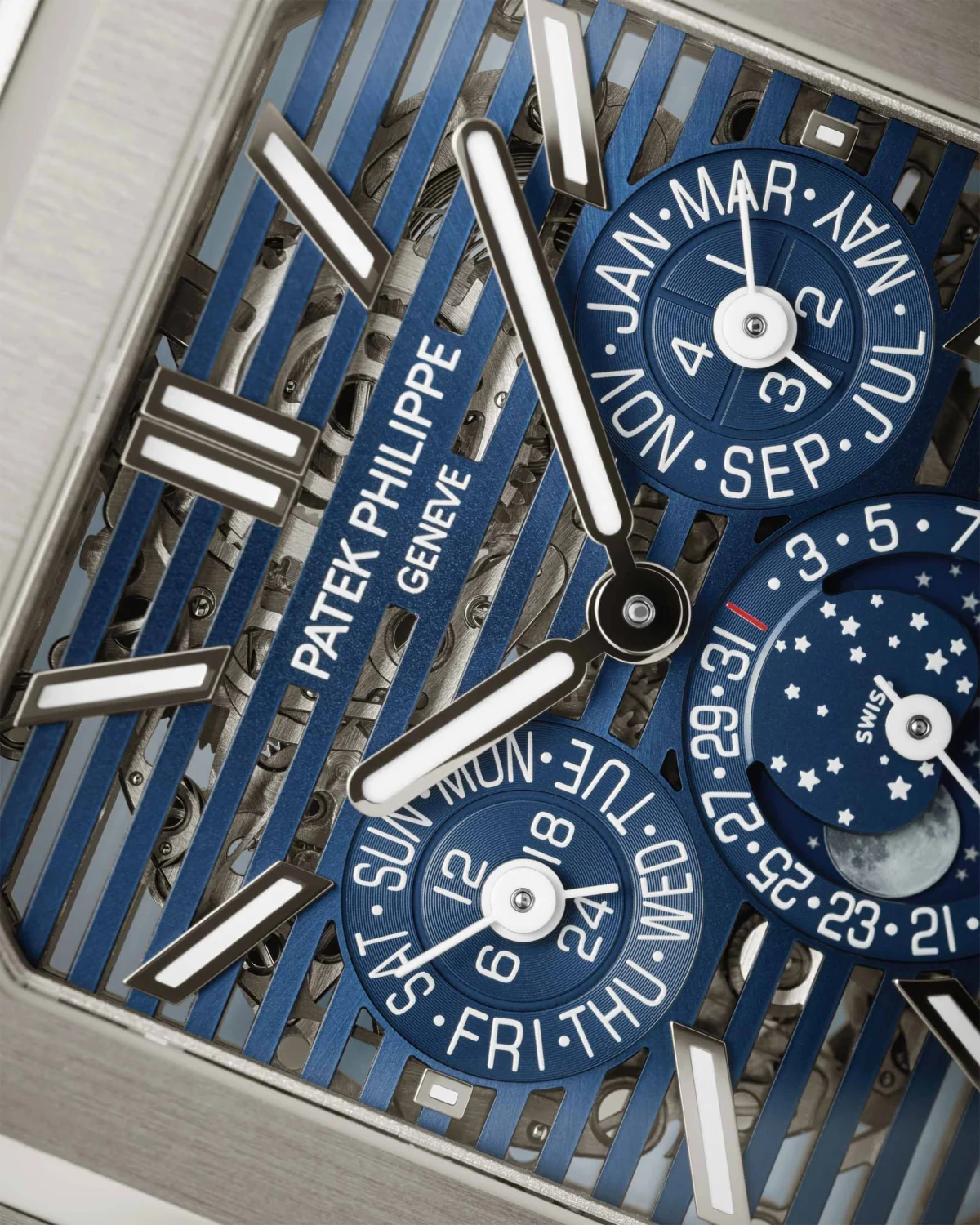
Patek Philippe, a maison synonymous with horological mastery and enduring elegance, has once again surprised the watchmaking world with its latest release from the Cubitus line: the Perpetual Calendar Skeleton Reference 5840P-001. Unveiled at this year’s Watches & Wonders, the timepiece provocatively channels 2000s aesthetics, a surprising yet intriguing direction for a brand often perceived as the epitome of classicism. This bold move, reminiscent of a bygone era often associated with the emergence of influential cultural figures, marks a significant moment for the Cubitus collection, introducing its first Grand Complication.
A Fusion of Eras: Cubitus Meets Perpetual Calendar
The Perpetual Calendar Skeleton Reference 5840P-001 is distinguished by the signature horizontal stripes that define all Cubitus models. However, in this iteration, these stripes are rendered in a striking blue PVD coating, artfully integrated with a skeletonized dial. This innovative approach allows glimpses of the intricate perpetual calendar and moonphase registers, creating a visually dynamic and complex aesthetic. The introduction of a perpetual calendar complication into the Cubitus line signals Patek Philippe’s commitment to expanding the collection’s horological depth and complexity, promising further sophisticated offerings in the future.

Technical Innovation Within a Distinctive Case
Measuring 45mm in diameter, the Perpetual Calendar Skeleton maintains the established dimensions of the Cubitus case, with a slight increase in height to 10mm from 9.6mm. This subtle adjustment accommodates the intricate perpetual calendar mechanism without compromising the collection’s characteristic profile. Patek Philippe has chosen to craft the case from 950 platinum, a noble metal that complements the brushed finish and enhances the open-worked dial. The parallel blue lines, a hallmark of the Cubitus design, serve as a visually arresting backdrop for the three meticulously balanced registers that display the perpetual calendar’s month, date, and day of the week. The perpetual calendar mechanism itself is a testament to Patek Philippe’s unparalleled expertise in calendar complications, thoughtfully engineered to account for leap years and the varying lengths of months, ensuring year-round accuracy without manual intervention. The dial is further adorned with angled baton indices crafted from 18 ct white gold, filled with white Super-LumiNova for enhanced legibility in low-light conditions.
A Grand Moon Display: A Nod to Anniversary Timepieces
A notable feature of the Reference 5840P-001 is its large moon phase display, a departure from Patek Philippe’s typical presentation of two successive moons on a single disk. Instead, this watch features a single, highly detailed moon set against a starry backdrop. This unconventional approach to the moon phase complication required significant engineering adjustments, necessitating a slower rotating disk that completes one rotation every 29.53 days, precisely mirroring a lunar cycle. This is a significant horological undertaking, as Patek Philippe last employed such a large-moon mechanism for its 175th-anniversary celebrations in 2014 with the World Time Moon watches, specifically the References 5575G and 7175R. The decision to integrate this grand moon display into a regular collection piece, and within the unique Cubitus case, underscores the brand’s willingness to innovate and reinterpret its own heritage.
The Evolution of Caliber 240 Q for a Unique Architecture
To house the perpetual calendar and moon phase complications within the distinctive square architecture of the Cubitus case, Patek Philippe developed an evolved version of its renowned Caliber 240 Q. This micro-rotor-powered movement, the Caliber 28-28 Q SQU, is a sophisticated piece of engineering. It features a 22 ct gold micro-rotor, providing a power reserve of approximately 48 hours, and operates at a frequency of 21,600 vibrations per hour. While the front of the watch offers a captivating view of the movement through its skeletonized dial and blue PVD-coated bars, the true spectacle is revealed through the transparent sapphire caseback. Here, the bridges are meticulously cut in the same parallel stripe motif, offering an expansive and unobstructed view of the movement’s intricate workings, including the iconic Gyromax balance. The liberal use of blue, from the blued screws to the Calatrava Cross emblem engraved on the micro-rotor, provides a vibrant contrast against the cool platinum of the case and the intricate metallic components of the movement.

Charting the Cubitus Line: From Novelty to Complication
The Cubitus line itself represents a relatively recent, albeit significant, chapter in Patek Philippe’s extensive history. Debuting in 2024, it marked the brand’s first entirely new watch collection in 25 years, a period that saw profound shifts in both the watch industry and popular culture. The initial reception of the Cubitus was met with a degree of polarization, largely due to its unconventional, blocky case shape. This design choice, while distinct, presented unique challenges for Patek Philippe’s traditional approach to watchmaking, especially when housing existing movement architectures. Some of the earliest Cubitus models featured standard round movements within their square cases, a design decision that further amplified the collection’s divisive nature among collectors and critics alike.
The introduction of the Perpetual Calendar Skeleton Reference 5840P-001 signifies a strategic evolution for the Cubitus line. By integrating one of Patek Philippe’s most revered complications, the brand is clearly aiming to elevate the collection’s status and appeal. This move demonstrates Patek Philippe’s ambition to not only embrace novel aesthetics but also to push the boundaries of its own technical capabilities, adapting and modifying movements to harmonize with the Cubitus’s distinctive architectural demands. The very existence of a specially adapted caliber, the 28-28 Q SQU, highlights the significant investment and engineering effort dedicated to making the Cubitus line a viable platform for high complications.
Watches & Wonders 2024: A Platform for Innovation
The unveiling of the Patek Philippe Cubitus Perpetual Calendar Skeleton at Watches & Wonders 2024 places it within the context of a highly anticipated global watchmaking event. Watches & Wonders, held annually in Geneva, serves as the premier stage for luxury watch brands to debut their most significant new creations. This year’s event, following the consolidation of previous major watch fairs, brought together a comprehensive selection of leading maisons, fostering an environment of intense competition and innovation. For Patek Philippe, a brand that typically makes fewer, more impactful announcements, showcasing the Cubitus Perpetual Calendar at such a prominent venue underscores its importance within the brand’s product strategy. The event provided a global audience of collectors, journalists, and industry professionals with a firsthand look at this groundbreaking timepiece, generating considerable discussion and interest.

Market Implications and Collector Response
The Perpetual Calendar Skeleton Reference 5840P-001, affectionately nicknamed "Patty P Cuby Skelly" within the ABTW office, is priced at 150,000 CHF. Notably, this timepiece is not a limited edition, a decision that suggests Patek Philippe’s intention to establish the Cubitus line as a permanent fixture in its regular collection, capable of housing significant complications. This approach contrasts with the brand’s historical practice of releasing highly sought-after, limited-edition pieces for special anniversaries or unique projects. The non-limited status of this Grand Complication could have several implications for the market. It may democratize access to a highly complex Patek Philippe watch within a more contemporary design language, potentially appealing to a new generation of collectors who are drawn to both technical prowess and modern aesthetics. However, it also raises questions about the long-term investment value and collectibility compared to historically limited pieces.
The integration of a perpetual calendar, a complication that requires extensive knowledge and meticulous execution, within the Cubitus’s avant-garde design, is a bold statement from Patek Philippe. It suggests a calculated effort to broaden the appeal of the Cubitus line beyond its initial niche audience. The brand appears to be strategically positioning the Cubitus not just as a design experiment but as a platform capable of showcasing its most advanced horological achievements. This dual focus on aesthetic innovation and mechanical complexity is likely to spark continued debate and admiration among watch enthusiasts worldwide, reinforcing Patek Philippe’s position as a leader in both tradition and forward-thinking design. The success of this strategy will ultimately be measured by its reception among collectors and its ability to carve out a lasting legacy within Patek Philippe’s illustrious history.