









The pursuit of an immaculate mirror shine on fine leather footwear, a hallmark of sartorial excellence, remains a coveted yet frequently elusive skill for many enthusiasts. Despite the proliferation of premium waxes and instructional content, achieving a truly glass-like gleam often evades even dedicated attempts, leading to finishes that are cloudy or streaked rather than flawlessly reflective. This challenge underscores a fundamental misunderstanding of the intricate processes involved, moving beyond mere application to a nuanced appreciation of leather’s inherent properties and the mechanics of precise layering.
In response to this persistent demand for advanced techniques, a masterclass featuring Preston Soto of The Elegant Oxford has emerged as a definitive resource, transcending basic tutorials to impart professional methodologies. This collaborative initiative aims to demystify the art of the mirror shine, elevating it from a simple chore to a sophisticated craft integral to the presentation of bespoke and high-end footwear. The instruction provided by Soto focuses not merely on product application but on the development of sensory cues and a deeper understanding of material interaction, critical elements often overlooked in conventional guides.
The Evolution of Shoe Care: A Historical Perspective
The practice of caring for and polishing footwear dates back centuries, evolving from rudimentary methods of protection to a sophisticated art form indicative of social standing and personal meticulousness. In earlier eras, natural substances like animal fats, oils, and waxes were used to waterproof and preserve leather, extending the life of essential footwear. The 19th century marked a significant shift with the advent of commercial shoe polishes, particularly with the rise of industrialization and the increased availability of leather shoes. These early polishes, often containing a mix of waxes, dyes, and solvents, offered improved shine and protection, making polished shoes a more accessible symbol of cleanliness and respectability.
By the early 20th century, a highly polished shoe became a quintessential element of military dress codes and a standard for the well-dressed gentleman. The ritual of shoe shining was often performed by valets or dedicated shoe shiners, reflecting the value placed on immaculate presentation. This era also saw the development of specialized tools and techniques, including the use of water to create a high-gloss finish, a precursor to today’s mirror shine methods. The current resurgence of interest in traditional menswear and luxury craftsmanship has further revitalized this classic discipline, with enthusiasts seeking to replicate the exacting standards once reserved for professional care. Brands like Saphir, with their "Médaille d’Or" range, represent the pinnacle of this evolution, offering products formulated with superior ingredients that cater to the exacting demands of discerning consumers.

Beyond the Surface: The Mechanics of a True Mirror Finish
A common misconception among novices is to approach shoe waxing as one might apply paint, assuming that a greater quantity of product equates to a superior shine. This perspective fundamentally misunderstands the structural requirements of a true mirror finish. The goal is not merely to cover the leather but to create an infinitesimally thin, perfectly smooth, and highly reflective surface layer of wax that fills the microscopic pores and irregularities inherent in the leather’s grain.
Leather, being an organic material, possesses a porous surface. Even the finest calfskin, when viewed under magnification, exhibits a texture that scatters light, preventing a direct reflection. The mirror shine technique works by systematically applying layers of hard wax, each meticulously thinned and smoothed with water, to gradually build up a perfectly flat, impermeable surface. This process, often referred to as "glazing," allows light to reflect uniformly, creating the coveted optical illusion of depth and brilliance. The success of this technique hinges on the precise control of wax quantity, the minimal application of water, and the gentle friction generated during buffing, which slightly melts and spreads the wax into an even film.

Preston Soto’s masterclass particularly emphasizes the distinction between general conditioning and targeted mirror shining. Nourishing creams, rich in oils and emollients, are essential for maintaining the leather’s health and flexibility across the entire shoe. Hard waxes, however, are specifically formulated to create a rigid, reflective layer. Confining these brittle waxes to the non-flexing areas of the shoe—primarily the toe cap and heel counter—is paramount. This strategic application prevents the wax from cracking and flaking when the shoe flexes during wear, a common frustration for those who apply wax indiscriminately.
Preston Soto’s Method: Nuance and Sensory Mastery
Unlike many guides that offer generic instructions, Preston Soto’s approach distinguishes itself by focusing on the nuanced sensory cues that a shoe care artisan must develop. This includes recognizing:
- The precise tactile feedback: Understanding how the cloth glides, or subtly resists, across the leather as wax layers build and refine.
- The visual transformation: Discernment of the subtle shifts in reflectivity and clarity as the shine develops, moving from a dull haze to a nascent gleam.
- The auditory signals: The faint, almost imperceptible "squeak" or "stick" of the cloth against the wax, indicating optimal moisture and wax dispersion.
- The ideal pressure: Learning the exact amount of pressure required—neither too much nor too little—to spread the wax without stripping it or creating streaks.
This emphasis on sensory intelligence elevates the process from a mechanical task to an intuitive art form, allowing the individual to respond dynamically to the leather’s specific needs and the evolving finish. Soto advocates for a method that is less about brute force and more about delicate, controlled refinement, ensuring that each layer contributes optimally to the final, flawless surface.
Essential Tools and Premium Products for Uncompromising Results
Achieving a professional-grade mirror shine necessitates not only expert technique but also the use of superior tools and products. Enthusiasts dedicated to mastering this traditional craft will find their valet box incomplete without certain uncompromising essentials, which typically include:

- Saphir Médaille d’Or Pate de Luxe Wax Polish: This product is widely regarded as a benchmark in the luxury shoe care market. Its formulation, often containing a blend of carnauba wax, beeswax, and turpentine, provides exceptional nourishment, protection, and a deep, lasting luster. The precise balance of solvents allows for smooth application and effective layering, crucial for building a mirror finish. Its "wet" consistency makes it ideal for initial layers and deep shine.
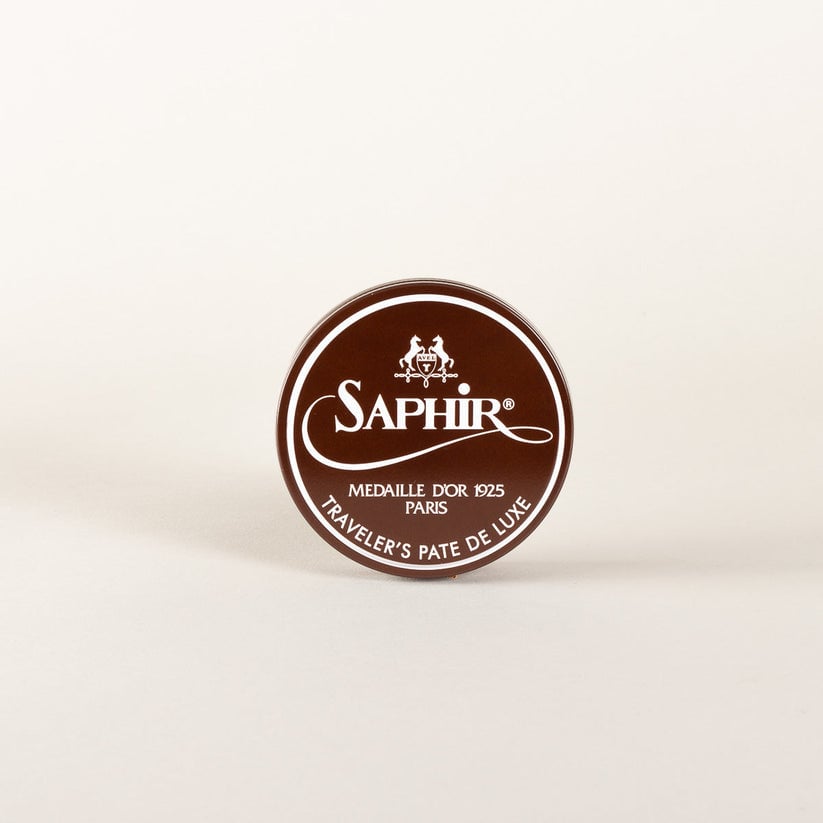
- Saphir Médaille d’Or Traveler’s Pate de Luxe Wax: A newer innovation, this wax offers a slightly dryer and harder consistency than the traditional Pate de Luxe, falling between it and the ultra-hard Saphir Mirror Gloss. Its lower solvent concentration makes it travel-friendly, while its unique properties provide an alternative for those seeking a harder, more immediate gloss in their regular waxing routine.
- Natural Horsehair Brush: An indispensable tool for daily maintenance and initial buffing. The soft yet firm bristles effectively remove surface dust and distribute wax, preparing the leather for deeper cleaning or shining. Regular brushing also helps to bring out a natural sheen between intensive polishing sessions.
- Saphir Médaille d’Or Spatula Brush: Designed for precise application of polishes and creams, this brush allows for controlled product distribution, particularly in crevices and along stitching, without direct hand contact. Its ergonomic design ensures comfortable use and prevents contamination of hands.
- High-Quality Chamois or Polishing Cloths: Crucial for the delicate work of building the mirror shine. Unlike many common fabrics or old t-shirts, a tightly woven, lint-free cotton chamois provides a smooth, consistent surface that prevents microscopic abrasions and swirls in the wax layers, leading to a truly flawless, glass-like finish.
- Distilled Water: Essential for thinning the wax layers and creating a smooth, even spread. The purity of distilled water prevents mineral deposits or impurities from interfering with the wax application, ensuring a crystal-clear finish.
The market for these high-end shoe care products has seen significant growth, driven by an increasing appreciation for luxury goods and the desire to extend their lifespan. Reports indicate a steady rise in consumer spending on premium leather care, reflecting a broader trend towards investment in quality over quantity within personal wardrobes.
Addressing Common Pitfalls: Expert Solutions to Persistent Challenges
Even with the right products and a foundational understanding, enthusiasts often encounter specific challenges. Soto’s masterclass directly addresses these common frustrations, offering clear, actionable solutions.

Does a mirror shine damage fine leather?
When executed correctly, a mirror shine does not cause damage. The critical factor is confining the hard wax exclusively to the toe cap and heel counter—the non-flexing, reinforced areas of the shoe. These parts are designed to be rigid, protecting the underlying leather from stress. Applying hard wax to these areas creates a protective, reflective shell without compromising the leather’s structural integrity or breathability elsewhere. However, it is imperative to occasionally strip the accumulated wax layers using a specialized cleaner. This allows the leather to be properly nourished and moisturized with conditioning creams, preventing dryness and ensuring its long-term health and suppleness.
Why does my mirror finish crack after a single wear?
This prevalent issue is almost universally attributed to the misapplication of hard wax onto the "vamp" or the natural flex points of the shoe, typically across the toes where the foot bends during walking. Hard wax, by its very nature, is brittle. When applied to areas that undergo constant movement, the wax cannot withstand the dynamic stress and consequently shatters, resulting in unsightly cracks. The solution lies in strictly adhering to the principle of applying mirror shine only to the rigid extremities of the shoe, where no flexing occurs. For the flexing areas, nourishing creams and softer waxes are recommended, which provide protection and a subtle sheen without compromising flexibility.
Is an old t-shirt an acceptable substitute for a chamois?
While an old t-shirt might be used in a pinch due to its accessibility, it is generally not recommended for achieving a truly flawless, professional mirror shine. Most modern t-shirts possess a knitted texture, which, despite feeling soft, can leave microscopic swirls and imperfections in the delicate wax layers. These minute abrasions scatter light, diminishing the desired glass-like clarity. For an uncompromising, truly reflective finish, a dedicated, tightly woven cotton polishing cloth or chamois is highly recommended. These specialized cloths offer a consistently smooth surface, ensuring that each wax layer is applied and buffed without introducing any textural irregularities.

The Broader Implications: Sustainability and Sartorial Discernment
The resurgence of interest in mastering skills like the mirror shine is indicative of several broader trends within contemporary culture. Economically, it reflects a growing consumer preference for investing in high-quality, durable goods and extending their lifespan through diligent care, rather than frequent replacement. This aligns with increasing awareness of sustainability and ethical consumption, where thoughtful maintenance of possessions reduces waste and environmental impact.
Culturally, the ability to achieve an impeccable shoe shine is a testament to personal discernment and an appreciation for craftsmanship. In an age of rapid consumption and disposable fashion, the dedication to preserving and enhancing luxury footwear speaks to a commitment to personal presentation and a respect for tradition. A well-maintained pair of shoes, culminating in a pristine mirror shine, projects an image of attention to detail, discipline, and an understanding of classic elegance. It underscores the philosophy that true style extends beyond the superficial, residing in the meticulous care and preservation of one’s wardrobe.
The techniques taught by experts like Preston Soto are therefore not just about polishing leather; they are about cultivating a skill that embodies a broader philosophy of quality, longevity, and refined personal expression. As the demand for bespoke and luxury footwear continues to grow, so too will the appreciation for the artisanal skills required to maintain them at their peak, ensuring that the art of the mirror shine remains a cornerstone of the gentleman’s wardrobe for generations to come.