










The horological world often celebrates the titans of timekeeping, figures whose innovations have fundamentally shaped the way we measure and perceive time. Among these luminaries, Christiaan Huygens stands as a particularly significant, yet perhaps not universally recognized, name. Dutch polymath, Huygens’ contributions extended far beyond the realm of watches, encompassing breakthroughs in astronomy, physics, and mathematics. It is this multifaceted genius that the nascent watch brand Kneijnsberg seeks to honor with its latest creation, the Hugenius, a timepiece that aims to blend historical reverence with contemporary design and mechanical ingenuity.
The genesis of this collaboration between Kneijnsberg and the legacy of Christiaan Huygens was first brought to light at a discreet gathering during the WindUp and WatchTime NYC events of the previous year. Held in an intimate meeting space within a distinguished boutique hotel, the event provided a platform for several emerging watch brands, including Sartory-Billard and Holthinrichs, to showcase their offerings. It was amidst this curated collection of independent watchmaking that Kneijnsberg, represented by its founder Brendan Horneman, first captured the attention of horological enthusiasts. While a previous, whimsical design inspired by feline forms has since been retired, the Hugenius represents a more profound engagement with history, specifically commemorating the 350th anniversary of Christiaan Huygens’ pivotal invention of the balance spring.

The Enduring Legacy of Christiaan Huygens
Christiaan Huygens’ impact on the field of horology is undeniable and deeply rooted in the annals of scientific history. Born in 1629, Huygens was a product of a highly intellectual era, a time when scientific inquiry was rapidly advancing. His life’s work spanned a remarkable breadth of disciplines, but his most enduring contributions to timekeeping emerged in the mid-17th century.
In 1657, while concurrently making groundbreaking observations of Saturn and its rings, Huygens patented the pendulum clock. This invention revolutionized timekeeping accuracy, establishing a new standard that remained unsurpassed until the widespread adoption of quartz technology in the 1930s. The pendulum clock’s precision offered an unprecedented level of reliability for scientific experiments, navigation, and daily life.
However, for watchmaking specifically, Huygens’ invention of the first functioning balance spring in 1675 proved to be equally, if not more, transformative. While it is important to acknowledge that Robert Hooke had independently conceived of the balance spring concept prior to Huygens, it was Huygens who successfully developed and implemented a working model. This innovation was critical in miniaturizing timekeeping devices, paving the way for the pocket watches and, subsequently, wristwatches that would define the subsequent centuries of horological development. The balance spring, acting as a miniature spring-and-mass system, allowed for more portable and accurate timepieces by regulating the oscillating balance wheel. Consequently, Huygens is rightfully celebrated as a seminal figure in horological history, a pioneer whose mechanical innovations continue to resonate today.

Beyond his horological achievements, Huygens made profound contributions to other scientific fields. His work in optics led to improvements in telescope lenses. His investigations into planetary science, particularly his identification of Saturn’s moon Titan and his accurate description of Saturn’s rings, were monumental. In mathematics, he developed methods for calculating probabilities and contributed to the study of calculus. The Kneijnsberg Hugenius, therefore, is not merely a tribute to a single invention, but an encompassing acknowledgment of Huygens’ entire intellectual corpus.
Design Philosophy: A Modern Interpretation of Historical Inspiration
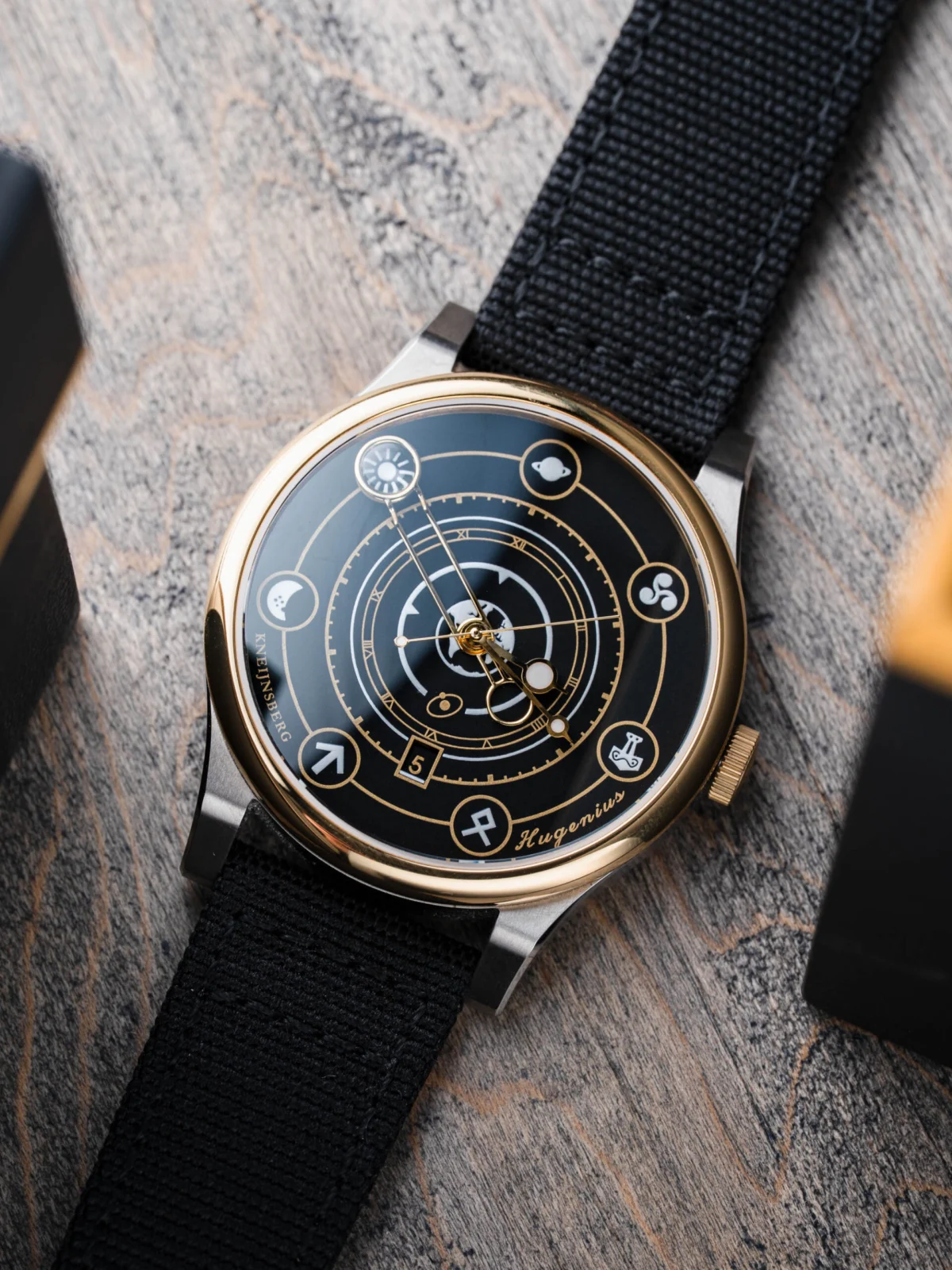
The design of the Kneijnsberg Hugenius is a deliberate fusion of historical nods and contemporary aesthetics. The case itself opts for a modern silhouette, providing a clean canvas for the dial’s more direct homage to Huygens. Constructed from grade 5 titanium, the 40mm case presents a stark, brushed finish on its flat sides, which transition into subtly rounded lugs. A polished chamfer runs along the entirety of the case’s edges, adding a refined detail.
A striking feature of the case is its bezel, crafted from gold-anodized titanium and finished with a high polish. Kneijnsberg offers the Hugenius in several variations, including an all-titanium case and an all-gold-anodized titanium case. However, the reviewer found the two-tone execution, isolating the precious metal accent to the bezel, to be the most aesthetically pleasing. This approach avoids what the reviewer perceives as the potential for tackiness in fully two-tone watches, particularly with matching bracelets – a sentiment echoed in discussions surrounding the Piaget Polo 79, though the Hugenius does not feature a bracelet option.

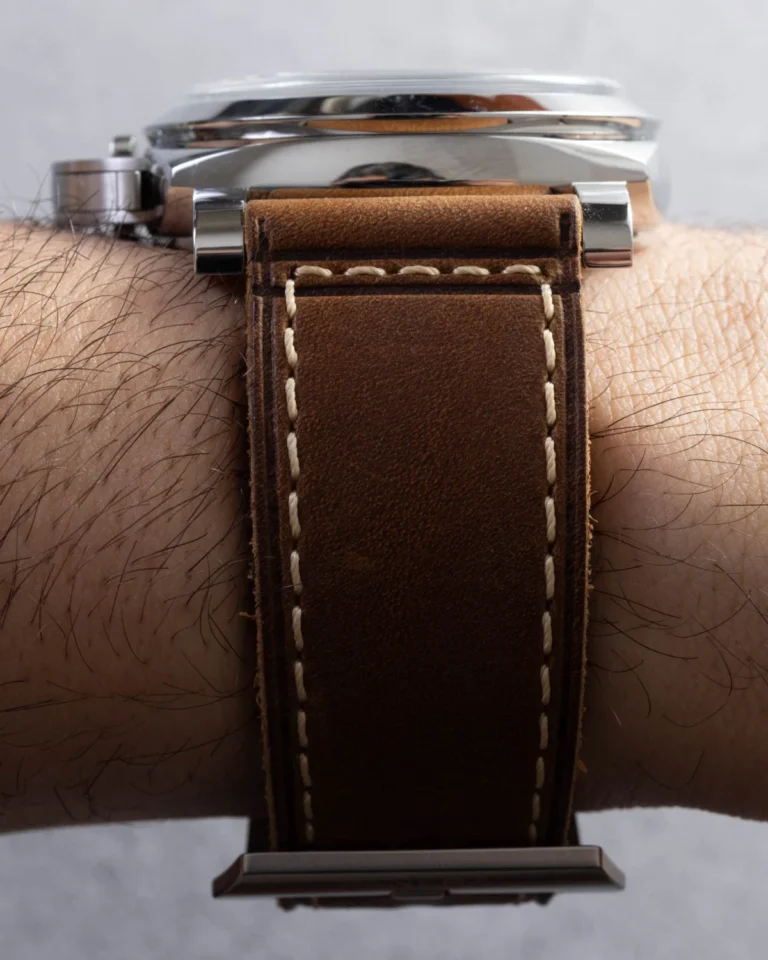
The Hugenius is presented on a canvas strap with a titanium buckle, a choice that further accentuates the juxtaposition of modern casualness with historical complexity. A secondary black leather strap with white contrast stitching was also provided for review. While both straps offer distinct styles, the reviewer expressed a preference for a more classic black leather strap that would more seamlessly complement the watch’s overall design.
On the wrist, the Hugenius measures 11mm in thickness and has a lug-to-lug measurement of 48.25mm. While it sits comfortably on a 7-inch wrist, it might appear somewhat large on wrists smaller than 6.5 inches, exhibiting a slightly boxy presence. The watch is equipped with a domed sapphire crystal, which offers excellent clarity. The pull-out crown, designed to match the bezel’s gold anodization, is unpolished, a detail that could have potentially enhanced the case’s cohesive appearance. With a water resistance rating of 50 meters, the Hugenius is suitable for everyday wear but is not intended for extreme aquatic environments, a practical consideration that aligns with its character as a piece of historical appreciation rather than a tool watch for arduous conditions.
A Dial Steeped in Astronomical and Optical References
The matte-black dial of the Kneijnsberg Hugenius is a densely detailed canvas, replete with references to Huygens’ scientific endeavors. All white elements are lumed with Super-LumiNova, providing excellent visibility in low light conditions. The printed gold accents on the dial are designed to harmonize with the gold-anodized bezel, though their integration might be less impactful on the all-titanium variants.

Starting from the center, the dial features a printed rendering of Earth, encircled by a wind rose. The Kneijnsberg logo is positioned at the 6 o’clock marker. A gold hour track encircles the dial, featuring Roman numerals that are remarkably small, requiring close inspection or magnification to discern. Surrounding this is what the brand terms the "stratosphere circle," a gold minute track that also incorporates a date window at the 6 o’clock position. The date font itself is rendered in gold, maintaining a visual consistency. The outermost ring displays the days of the week.
While the dial’s layout can appear congested at first glance, it remains remarkably straightforward in its execution. Most elements are positioned in conventional locations, with the exception of the date display, which presents a unique quirk that is likely to be polarizing – a feature one either embraces or finds challenging.
The "stratosphere circle" and the planet-like motifs on the hands and the central Earth rendering serve as clear tributes to Huygens’ groundbreaking work in planetary science. However, the day display mechanism offers a more nuanced and intellectually engaging connection to his broader scientific contributions. Huygens made significant advancements in the field of optics and lens design. This legacy is directly referenced in the Hugenius through a magnifier mounted at the end of the double-armed day hand. This unique mechanism allows for an instantaneous, counterclockwise jump to the next day symbol precisely at midnight.

The cryptic symbols adorning the day display are not arbitrary. They are carefully chosen to represent historical or mythological associations with each day of the week:
- Sunday: Symbolized by the Sun.
- Monday: Represented by the Moon.
- Tuesday: Depicted by a spear, referencing the Roman god of war, Mars.
- Wednesday: Marked by Odin’s rune, Othala, signifying the Norse god Odin.
- Thursday: Illustrated with Thor’s hammer, Mjöllnir, honoring the Norse god Thor.
- Friday: Features a symbol associated with the goddess Freya, a significant figure in Norse mythology.
- Saturday: Labeled with Saturn, a fitting tribute given Huygens’ pivotal observations of the planet Saturn and its celestial bodies.
This intricate detail underscores Kneijnsberg’s commitment to not just superficial representation but to embedding meaningful historical connections within the watch’s functionality.
Legibility and Movement: A Blend of the Familiar and the Bespoke
Despite the dial’s rich detail, the Super-LumiNova lume is impressively bright and evenly applied, ensuring good visibility. However, the hands, while perfectly aligned with their respective tracks, are notably small. The dominant visual element when glancing at the dial is the date magnifier, which extends over the day track. This design choice, while aesthetically intriguing, can impede immediate time reading. Each attempt to quickly ascertain the time requires a refocusing of the eyes towards the smaller handset located towards the dial’s center. While this presents a minor challenge, it does not fundamentally compromise the watch’s basic timekeeping function. The reviewer posits that the Hugenius remains more legible than watches with exceptionally complex displays, such as the Bell & Ross BR 03-92 Radiocompass, and significantly more so than most skeletonized timepieces.

Powering the Kneijnsberg Hugenius is the Caliber 28.350, a movement that is based on the robust ETA 2834-2. This automatic movement offers a power reserve of 42 hours and operates at a frequency of 28,800 vibrations per hour. Visible through the sapphire caseback, the movement features a pleasing gold finish.
Crucially, Kneijnsberg has undertaken significant in-house modifications to the base ETA movement to achieve the unique day complication. The standard ETA 2834-2 typically features a day display at the 12 o’clock position within a fixed aperture. Brendan Horneman, drawing upon his extensive experience as a watchmaker at esteemed institutions like Breitling and Richemont, has developed a custom modification that enables the distinctive day display envisioned for the Hugenius. This bespoke engineering highlights Kneijnsberg’s commitment to creating watches that are not merely assembled but are thoughtfully designed and meticulously crafted with unique complications.
Conclusion: A Quirky Tribute with Horological Merit
The Kneijnsberg Hugenius is undeniably a quirky timepiece, but it is precisely this distinctiveness that makes it a fitting and compelling tribute to Christiaan Huygens, a figure of immense historical and scientific importance. While the dial’s display can present a learning curve, the watch ultimately captivates with its unique aesthetic, modern design, and the underlying ingenuity of its mechanical execution.

For collectors and enthusiasts who cherish the history of watchmaking as much as the timepieces themselves, the Hugenius offers a compelling proposition. It is a watch that invites contemplation, a conversation starter that bridges the gap between past and present. The Kneijnsberg Hugenius is priced starting at €1,150.
For further information, interested parties are encouraged to visit the official Kneijnsberg website. This timepiece represents a bold statement from a new brand, demonstrating a clear vision to honor horological heritage through innovative and thoughtfully designed watches.