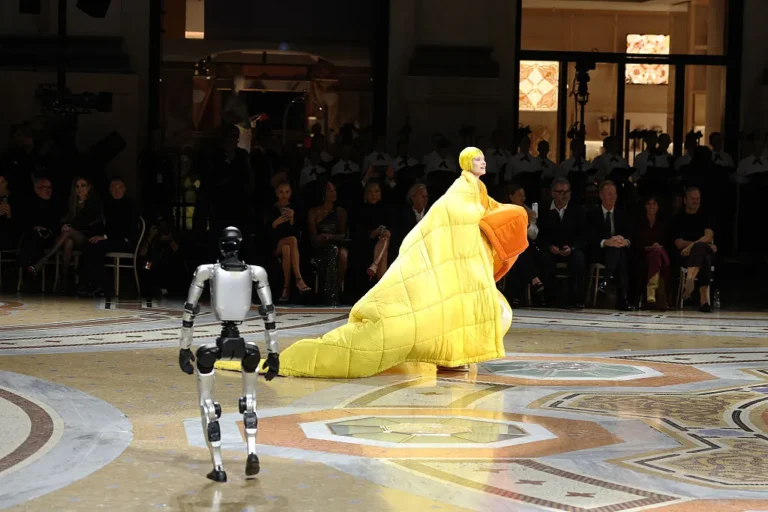











On Saturday, designer Kate Barton will unveil her latest collection at New York Fashion Week with a significant technological integration that seeks to bridge the gap between high-concept couture and advanced artificial intelligence. Partnering with Fiducia AI, Barton has developed a multilingual AI agent built on the IBM watsonx platform and hosted on IBM Cloud. This digital interface is designed to transform the traditional runway experience into an interactive environment where guests can use a visual AI lens to identify specific garments, ask questions in multiple languages via voice or text, and engage with photorealistic virtual reality try-ons. This deployment represents a move away from the speculative use of technology in fashion toward a production-grade application aimed at enhancing consumer engagement and brand storytelling.
The collaboration comes at a pivotal moment for the fashion industry, as New York Fashion Week (NYFW) increasingly serves as a testing ground for digital innovation. While many luxury houses have historically approached technology with a degree of trepidation, the integration of generative AI is beginning to move from the back-office operational sphere to the front-facing consumer experience. For Barton, the inclusion of AI is not a peripheral addition but a core component of her creative process. She views technology as a "portal" into the collection’s world, emphasizing that the goal is to create a sense of curiosity rather than utilizing technology for its own sake.
Technical Infrastructure and the Role of IBM Watsonx
The technical backbone of the presentation relies on a sophisticated stack of IBM technologies orchestrated by Fiducia AI. Ganesh Harinath, the founder and CEO of Fiducia AI, noted that the project utilized IBM watsonx, IBM Cloud, and IBM Cloud Object Storage to ensure the stability and scalability required for a high-traffic event like NYFW. The primary feature of the activation is a visual AI lens that has been trained to detect and recognize specific pieces from Barton’s new collection. Unlike standard chatbots, this system is designed for "production-grade" performance, meaning it must handle real-time visual recognition and natural language processing with high accuracy.
According to Harinath, the most significant challenge in developing the agent was not the fine-tuning of the large language models themselves but the orchestration of the various components. The system must seamlessly transition between visual identification, multilingual communication, and the rendering of photorealistic virtual try-ons. This requires a robust data management strategy, facilitated by IBM Cloud Object Storage, to handle the high-resolution assets necessary for a photorealistic experience. The multilingual capability is particularly relevant for NYFW, which attracts a global audience of buyers, journalists, and influencers, allowing the AI to serve as a universal concierge for the collection.
The Evolution of Fashion Technology at New York Fashion Week
The intersection of fashion and technology is not a new phenomenon, but the nature of the integration has evolved significantly over the past decade. In the early 2010s, "fashion tech" often manifested as wearable electronics or LED-integrated fabrics—concepts that were visually striking but frequently lacked commercial scalability. As the industry moved into the 2020s, the focus shifted toward the "phygital" realm, incorporating Augmented Reality (AR) and Non-Fungible Tokens (NFTs).
Kate Barton’s latest endeavor follows her previous experimentation with AI models during the last season, also in collaboration with Fiducia AI. This trajectory mirrors a broader industry trend where designers are moving past the "gimmick" phase of technology. Barton compares the current state of AI in fashion to the early days of e-commerce. Initially, many established fashion houses were hesitant to launch websites, fearing that an online presence would diminish the exclusivity of the brand. Eventually, the conversation shifted from whether a brand should be online to whether their online presence was effective. Barton suggests that AI is currently undergoing a similar transition, where its eventual ubiquity is inevitable.
Market Context and the Economic Impact of AI in Fashion
The deployment of AI by designers like Barton is supported by significant market growth in the sector. According to industry reports from McKinsey & Company, generative AI could add between $150 billion to $275 billion to the apparel, fashion, and luxury sectors’ profits over the next three to five years. While much of this value is currently derived from supply chain optimization, inventory management, and personalized marketing, the creative and experiential applications are gaining traction.

Data indicates that virtual try-on technology can significantly impact retail performance by reducing return rates—a major cost center for fashion brands. By allowing users to visualize how a garment fits and moves in a photorealistic digital environment, brands can provide a more accurate representation of their products before a physical purchase is made. In the context of a runway show, this technology allows the audience to move beyond passive observation, fostering a deeper connection with the craftsmanship and design of the collection.
Operational Efficiency vs. Creative Preservation
While the public-facing AI agent is the centerpiece of Barton’s show, the designer also highlighted the internal benefits of the technology. AI is increasingly being used for better prototyping, visualization, and smarter production decisions. These tools allow designers to iterate on designs in a digital space, reducing the need for physical samples and thereby minimizing waste. This aligns with the industry’s broader push toward sustainability and more efficient manufacturing processes.
However, the rise of AI in fashion has also prompted concerns regarding the displacement of human labor and the potential for "automated fashion" to lack the emotional resonance of traditional design. Barton was firm in her stance that technology should not be used to erase the human element of the industry. She emphasized that audiences are discerning and can distinguish between genuine innovation and "avoidance"—using technology to cut corners or bypass human creativity. For Barton, the value of AI lies in its ability to heighten craft and deepen storytelling, rather than replacing the artisans and designers who make the clothes "worth wearing."
Industry Perspectives and the Path to 2030
The collaboration has drawn attention from technology leaders who see fashion as a critical frontier for AI application. Dee Waddell, Global Head of Consumer, Travel and Transportation Industries at IBM Consulting, noted that when product intelligence and consumer engagement are connected in real-time, AI becomes a "growth engine" rather than just a feature. This perspective suggests that the long-term value of AI in fashion lies in its ability to provide measurable competitive advantages through data-driven insights and enhanced customer experiences.
Looking forward, Ganesh Harinath predicts a rapid normalization of these technologies. He anticipates that by 2028, AI-driven experiences will be a standard expectation at major fashion events. By 2030, he expects AI to be fully embedded into the operational core of the retail industry, moving from experimental activations to a foundational element of how fashion is designed, produced, and sold. The differentiator for brands in the coming years will be their ability to assemble the right partners and build teams capable of operationalizing AI responsibly and ethically.
Implications for the Future of Luxury Retail
The Kate Barton and Fiducia AI presentation serves as a case study for the future of luxury retail. As the digital and physical worlds continue to converge, the "customer journey" is becoming increasingly non-linear. A consumer may first encounter a garment on a digital avatar, interact with an AI agent to learn about its material composition, and then visit a physical atelier for a final fitting.
The success of such integrations depends on "clear discourse, clear licensing, and clear credit," according to Barton. As AI models are trained on vast datasets of existing designs, the industry must navigate complex questions of intellectual property and creative attribution. The goal is to establish a shared understanding that human creativity is a primary value driver, not an "annoying overhead cost."
As the Saturday show approaches, the industry will be watching closely to see how the audience interacts with Barton’s AI agent. If successful, the activation could provide a blueprint for other designers looking to leverage IBM watsonx and similar platforms to create more immersive, inclusive, and technologically advanced fashion experiences. The ultimate objective remains the same: to use the tools of the future to celebrate the timeless art of fashion design without "flattening" the people who bring it to life.