










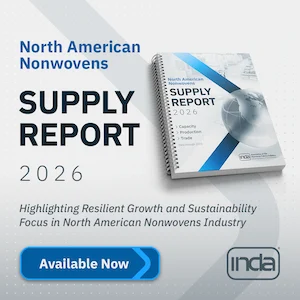
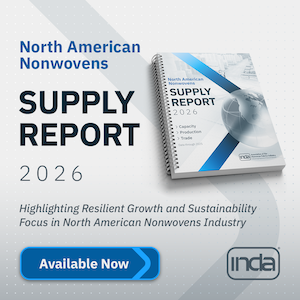
CARY, N.C. — INDA, the Association of the Nonwoven Fabrics Industry, has officially published its 13th annual North American Nonwovens Supply Report, providing an exhaustive analysis of the sector’s 2025 performance and offering a strategic roadmap for the coming years. Released on April 15, 2026, the document serves as the definitive benchmark for the nonwovens industry, encompassing the United States, Canada, and Mexico. The report arrives at a critical juncture for the manufacturing sector, as global trade complexities, shifting regulatory landscapes, and a renewed focus on environmental stewardship redefine the parameters of industrial growth.
The findings within the 2026 report paint a picture of an industry navigating a "complex landscape" characterized by significant geopolitical headwinds. While the nonwovens sector has historically been a pillar of stability within the broader textiles market, the 2025 calendar year saw a measurable deceleration in production output. This slowdown is attributed primarily to a "wait-and-see" sentiment among major stakeholders, triggered by fluctuating tariff policies and heightened tensions in international trade corridors. Despite these challenges, the report underscores the inherent resilience of North American producers, who continue to prioritize long-term capacity expansion and technological innovation.
A Chronology of Industry Shifts: From Pandemic Surge to Strategic Moderation
To understand the current state of the North American nonwovens market, the 2026 report places the recent production data within a five-year historical context. The industry underwent a period of unprecedented volatility beginning in 2020, driven by the global demand for Personal Protective Equipment (PPE) and disinfecting wipes during the COVID-19 pandemic. This era was defined by rapid-fire capacity investments, particularly in meltblown and spunbond technologies.
By 2023, the market began a period of "inventory normalization," where the surplus of goods produced during the pandemic peak was gradually absorbed by the market. The 2024 fiscal year showed signs of stabilization; however, as the industry moved into 2025, new variables emerged. The latest report identifies 2025 as a year of "cautious recalibration." While the demand for essential hygiene and medical products remained steady, the industrial and construction segments of the nonwovens market felt the impact of higher interest rates and a cooling of the housing market.
Furthermore, the chronology of 2025 was marked by several pivotal trade announcements. New rounds of tariffs on imported raw materials and finished nonwoven goods from overseas markets forced North American manufacturers to re-evaluate their supply chains. This period of uncertainty led many firms to delay major capital expenditures, resulting in the moderated production levels highlighted in the 13th annual report.
Comprehensive Data Analysis: Capacity, Production, and Operating Rates
The 2026 Supply Report is the result of rigorous primary research, incorporating data from producer surveys and exclusive interviews with C-suite executives across the nonwovens value chain. The report provides a granular look at the three pillars of the industry: composites, roll goods, and finished products.
According to the data, North American nonwoven capacity continued to grow in 2025, albeit at a more measured pace than in previous years. This increase in capacity, even during a production slowdown, suggests that manufacturers are betting on a long-term demand recovery. However, the report notes that "operating rates"—the ratio of actual production to total capacity—saw a slight decline in 2025. This metric is a key indicator of industry health, and the current dip reflects the strategic decision by many mills to reduce shifts or temporarily idle lines rather than overproduce in an uncertain trade environment.
Regional trade dynamics also feature prominently in the analysis. The United States remains the dominant producer and consumer within the North American bloc, but the report highlights significant growth in Mexico’s nonwovens sector. This growth is largely driven by the "nearshoring" trend, as companies seek to insulate their supply chains from trans-Pacific disruptions. Canada, meanwhile, continues to carve out a niche in high-value, specialized nonwovens used in filtration and advanced medical applications.
Strategic Evolution: The Sustainability Imperative
A central theme of the 2026 report is the industry’s "strategic evolution" toward sustainability. No longer a peripheral concern, environmental stewardship has become a core business driver. The report details how North American producers are increasingly investing in "circular economy" initiatives, which include the development of biodegradable fibers, the reduction of manufacturing waste, and the implementation of energy-efficient production processes.
Innovation in the wipes sector is a prime example of this shift. Following several years of regulatory scrutiny regarding "flushability" and plastic content, the 2025 data shows a significant uptick in the production of nonwovens made from natural fibers such as wood pulp, cotton, and polylactic acid (PLA). These materials are replacing traditional petroleum-based synthetics in response to both consumer demand and legislative mandates.
The report also identifies a growing market for "durable" nonwovens. While "disposable" products (such as diapers and feminine hygiene items) still account for the majority of the market by volume, durable nonwovens used in automotive interiors, geotextiles for civil engineering, and high-performance roofing materials are seeing increased investment. These products offer longer lifespans and contribute to the industry’s overall sustainability profile.
Official Perspectives: Leadership on Industry Resilience
Tony Fragnito, President and CEO of INDA, emphasized the strategic value of the report during its launch. "As part of INDA’s role as the industry’s trusted data source, this report delivers valuable insights for benchmarking, strategic planning, and decision-making," Fragnito stated. He noted that despite the "wait-and-see" environment, the underlying fundamentals of the industry remain strong. "This year’s findings highlight a resilient industry that continues to expand capacity through ongoing investments across all regions and sectors. We are also seeing a clear shift toward sustainable, durable products, alongside continued innovation to meet evolving demand across North America."
Mark Snider, INDA’s Chief Market and Industry Analyst, echoed these sentiments while highlighting the importance of data transparency. "INDA remains committed to enhancing the quality and depth of our industry data and insights," Snider said. "Strong participation from suppliers is essential to that mission. As global supply chain pressures intensify, this report examines the key dynamics shaping the market and influencing future direction."
Snider also pointed out that the data from the Supply Report serves as a foundation for INDA’s biennial Global Nonwoven Markets Demand Report. This interconnectedness allows North American producers to see how their regional performance fits into the larger global context, particularly as competition from Asian and European markets intensifies.
Broader Implications and Future Outlook
The implications of the 13th annual North American Nonwovens Supply Report extend far beyond the manufacturing floor. For retailers and consumer packaged goods (CPG) companies, the report’s findings on moderated production and rising material costs suggest that price volatility for nonwoven-based products may persist into 2027.
From a policy perspective, the report provides a data-driven argument for the importance of stable trade relations. The "wait-and-see" environment described in the report is a direct consequence of policy uncertainty. Economists analyzing the report suggest that if trade tensions ease in the latter half of 2026, the North American nonwovens industry is well-positioned for a "coiled spring" recovery, given the recent capacity expansions.
Furthermore, the industry’s pivot to sustainability is likely to spark a new wave of mergers and acquisitions. Larger firms with the capital to invest in "green" technologies are expected to acquire smaller, specialized players who possess proprietary sustainable fiber technologies. This consolidation could lead to a more streamlined and environmentally focused North American supply chain.
As the industry looks toward the 2027 fiscal year, the INDA report suggests that "agility" will be the defining characteristic of successful firms. Companies that can balance the immediate challenges of trade tariffs with the long-term necessity of sustainable innovation will likely emerge as market leaders.
About the Report and INDA
The North American Nonwovens Supply Report is provided at no cost to the producers who participate in the data collection process, ensuring a high level of accuracy and industry buy-in. INDA members receive the Executive Summary as a benefit of their membership, while the full report is available for purchase by non-members and industry analysts.
INDA, the Association of the Nonwoven Fabrics Industry, serves hundreds of member companies in the nonwovens/engineered fabrics industry doing business in North America. Since 1968, INDA events have helped members connect, learn, and grow their businesses. INDA educational courses, market data, test methods, consultancy, and issue advocacy help members succeed by providing them the information they need to better plan and execute their business strategies.
The 2026 report stands as a testament to the association’s commitment to providing the market intelligence necessary for navigating an increasingly volatile global economy. For those seeking to understand the intricacies of the fibers, resins, and technologies that bind the modern world together, the 13th annual North American Nonwovens Supply Report remains an indispensable resource.