









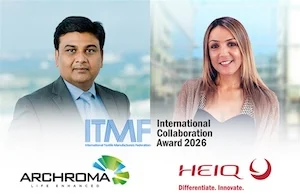
In a significant milestone for the international textile manufacturing sector, the strategic partnership between Swiss-based innovation powerhouse HeiQ and global specialty chemicals leader Archroma has been formally recognized with the ITMF International Collaboration Award 2026. Announced on September 21, 2026, this accolade underscores a transformative shift in how material science and industrial application intersect, setting a new benchmark for how disparate organizations can unite to address the industry’s most pressing challenges: sustainability, functional performance, and global scalability.
The International Textile Manufacturers Federation (ITMF), founded in 1904, serves as the premier global forum for the textile value chain. By honoring this collaboration, the ITMF has signaled that the future of the industry lies not in isolated corporate silos, but in synergistic partnerships that bridge the gap between high-tech research and large-scale industrial deployment.
A Strategic Alliance Built on Complementary Strengths
The collaboration between HeiQ and Archroma represents a calculated convergence of technical expertise and market infrastructure. HeiQ, a pioneer in high-performance material technologies, has long been recognized for its agility in R&D, particularly in the fields of antimicrobial, anti-odor, and thermoregulation treatments. Archroma, by contrast, brings a massive commercial footprint, an extensive global distribution network, and a deep understanding of the regulatory and compliance hurdles that textile mills face daily.
The partnership was formalized to address a persistent friction point in the textile market: the difficulty of scaling sustainable innovations. Historically, many high-performance textile technologies struggled to move from pilot-scale laboratory success to widespread adoption because of logistical complexities and a lack of localized technical support. By combining Archroma’s global technical platform with HeiQ’s proprietary material science, the two firms effectively streamlined the implementation process for brands and retailers, ensuring that high-performance, planet-conscious finishes could be integrated into the manufacturing workflow with minimal disruption.
Chronology of the Partnership and Path to Recognition
The trajectory of this partnership mirrors the broader industry’s move toward "clean" manufacturing. Since the inception of their co-marketing agreement, the companies have focused on creating a seamless bridge between chemical innovation and garment production.
- Early 2024: Initial discussions regarding the synergy between HeiQ’s functional additives and Archroma’s finishing portfolio.
- Late 2024: Launch of the co-marketing and global distribution strategy, targeting key manufacturing hubs in Asia, Europe, and the Americas.
- 2025: Rapid expansion of the partnership, with an emphasis on introducing bio-based solutions, such as HeiQ Mint, into the portfolios of major global apparel brands.
- Mid-2026: Comprehensive evaluation by the ITMF committee, analyzing the impact of the collaboration on textile waste reduction, energy consumption, and industry adoption rates.
- September 2026: Formal receipt of the ITMF International Collaboration Award.
The Technological Edge: Focus on HeiQ Mint
A central pillar of the partnership’s success is the deployment of technologies like HeiQ Mint. In an era where "fast fashion" is increasingly scrutinized for its environmental impact, the demand for garment longevity has become a priority for both consumers and regulators. HeiQ Mint is a bio-based, non-biocidal odor-control technology designed to address the lifecycle of a garment.
By capturing odor molecules during wear and releasing them during the laundering process, the technology significantly extends the time a garment can be worn between washes. The environmental data supporting this is compelling: reducing the frequency of washing not only saves massive amounts of water—a critical resource in textile production—but also lowers the energy consumption associated with machine drying and extends the physical lifespan of the fabric, delaying the garment’s eventual entry into a landfill.
Official Perspectives on the Collaboration
The recognition by the ITMF has prompted reflections from leadership at both organizations, highlighting the cultural alignment required to maintain such a high-level partnership.
Raquel Vaz Vieira, Executive Vice President at HeiQ Advanced Materials, emphasized the collaborative ethos that facilitated the win. "Our collaboration demonstrates what can be achieved when two organizations with complementary strengths unite around a shared purpose," she stated. "This award is not only a recognition of what has been achieved so far, but also an encouragement to continue pushing the boundaries of sustainable textile innovation."
Dhirendra Gautam, Vice President of Marketing at Archroma, echoed these sentiments, focusing on the democratization of innovation. "This recognition from ITMF validates our belief that innovation has greater impact when it is made accessible at scale," Gautam noted. "Together with HeiQ, we are advancing meaningful transformation for brands and mills worldwide as they adopt more sustainable, high-performance textile technologies."
Data-Driven Implications for the Textile Industry
The broader implications of the HeiQ-Archroma partnership extend beyond mere corporate prestige. In a global textile market valued at over $1.7 trillion, the ability to shift manufacturing paradigms is significant. By providing mills with "compliance-ready" solutions, the collaboration reduces the cost of entry for sustainable manufacturing.
Data from industry analysts suggest that textile mills often cite "regulatory complexity" and "process downtime" as the primary reasons for resisting the adoption of new, greener chemical additives. By standardizing the technical support and providing pre-verified compliance documentation, the HeiQ-Archroma model has successfully lowered the threshold for sustainability.
Furthermore, the industry’s shift toward bio-based, non-biocidal solutions is gaining momentum as environmental regulations—such as those found in the European Union’s Green Deal—become more stringent. The partnership’s ability to pivot toward these eco-conscious solutions while maintaining the high performance required by high-end sportswear and fashion brands represents a vital step toward the industry’s circular economy goals.
Future Outlook and Industry Impact
The ITMF award serves as a bellwether for the textile industry’s trajectory. As brands face increasing pressure from stakeholders to disclose supply chain impacts, the need for transparent, high-performance, and sustainable chemical partnerships will only increase.
The success of HeiQ and Archroma highlights three critical lessons for the industry:
- Interoperability is Key: Innovation cannot exist in a vacuum; it requires a robust distribution and technical support infrastructure to reach global scale.
- Sustainability Must Perform: Technologies like HeiQ Mint prove that consumers are not required to trade performance for sustainability. The dual benefit of freshness and resource conservation is a potent market driver.
- Cross-Sector Synergy: By leveraging the strengths of a chemical giant and a materials science innovator, the textile industry can accelerate the pace of change significantly faster than through individual R&D efforts.
As the industry looks toward 2030, the model established by this partnership is likely to be replicated across other segments of the supply chain, including dyeing, finishing, and fiber development. The ITMF International Collaboration Award 2026 is, therefore, not merely a celebration of past achievements, but a roadmap for future collaborative success.
By aligning their commercial interests with the global necessity for sustainable production, HeiQ and Archroma have demonstrated that the path to a cleaner textile industry is paved with strategic, science-backed, and operationally rigorous partnerships. Their work continues to influence how mills approach production, how brands market their products, and how consumers interact with their clothing—ultimately fostering a more responsible and efficient global textile ecosystem.