










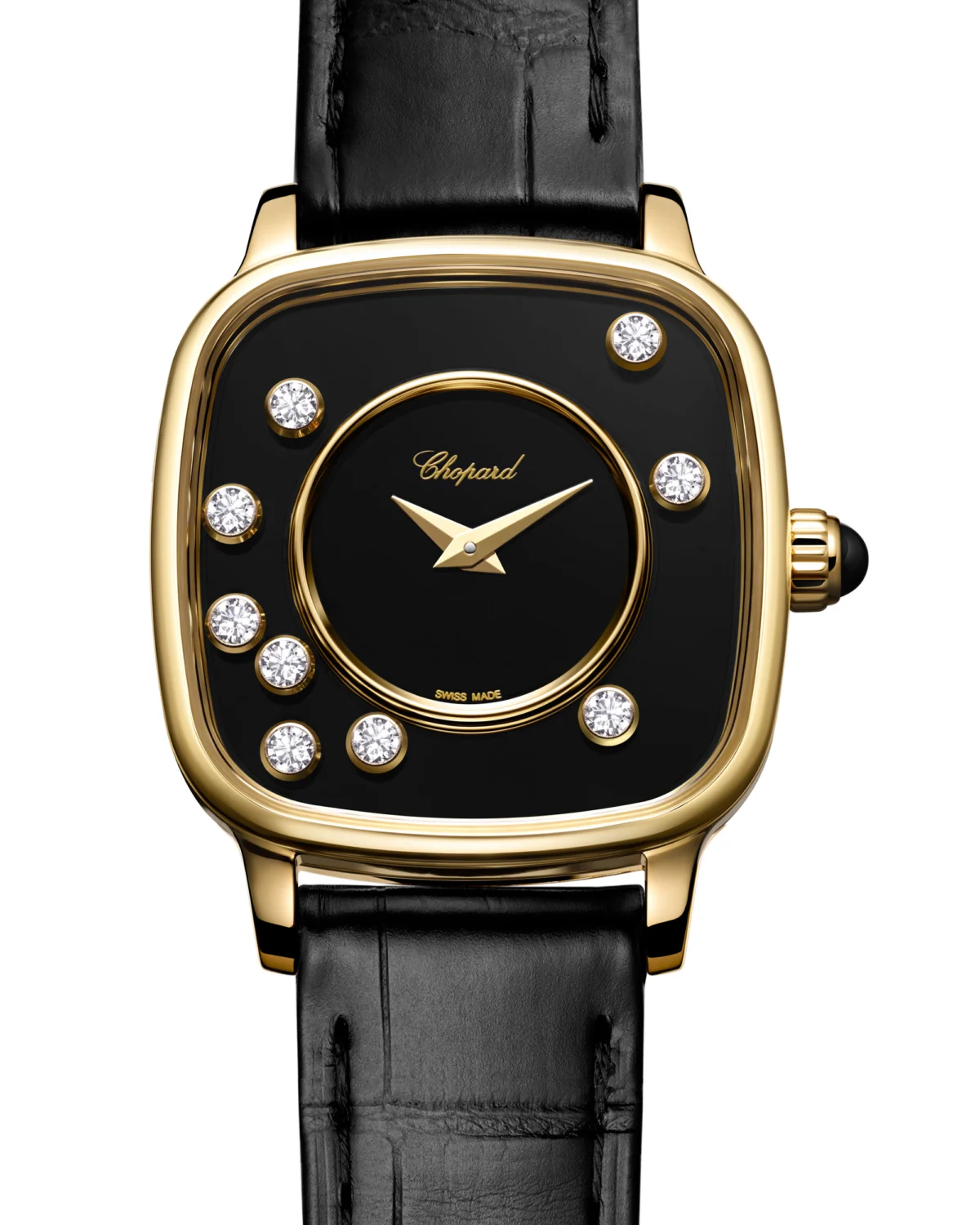
The Swiss luxury house of Chopard is marking a significant milestone in horological history this year, commemorating the 50th anniversary of its iconic Happy Diamonds collection. First introduced in 1976, the concept of "dancing diamonds"—stones that move freely between two sapphire crystals—fundamentally altered the perception of jewelry watches. To honor this half-century of innovation, the brand has released two new Chopard Happy Diamonds Heritage models. These timepieces, available in 34mm and 24mm case sizes, serve as a direct homage to the original design language that launched in the late 1970s, blending historical reverence with the technical precision of modern watchmaking.

A Legacy of Kinetic Design
The origins of the Happy Diamonds concept are rooted in a moment of serendipity during a visit to the Black Forest in Germany in 1976. Chopard designer Ronald Kurowski, inspired by the light reflecting off a waterfall, sought to create a watch where diamonds were not static, bezel-set ornaments, but rather fluid, kinetic elements. By placing diamonds in mobile gold capsules between two layers of sapphire crystal, the brand effectively "liberated" the gemstones, allowing them to glide and bounce across the dial with every movement of the wearer’s wrist.
This design was not merely an aesthetic choice; it was a technical feat. The assembly requires a precise vacuum-sealed environment to ensure the diamonds do not damage the dial or the underlying hands, while simultaneously maintaining a profile thin enough to remain elegant. Over the last five decades, this concept has expanded into the broader Happy Sport collection, but the Heritage series marks a deliberate return to the minimalist, cushion-shaped geometry of the mid-1970s models.

Chronology of the Happy Diamonds Collection
The trajectory of the Happy Diamonds line has been marked by several key developmental phases:
- 1976: The initial launch of the Happy Diamonds men’s watch, featuring a cushion-shaped case and a revolutionary floating diamond mechanism.
- 1980s: Expansion of the collection into women’s jewelry watches, incorporating bolder case shapes and integrated bracelets, solidifying Chopard’s reputation as a master of both watchmaking and high jewelry.
- 1993: The introduction of the Happy Sport collection, which pivoted the concept toward a more casual, everyday luxury aesthetic by using stainless steel, which was unconventional for a brand known primarily for gold high jewelry.
- 2026: The 50th-anniversary celebration, characterized by the release of the Happy Diamonds Heritage models, which utilize ethical 18k yellow gold and emphasize the original design purity of the 1976 debut.
Technical Specifications and Materiality
The newly released Heritage models reflect a commitment to high-grade materials and horological integrity. The 34mm model features an 18k yellow gold case with a thickness of 8.53mm, a slim profile that upholds the tradition of the refined cocktail watch. It is powered by the Chopard 10.01-C mechanical movement, a caliber consisting of 101 components, measuring 15.70mm in diameter and 2.90mm in height. Operating at a frequency of 3Hz (21,600 vibrations per hour), the movement provides a 45-hour power reserve, ensuring reliability alongside its decorative function.

The 24mm version, designed with a more compact footprint, is powered by a high-precision quartz movement, measuring 6.72mm in thickness. Both models feature deep, pitch-black onyx dials, chosen for their ability to provide a high-contrast backdrop that allows the diamonds to stand out. The 34mm variant houses 21 dancing diamonds, while the 24mm variant features nine. Both models are finished with an onyx cabochon set into the crown, a signature detail that reinforces the cohesive, monochromatic look of the collection.
Ethical Sourcing and Corporate Stance
Chopard, under the stewardship of co-presidents Caroline and Karl-Friedrich Scheufele, has positioned itself as a leader in sustainable luxury. Since 2018, the company has pledged to use 100% ethical gold across all its watch and jewelry production. This commitment is central to the identity of the new Heritage collection. The use of "ethical" gold signifies that the material is either recycled or sourced through artisanal mines that are members of the Swiss Better Gold Association or certified by the Responsible Jewellery Council (RJC).

This strategic focus on ethics has provided the brand with a distinct competitive advantage, particularly among a demographic of younger, socially conscious consumers who view the provenance of materials as being just as important as the craftsmanship of the movement.
Market Impact and Industry Positioning
The watch industry has seen a proliferation of "vintage re-releases" in recent years, as brands look to their archives to satisfy collector demand for mid-century aesthetics. However, the Happy Diamonds Heritage collection occupies a unique space. Unlike many sport watches that are re-issued with minor cosmetic tweaks, the Happy Diamonds concept remains inherently singular. The "dodge-em car" movement of the diamonds offers a tactile experience that few other complications or jewelry-watch hybrids can replicate.

Financial analysts monitoring the luxury goods sector note that the stability of the Happy Diamonds line has been a pillar for Chopard’s revenue, particularly in Asian and North American markets where the combination of jewelry and watchmaking is highly sought after. By pricing the 34mm model at $48,400 USD and the 24mm model at $24,000 USD, Chopard is positioning these pieces firmly in the high-luxury, collector-grade segment of the market.
Broader Implications for Chopard
The 50th anniversary serves as a strategic inflection point for the family-owned company. While many of its competitors have been subsumed by large luxury conglomerates, Chopard’s independence has allowed it to maintain a consistent design identity. The success of the Happy Diamonds Heritage collection suggests that the brand will continue to leverage its archive to reinforce its brand narrative: that innovation is not always about adding more complications, but about refining the relationship between the object and the wearer.

The industry consensus is that these Heritage models are likely just the beginning of a year-long anniversary campaign. Market observers speculate that additional, more limited-edition variations, potentially including platinum versions or even more intricate mechanical movements, could be unveiled at upcoming international watch trade shows.
Ultimately, the Happy Diamonds Heritage collection reinforces the idea that true luxury design is enduring. By returning to the original 1976 blueprints, Chopard is not merely repeating history; it is affirming that the playful, kinetic brilliance of its most famous innovation remains as relevant in the modern era as it was at its inception. As the watch market continues to prioritize heritage-driven design, the Happy Diamonds line remains a benchmark for how to balance the artistic demands of jewelry with the technical rigors of high horology.