











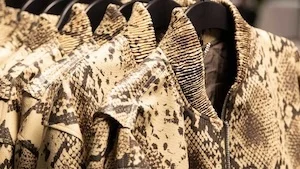
The global fashion landscape witnessed a significant technological shift on May 22, 2026, as BioFleax, a 100% plant-based performance material, made its commercial debut within the highly anticipated Stella McCartney H&M Spring 2026 collection. The material was prominently featured in a snakeskin-print bomber jacket, a centerpiece of the collaboration that signals a move away from experimental lab-scale textiles toward mass-market consumer availability. Developed by Leaf Bio, BioFleax represents a new category of "next-generation" materials designed to replicate the aesthetic and functional qualities of traditional synthetics and animal-derived leathers using exclusively renewable biomass.
This launch arrives exactly 21 years after the inaugural partnership between the British luxury designer and the Swedish retail giant, a collaboration that originally redefined the "high-low" fashion model. In 2026, however, the focus has shifted from mere brand synergy to deep-tier material innovation. The inclusion of BioFleax in a global retail collection suggests that the fashion industry is entering a phase where sustainable alternatives are no longer confined to limited-edition "concept" pieces but are being integrated into complex, high-volume supply chains.
The Evolution of the Stella McCartney and H&M Partnership
The relationship between Stella McCartney and H&M has historically served as a bellwether for industry trends. Their first collaboration in 2005 was a landmark moment for the democratization of luxury design. Two decades later, the Spring 2026 collection reflects a contemporary set of priorities: lower-impact design, supply chain transparency, and circularity.
While the 2005 collection focused on silhouette and brand accessibility, the 2026 iteration is built around the "materiality" of the garments. The decision to feature BioFleax in a snakeskin-print bomber jacket is a strategic one. Snakeskin patterns traditionally require either exotic skins or petroleum-based synthetic coatings (such as PVC or PU) to achieve the necessary texture and sheen. By utilizing BioFleax, the collaboration demonstrates that high-performance, visually complex textures can be achieved without animal inputs or fossil-fuel-derived plastics.
For H&M, the partnership serves as a vehicle to test and scale innovative materials that may eventually be integrated across its broader brand portfolio. For Stella McCartney, a lifelong advocate for animal-free fashion, the use of BioFleax represents the culmination of years of searching for a plant-based material that does not sacrifice the durability or "hand-feel" of premium textiles.
Technical Specifications: The BioFleax Platform
BioFleax is not merely a single fabric but a proprietary technology platform developed by Leaf Bio. It is engineered to bridge the "performance gap" that has historically hindered the adoption of bio-based materials in the mainstream market. Traditional natural fibers like cotton or hemp offer comfort but often lack the elasticity, water resistance, or tensile strength of synthetics. Conversely, petroleum-based synthetics like polyester and nylon provide high performance but carry a heavy environmental toll.
The BioFleax platform utilizes a three-pillar approach to material science:
- Renewable Biomass Sourcing: Unlike first-generation bio-plastics that often competed with food crops, BioFleax is derived from diversified biomass resources. This approach ensures that the raw material intake is compatible with regenerative agricultural practices and does not contribute to deforestation.
- Molecular Design: Through advanced molecular engineering, Leaf Bio is able to manipulate the polymers within the plant matter to mimic the long-chain structures found in synthetic fibers. This allows for specific "performance tunability," meaning the material can be made soft and breathable for apparel or tough and weather-resistant for outerwear.
- Process Innovation: The manufacturing process for BioFleax is designed for compatibility with existing textile machinery. This "drop-in" capability is crucial for scaling, as it allows factories to process the material without requiring massive capital expenditures for new equipment.
In the case of the snakeskin-print bomber jacket, BioFleax was engineered to accept high-definition digital printing while maintaining a structural integrity that supports the garment’s silhouette. The result is a material that offers the tactile satisfaction of a luxury product with the environmental profile of a renewable resource.
Chronology of Development and Commercialization
The journey of BioFleax from a laboratory concept to a global retail product has followed a rigorous five-year timeline:
- 2021–2022: Research and Development. Leaf Bio initiated the development of the BioFleax platform, focusing on the extraction of high-purity polymers from non-food biomass. Early prototypes focused on basic fiber strength and dye affinity.
- 2023: Pilot Scaling. The material moved into pilot production, where it was tested for "wear-and-tear" durability. During this phase, Leaf Bio began engaging with luxury brands to refine the aesthetic qualities of the material.
- 2024: Strategic Partnership with Stella McCartney. McCartney’s design team began working with Leaf Bio to customize the material for high-fashion applications. This period involved rigorous testing of the material’s reaction to various printing and finishing techniques.
- Late 2025: Supply Chain Integration. In preparation for the H&M launch, BioFleax production was scaled to meet the demands of a global retail rollout. This involved coordinating with H&M’s Tier 1 and Tier 2 suppliers to ensure the material could be cut, sewn, and finished at scale.
- May 22, 2026: Official Launch. The Stella McCartney H&M Spring 2026 collection is released simultaneously in select stores and online, featuring BioFleax as a headline innovation.
Supporting Data: The Shift Toward Next-Gen Materials
The debut of BioFleax occurs against a backdrop of rapid growth in the "Next-Gen Materials" sector. According to industry reports released in early 2026, the market for bio-based textile alternatives has seen a compound annual growth rate (CAGR) of 28% since 2022.

Data from the Material Innovation Initiative (MII) suggests that consumer demand for "sustainable" products has evolved. While "recycled polyester" was the industry standard in the early 2020s, 2026 consumers are increasingly wary of microplastic shedding and the limitations of mechanical recycling.
Key market drivers include:
- Regulatory Pressure: New EU regulations regarding the "Digital Product Passport" (DPP) now require brands to provide detailed data on the environmental impact of their materials. BioFleax’s plant-based origins and lower carbon footprint provide a competitive advantage in compliance.
- Investment Inflow: Between 2023 and 2025, venture capital investment into bio-textile startups exceeded $3.5 billion globally, providing companies like Leaf Bio with the resources needed to scale manufacturing.
- Carbon Parity: As carbon taxes on petroleum-based products have increased in several jurisdictions, the price gap between high-end synthetics and bio-based performance materials has narrowed significantly.
Stakeholder Reactions and Industry Significance
The launch has drawn praise from environmental advocates and fashion analysts alike. While Leaf Bio has remained focused on the technical success of the launch, the broader industry sees this as a proof-of-concept for circular fashion.
"The significance of BioFleax in this collection cannot be overstated," noted an industry analyst specializing in textile technology. "For years, the ‘Valley of Death’ for material startups has been the transition from a 10-meter sample to a 10,000-unit production run. By successfully navigating the H&M supply chain, BioFleax has proven that plant-based performance is ready for the mass market."
Inferred statements from the design teams suggest that the choice of the bomber jacket was intentional. Outerwear is one of the most demanding categories for materials, requiring a balance of flexibility, wind resistance, and aesthetic appeal. If a plant-based material can succeed in a technical garment like a bomber jacket, its application in softer goods like dresses or trousers is virtually guaranteed.
Furthermore, the "snakeskin" element addresses a specific ethical hurdle in the fashion industry. By providing a 100% plant-based alternative that looks and feels like exotic leather, the collaboration offers a solution for luxury consumers who are increasingly opting for "cruelty-free" wardrobes but are dissatisfied with the plastic-heavy nature of traditional vegan leathers.
Broader Impact and Implications for the Future of Fashion
The introduction of BioFleax into a mainstream collection marks a pivot point for the fashion industry’s approach to sustainability. For the past decade, the industry has focused largely on "efficiency"—reducing water use or switching to recycled versions of existing plastics. BioFleax represents a shift toward "innovation"—the creation of entirely new material streams that are regenerative by design.
One of the most critical implications of this launch is the advancement of circularity. Because BioFleax is derived from biomass and engineered at the molecular level to be compatible with natural systems, it offers a more viable end-of-life pathway than blended "poly-cotton" fabrics, which are notoriously difficult to recycle. Leaf Bio has indicated that future iterations of the material will focus on enhanced biodegradability and closed-loop chemical recycling.
Moreover, the success of this collaboration is likely to trigger a "race to the top" among other global retailers. As H&M demonstrates that high-performance bio-materials can be integrated into affordable collections, competitors will face increased pressure to move beyond recycled plastics and explore their own bio-based solutions.
As the Spring 2026 collection hits the shelves, the focus remains on consumer reception. The ultimate test for BioFleax will be its performance in the real world—how it breathes, how it ages, and how it holds up to the rigors of daily wear. If the snakeskin bomber jacket meets consumer expectations, it may well be remembered as the garment that ended the era of petroleum-based "fast fashion" and ushered in the age of performance biology.