






The fashion industry is currently navigating a profound technological shift as generative artificial intelligence moves from experimental curiosity to a cornerstone of commercial advertising. While the integration of AI promised efficiency and a new frontier of creativity, its recent prominence in high-profile publications has ignited a fierce debate regarding labor rights, the ethics of "artificial diversity," and the future of human authenticity in a world of digital perfection. This tension reached a boiling point following the July edition of Vogue, where a seemingly traditional advertisement for the brand Guess was revealed to feature a model generated entirely by silicon and code.
The Vogue Controversy and the Normalization of Synthetic Beauty
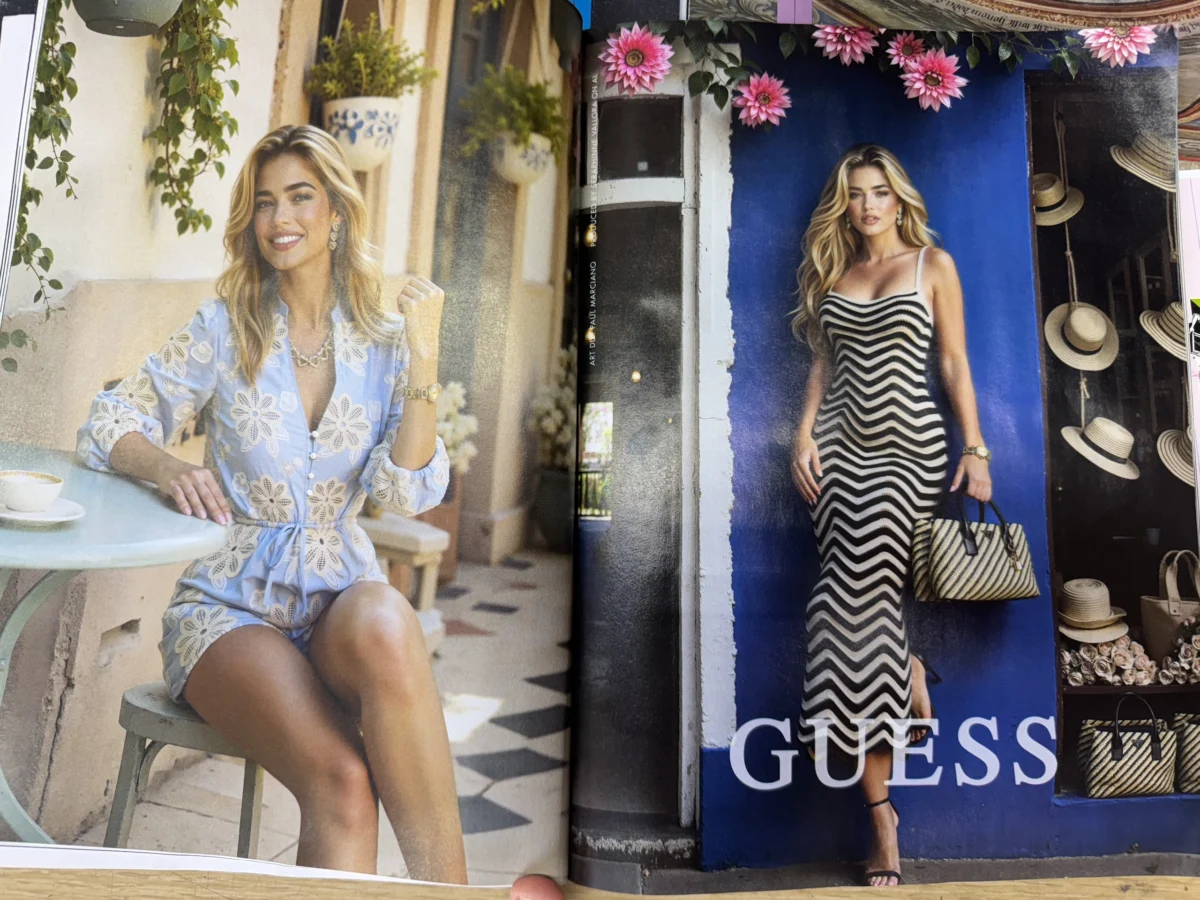
In July, readers of Vogue’s print edition encountered a full-page advertisement for Guess that featured a model embodying the brand’s classic aesthetic: a thin, blonde woman with a sun-kissed complexion and a polished, high-fashion pout. To the casual observer, the image appeared to be a standard editorial-style photograph. However, as the image circulated online, it was revealed that the model was an AI-generated construct created by the agency Seraphinne Vallora.
The reaction from the fashion community was swift and largely critical. For decades, Vogue has served as the "fashion bible," an arbiter of industry standards and cultural relevance. By allowing an AI-generated model to occupy its pages—even within an advertisement rather than an editorial spread—critics argue the publication has signaled a tacit approval of technology that could eventually render human models, photographers, and stylists obsolete.

In response to inquiries, Vogue clarified that the advertisement met its internal advertising standards, emphasizing the distinction between paid commercial content and editorial journalism. However, for many industry professionals, this is a distinction without a difference. The visibility afforded by such a prestigious platform provides AI models with a level of legitimacy that was previously reserved for the world’s top human talent.
The Economic Imperative: Cost, Scale, and the E-commerce Shift
The primary driver behind the adoption of AI modeling is economic. According to industry experts and technologists, the cost of producing traditional fashion photography has become a significant burden for brands operating in the age of social media and rapid-fire e-commerce.
Paul Mouginot, an art technologist with experience in the luxury sector, notes that working with live models involves substantial overhead, including agency fees, travel expenses, catering, hair and makeup artists, and studio rentals. Furthermore, the volume of content required today has increased exponentially. While a luxury brand in the 1990s might have produced four major campaigns a year, modern retailers often require hundreds, if not thousands, of images for their websites, TikTok feeds, and Instagram stories.
PJ Pereira, co-founder of the AI advertising firm Silverside AI, argues that the current marketing ecosystem was not built for this scale. Small to mid-sized brands, in particular, find it nearly impossible to keep up with the demand for "content" using traditional methods. AI allows these companies to take a "flat-lay" product shot of a garment and digitally drape it onto a photorealistic virtual model in any setting imaginable—all for a fraction of the time and cost of a physical shoot.

This shift is most acutely felt in the e-commerce sector. Sinead Bovell, a model and founder of the WAYE organization, explains that e-commerce is the "bread and butter" of the modeling profession. While high-fashion runway shows provide prestige, the steady income that sustains most models comes from posing for online catalogs. As brands like H&M, Mango, and Veepee increasingly turn to virtual mannequins and AI-generated avatars, the financial security of thousands of working models is placed at risk.
The Ethics of "Artificial Diversity"
The controversy surrounding AI in fashion is not merely about job displacement; it is also about the representation of identity. In 2023, the denim giant Levi’s faced a public relations crisis after announcing a partnership with Lalaland.ai to create "diverse" digital models. The company’s stated goal was to increase inclusivity by showing clothes on models of various body types and ethnicities.
However, the move was widely panned as "artificial diversity." Critics pointed out that the fashion industry has historically struggled to hire and fairly compensate human models of color. By choosing to generate diverse "avatars" rather than hiring diverse people, brands are accused of performing inclusivity while simultaneously bypassing the need to support the communities they claim to represent.
Sarah Murray, a commercial model, expressed a sense of exhaustion regarding this trend. She noted that there is no shortage of diverse human talent waiting for opportunities. When a brand uses AI to "supplement" human diversity, it effectively erases the lived experience of marginalized groups from the creative process. Bovell has termed this phenomenon "robot cultural appropriation," where a brand can project a specific identity or cultural story through a machine-generated image without actually engaging with human beings of that background.

A Timeline of the Digital Evolution in Fashion
The integration of digital humans into fashion has been a gradual process that has accelerated rapidly in the last five years:
- 2013: French retailer Veepee begins using virtual mannequins to display clothing, marking an early shift toward non-human product presentation.
- 2017-2018: The rise of "CGI influencers" like Lil Miquela and Shudu Gram. These characters, while clearly digital, began securing high-profile brand deals with companies like Prada and Balmain.
- March 2023: Levi’s announces its partnership with Lalaland.ai to generate diverse models, sparking a global conversation about the ethics of AI in inclusivity.
- Late 2024: Global retailers such as Mango and H&M begin launching entire marketing campaigns featuring AI-generated teenagers and adults.
- July 2025: The Guess AI model appears in Vogue, signaling the technology’s arrival in the most elite tiers of fashion media.
The Legal Frontier: The Battle for Likeness and Consent
As the technology becomes more sophisticated, the legal framework governing the use of a model’s likeness is under intense scrutiny. Many models have reported seeing new clauses in their contracts that allow brands to use their images to train AI systems. This could potentially allow a company to hire a model once, scan their body and face, and then generate infinite new images of that model without further compensation or consent.
In response, advocacy groups like the Model Alliance, led by founder Sara Ziff, are pushing for legislative protections. The Fashion Workers Act, currently being debated in the New York State Legislature, aims to establish basic labor rights for models and content creators. A key provision of the act would require brands to obtain clear, written consent and provide fair compensation whenever a model’s digital replica or AI-generated likeness is used.
Proponents of these laws argue that while AI is inevitable, it must be implemented in a way that protects the dignity and economic rights of the workers who provided the data the AI was trained on. Some technologists suggest that "digital twins" could eventually become a new revenue stream for top models, allowing them to "work" multiple shoots simultaneously. However, this benefit would likely only apply to a small elite, leaving the majority of the workforce without a path forward.

The "AI Artisan" and the Persistence of Imperfection
Despite the push toward automation, some believe that the human element will remain the "luxury" standard of the future. Sandrine Decorde, CEO of the creative studio Artcare, describes her team as "AI artisans." Rather than relying on generic, homogenous outputs, they use advanced tools like Black Forest Labs’ Flux to fine-tune datasets, ensuring their digital models possess the "charming imperfections"—such as asymmetrical features or a specific gaze—that define human beauty.
Decorde also points to an unexpected ethical application of AI: the children’s fashion market. The use of minors in fashion has long been criticized for potential exploitation and grueling schedules. By using AI to generate infants and children for catalogs, brands can meet market demand without subjecting real children to the pressures of a professional set.
However, even the most advanced AI struggles to replicate the "sensual reality" of a human being. Paul Mouginot suggests that the very perfection of AI models may eventually lead to their downfall in the luxury sector. As consumers become more aware of synthetic imagery, they may begin to crave the authenticity of a human story, complete with the "touch of imperfection" that a machine cannot truly understand.
Broader Implications and the Path Forward
The fashion industry’s experiment with AI is a microcosm of the challenges facing all creative professions. As AI creates the conditions where high-quality work can be produced in a fraction of the time, the value of human labor is being recalibrated.

For models, the path forward may involve a transition from being "blank canvases" for brands to becoming entrepreneurs in their own right. Sinead Bovell advises models to build personal brands and engage in storytelling—podcasting, brand endorsements, and social advocacy—to differentiate themselves from digital avatars. "AI will never have a unique human story," she notes.
Ultimately, the future of AI in fashion will likely be determined by consumer acceptance. While data shows that AI-generated content can drive high engagement and sales, the long-term impact on brand loyalty and cultural prestige remains uncertain. If the industry continues to prioritize the "cheap and fast" over the "human and authentic," it risks losing the very soul that has made fashion a cornerstone of human expression for centuries. Whether Vogue and other industry leaders will continue to embrace the synthetic catwalk or return to the human element remains the defining question of the decade.