






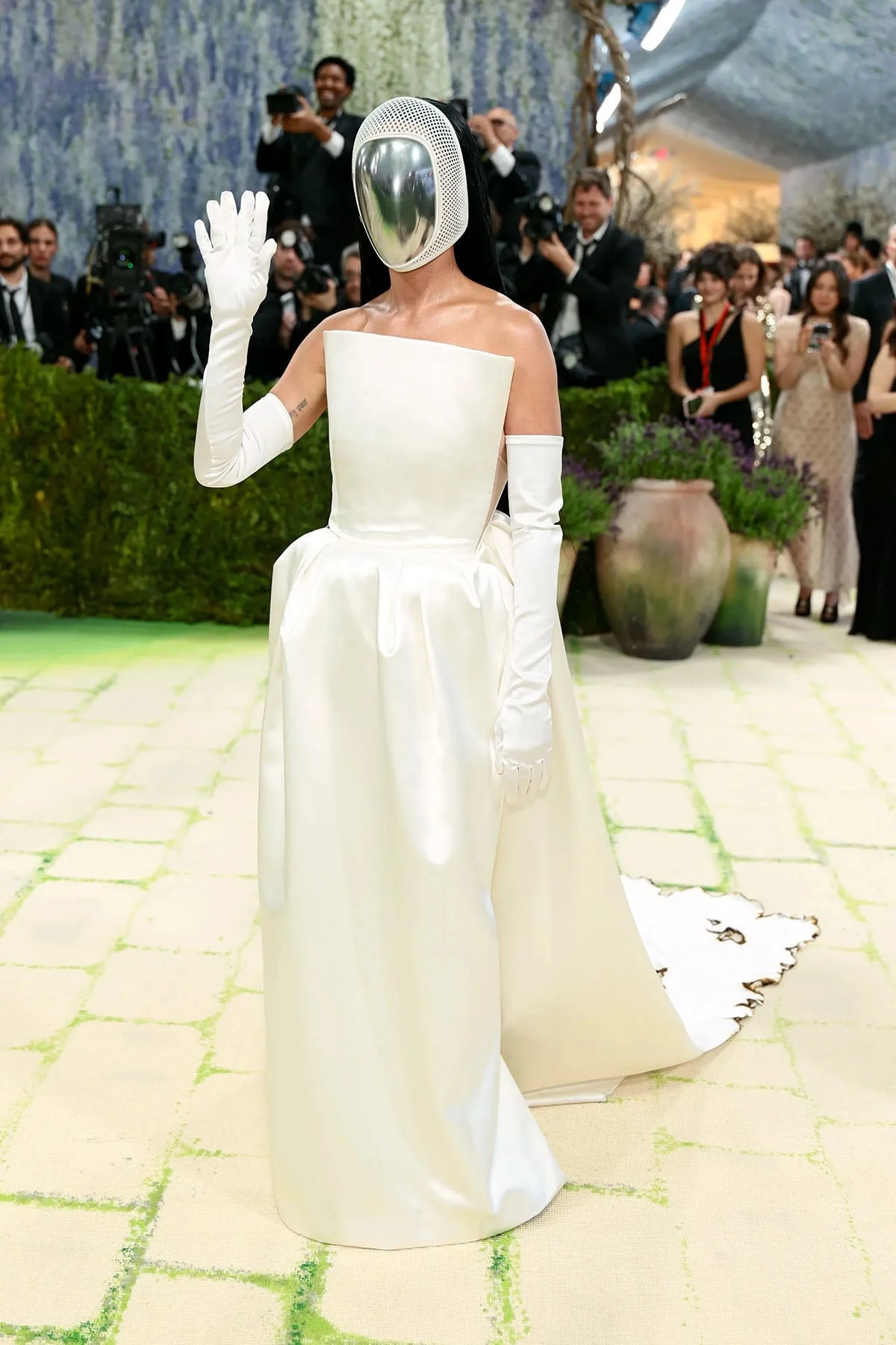
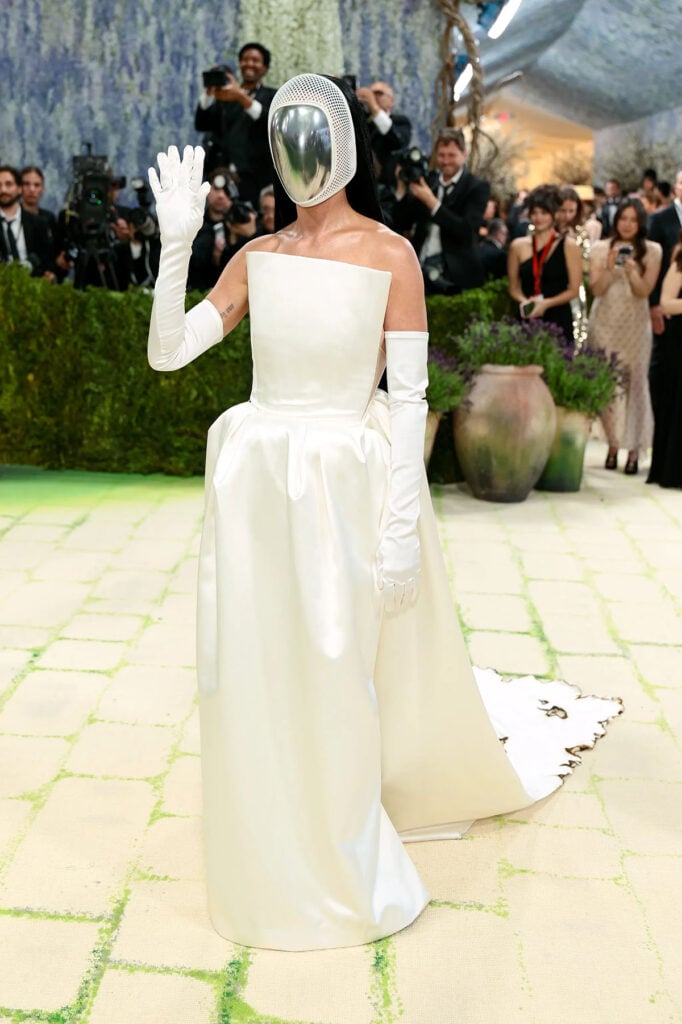
The 2026 Met Gala witnessed a significant intersection of technology, social commentary, and high fashion as Katy Perry arrived on the steps of the Metropolitan Museum of Art in an ensemble designed by Stella McCartney. While the Met Gala is traditionally a venue for showcasing craftsmanship and thematic interpretation, Perry’s appearance moved beyond aesthetic display into the realm of conceptual performance art. Wearing a stark white strapless gown characterized by a scorched, frayed train and accessorized with a mirrored face shield and six-fingered gloves, the artist presented a deliberate critique of artificial intelligence and the erosion of digital authenticity.
The ensemble, developed in collaboration with McCartney’s design house, serves as a direct response to the increasing prevalence of AI-generated imagery in the fashion industry. In recent years, Perry has become a recurring subject of "digital hallucinations," where sophisticated AI models generate hyper-realistic images of her attending high-profile events she did not actually attend. The 2026 look aims to reclaim her physical presence by leaning into the "uncanny valley"—the psychological discomfort felt when a humanoid object looks almost, but not quite, like a real person.
The Architecture of the Ensemble
The foundation of the look is a custom Stella McCartney gown crafted from sustainable, high-performance fabrics, consistent with the designer’s long-standing commitment to ethical fashion. The bodice is a minimalist, structured strapless design in a clinical white shade, providing a neutral canvas for the more disruptive elements of the outfit.
The most striking architectural feature is the train. Unlike the traditional flowing silk or chiffon typically seen on the Met Gala red carpet, this train features a "scorched" finish. The edges are blackened and frayed, appearing as though the garment has been physically corrupted or subjected to an external heat source. According to design notes from the McCartney atelier, this treatment symbolizes a "glitch in the system," representing the point where digital perfection meets physical reality and begins to break down.
The accessories provide the heavy lifting for the conceptual narrative:

- The Mirrored Mask: A reflective face shield that obscures Perry’s features entirely. By removing human expression, the look mirrors the blankness of an unrendered digital model.
- The Structured Headpiece: A geometric extension that alters the silhouette of the head, further dehumanizing the form.
- The Six-Fingered Gloves: Perhaps the most pointed commentary on AI, the elongated gloves feature an extra digit. This is a nod to a common technical flaw in early-generation AI image generators, which frequently struggled to accurately render the complex anatomy of human hands.
A Chronology of Digital Displacement
The inspiration for Perry’s 2026 appearance can be traced back to the 2024 Met Gala. During that event, despite Perry’s actual absence, an AI-generated image of her wearing a floral, moss-covered gown went viral on social media platforms including X (formerly Twitter) and Instagram. The image was so convincing that it fooled millions of users, including Perry’s own mother, who reportedly sent her a message praising the "beautiful" look.
This incident marked a turning point in the conversation regarding celebrity likeness and the "dead internet theory"—the idea that a significant portion of internet content is now generated by bots rather than humans. By 2025, the frequency of these "faked" appearances had increased, leading to legal and ethical debates regarding the right of publicity in a post-AI world. Perry’s 2026 Met Gala appearance represents the culmination of two years of digital identity theft, using the very platform she was digitally "placed" in to assert a physical, albeit distorted, reality.
Collaboration and Design Philosophy
Stella McCartney’s involvement in the project adds a layer of material integrity to the conceptual framework. McCartney has frequently explored the tension between nature and technology in her collections. For the 2026 Met Gala, the designer utilized a blend of recycled polyester and lab-grown silk, emphasizing that while the theme deals with the artificial, the construction remains rooted in tangible, sustainable innovation.
"The goal was to create something that felt like it was still loading," a representative for the design team stated during a press preview. "We wanted to capture that specific moment of digital corruption where the image is almost complete, but the errors reveal the underlying code. The scorched train is the physical manifestation of a system crash."
Industry data suggests that Perry’s choice to go conceptual aligns with a broader trend among "A-list" celebrities who are moving away from traditional glamour in favor of "statement dressing" that addresses global technological shifts. According to fashion analytics firm Trendalytics, searches for "conceptual fashion" and "AI-inspired design" have seen a 45% year-over-year increase, driven largely by red carpet moments that challenge the viewer’s perception.
Critical Analysis and Industry Response
Fashion critics have noted that Perry’s 2026 look is a departure from her previous, more literal interpretations of Met Gala themes. In 2018, for "Heavenly Bodies," she wore massive feathered wings; in 2019, for "Camp: Notes on Fashion," she famously dressed as a chandelier and later a hamburger. While those looks were celebrated for their theatricality, the 2026 ensemble is being viewed as her most intellectually rigorous contribution to the event.
"This is not about being pretty or even being seen in the traditional sense," noted fashion historian Dr. Elena Vance. "It is about the invisibility of the self in a digital age. By wearing a mask, Perry is saying that her face is no longer her own—it is public domain for algorithms. By wearing six fingers, she is mocking the very technology that seeks to replicate her."
The reaction within the tech community has been equally focused. AI ethicists point to the look as a rare example of "adversarial fashion"—clothing designed to disrupt or comment on surveillance and algorithmic categorization. The mirrored mask, for instance, is a classic trope in anti-facial recognition design, intended to bounce light back at cameras and obscure data collection.
Broader Implications for the Fashion Industry
The 2026 Met Gala comes at a time when the fashion industry is grappling with the legalities of AI. Several high-profile lawsuits are currently moving through the courts regarding the use of celebrity likenesses to train Large Language Models (LLMs) and image generators without compensation or consent.
Perry’s ensemble highlights several key issues:
- Identity Control: As deepfakes become indistinguishable from reality, celebrities are forced to adopt more extreme or "uncanny" physical styles to differentiate their real selves from their digital counterparts.
- The Value of the Physical: The scorched, frayed elements of the dress emphasize the "imperfection" of the physical world, something AI still struggles to replicate with emotional resonance.
- The Future of Creative Direction: Designers like McCartney are increasingly acting as social commentators, using the runway to address the ethical vacuum created by rapid technological advancement.
As the Met Gala concludes, the conversation sparked by Perry’s "Artificial Identity" look is expected to persist. It serves as a reminder that as the boundary between the digital and the physical continues to blur, fashion remains one of the few mediums capable of providing a tangible critique of the intangible.
The 2026 event will likely be remembered not for the gowns that followed the theme perfectly, but for the one that questioned the reality of the theme itself. Perry’s collaboration with Stella McCartney has set a new benchmark for how public figures can engage with their own digital shadows, turning a viral glitch into a permanent fixture of fashion history. Through the use of deliberate error and obscured identity, the ensemble asserts that in an era of infinite digital replication, the most powerful statement a person can make is one that proves they are undeniably, imperfectly real.