








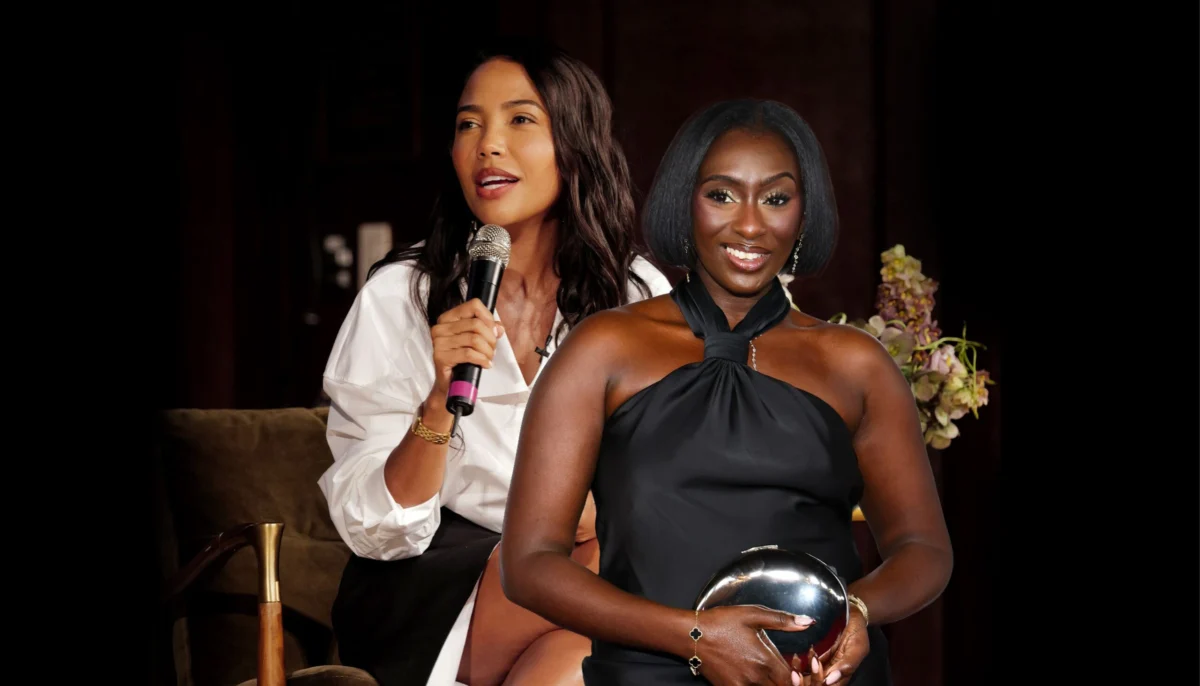
British entrepreneur Emma Grede, a prominent figure in the beauty and fashion industries, has recently found herself at the center of a public discussion ignited by her comments on the "She’s So Lucky" podcast. The controversy stems from Grede’s explanation for why she did not initially invest in Ami Colé, the makeup brand founded by Diarrha N’Diaye-Mbaye, only to later hire N’Diaye-Mbaye for a role within Skims, a brand co-founded by Grede and Kim Kardashian. Grede’s initial rationale – that she "didn’t see that" extraordinary potential in N’Diaye-Mbaye or her proposition at the time – has drawn sharp criticism, particularly from those who perceive it as a reflection of heightened and often unfair expectations placed upon Black women founders.
The crux of the debate lies in Grede’s assertion that she "doesn’t invest in first-time founders unless I think there’s something extraordinary about that founder and about that proposition." She further elaborated that her assessment of Ami Colé led her to believe "it was going to come and go." This statement, made in retrospect after N’Diaye-Mbaye had already achieved significant recognition for her brand, created a perception of dismissal. The subsequent hiring of N’Diaye-Mbaye by Skims, a move that seemingly contradicted Grede’s earlier assessment, intensified the scrutiny. This apparent shift in perspective has led many to question what, if anything, changed in Grede’s evaluation of N’Diaye-Mbaye’s capabilities and the potential of her venture.
A Contradictory Narrative: From Dismissal to Recruitment
The timeline of events is critical to understanding the public reaction. Ami Colé, launched by Diarrha N’Diaye-Mbaye, quickly gained traction in the beauty market, particularly for its focus on inclusive formulations designed for deeper skin tones. The brand cultivated a loyal following, celebrated for its "no-makeup makeup" aesthetic and its commitment to serving an often-underserved demographic. Despite this growing momentum, Emma Grede, when asked about potential investments, indicated a lack of conviction in Ami Colé’s long-term viability. Her statement suggested that she did not perceive an "extraordinary" element in the founder or the business model that would warrant her investment.
However, in a later development, N’Diaye-Mbaye was brought into the Skims organization. Grede, speaking on her own podcast, attempted to reconcile these seemingly divergent actions. She reiterated her initial assessment of Ami Colé’s independent trajectory, arguing that her decision to hire N’Diaye-Mbaye at Skims was ultimately a more beneficial outcome for the founder. Grede posited that the Skims infrastructure, mentorship, and resources offered a more robust platform for N’Diaye-Mbaye’s professional growth and impact than she might have achieved navigating the challenges of independent brand building.
This explanation, however, has been met with considerable pushback. Critics argue that Grede’s framing inadvertently reinforces a narrative where Black women entrepreneurs are held to an almost impossibly high standard. The emphasis on "extraordinary" founders and the scrutiny of their "fit" as business leaders, rather than solely focusing on product viability and market opportunity, is seen as a systemic issue. Furthermore, Grede’s suggestion that N’Diaye-Mbaye might have lacked the initial business acumen to launch a company in the first place, despite the success Ami Colé did achieve, has been particularly contentious.
The Burden of "Extraordinariness" on Black Women Founders
The discourse surrounding Grede’s comments has illuminated a broader societal and industry-wide pressure on Black women entrepreneurs. Unlike their counterparts, Black women founders often face a higher bar for securing investment and gaining market acceptance. This phenomenon is supported by industry data indicating significant disparities in venture capital funding. According to a 2023 report by Deloitte, Black women founders received only 0.4% of all venture capital funding in 2022, a figure that underscores the persistent challenges in accessing capital. This statistic highlights the systemic hurdles that Black women entrepreneurs must overcome, often requiring not just a solid business plan but an almost mythical level of perceived exceptionalism.
Social media commentary has been replete with examples and discussions pointing to this disparity. The narrative often shifts from a product’s market potential to a founder’s personal attributes, creating an additional layer of evaluation that can be disproportionately applied. Grede’s initial comments, by suggesting that Ami Colé did not meet her threshold for "extraordinary," have been interpreted by many as perpetuating this very dynamic, implying that N’Diaye-Mbaye’s initial offering was somehow less than remarkable, despite its clear market appeal and customer base.
A Nuanced Perspective: Investor-Founder Fit and Market Realities
To offer a balanced perspective, it is important to acknowledge that not every investor is the ideal fit for every brand. Investment decisions are complex and multifaceted, often involving a combination of market analysis, personal conviction, and strategic alignment. In the realm of entrepreneurship, there are numerous instances where promising ventures do not secure initial funding but later achieve substantial success. The analogy to "Shark Tank," where investors may pass on a product that subsequently thrives, is apt. Investors may decline to fund a company for a variety of reasons, including a lack of personal connection to the brand, a differing vision for its future, or a perceived lack of alignment with the founder’s leadership style.
Grede’s assessment that Ami Colé eventually closed, while factually accurate, is contextualized by the brand’s significant impact and the passion it generated among its consumers. The excitement surrounding Ami Colé, the distinct market niche it carved out, and the subsequent achievements of its founder suggest that its existence was more than a fleeting trend. To characterize its closure as simply "coming and going" might indeed feel dismissive of the considerable effort and success N’Diaye-Mbaye experienced in building a brand that resonated deeply with its target audience.
Diarrha N’Diaye-Mbaye demonstrated a clear capacity to build a cult-favorite brand before reaching her mid-thirties. Grede’s inability to recognize this "extraordinary" potential at the time of her initial investment consideration indicates that, from an investor’s standpoint, the alignment was not present. Investors are not obligated to back every promising venture. However, the subsequent framing of Ami Colé’s trajectory, especially with the benefit of hindsight, as lacking any "extraordinary" qualities, appears to disregard the brand’s tangible impact and the founder’s demonstrated vision.
Ami Colé’s Genesis: A Founder with Vision and Market Insight
Ami Colé was conceived with a specific mission: to create a "no-makeup makeup" brand tailored for and by Black and Brown women. This focus addressed a significant gap in the beauty market, where inclusivity and representation had historically been lacking. N’Diaye-Mbaye’s background provided her with a unique advantage. Prior to founding Ami Colé, she was recruited by Glossier CEO Emily Weiss in 2018. Her tenure at L’Oréal in social media strategy and her subsequent pivot into product development and innovation provided her with a deep understanding of both marketing and product creation. This experience was instrumental in shaping Ami Colé’s minimalist, skin-first aesthetic, a philosophy that resonated with an audience Glossier was not then fully serving. Therefore, N’Diaye-Mbaye was not a novice entrepreneur with a nascent idea; she was a founder with established product knowledge and astute marketing instincts.
The loyalty Ami Colé garnered is evident in the strong consumer reaction to its closure. Many customers expressed their devotion by stockpiling their favorite products, such as the brand’s popular lip glosses. This level of consumer attachment underscores the brand’s success in meeting a genuine market demand and executing its vision effectively. The closure of Ami Colé, while unfortunate, did not signify the end of the demand it served, nor did it diminish the founder’s insights or the loyalty of its customer base. Rather, the enthusiastic response to the brand’s products validated the market appetite for its offerings and the effectiveness of its execution.
Navigating Investor Sentiment and Market Cycles
N’Diaye-Mbaye herself has articulated the challenges that contributed to Ami Colé’s closure. She described experiencing a "temperamental wave of investor enthusiasm" that was notably high in 2020, a period characterized by increased focus on equity and inclusivity in investment circles. However, by the time she required crucial funding, that enthusiasm had significantly waned. This shift in the investment landscape meant that the market conditions that had facilitated Ami Colé’s launch were not the same as those present a few years later. This experience highlights a common challenge for startups: the timing of funding and the prevailing investor sentiment can be as critical as the product or market itself.
In conversations between N’Diaye-Mbaye and Grede, it appears that N’Diaye-Mbaye possessed the essential elements for success: a compelling product, a strong community of supporters, a credible background, a clear vision, and even initial investor interest. However, the critical gap may have been in the operational infrastructure required to scale the business effectively. This is a frequent reason for startup failure, often less about the product or market viability and more about the capacity to transition from building a foundation to sustaining rapid growth.
The challenges faced by Pat McGrath Labs, another prominent Black woman-led beauty business that has recently encountered financial difficulties, offer a parallel. Despite beloved products, a dedicated community, and a sound vision, discussions surrounding its struggles often revert to the founder’s actions or perceived shortcomings. Grede’s career, built on understanding how access to capital, strategic investment, and the right infrastructure can shape a brand’s destiny, makes her explanation of the Ami Colé situation particularly noteworthy and, for some, difficult to reconcile.
The Irony of Access and Operational Expertise
The success of brands like Skims and Good American, in which Grede has played a pivotal role, underscores a critical point: traditional business acumen is not always a prerequisite for building a successful company. Instead, access to operational expertise, strategic partnerships, and robust investment can be the driving forces. Grede has herself spoken about the model behind Good American, which deliberately pairs a strong product (denim) with leveraging "talent" to unlock audience reach. In this partnership with Khloé Kardashian, Grede’s operational experience is complemented by Kardashian’s significant visibility and influence, a synergy that has been instrumental in building a customer base and driving business growth.
Similarly, the success of Rhode, Hailey Bieber’s skincare brand, illustrates this model. Co-founded with Michael D. Ratner and Lauren Ratner, the brand was built around Bieber’s creative vision, with the Ratners focusing on establishing the brand’s architecture and scaling operations. Lauren Ratner has emphasized the importance of marketing, content, and community building in Rhode’s growth trajectory, which ultimately led to its acquisition by e.l.f. Beauty for a reported $1 billion.
In both these instances, founders with cultural capital and influence were paired with experienced operators capable of building and scaling businesses, supported by substantial and patient investment. Whether such a supportive and strategic investment environment was ever genuinely available to Diarrha N’Diaye-Mbaye for Ami Colé remains a pertinent question.
Conclusion: Rethinking "Extraordinary" in the Context of Equity
By suggesting that Ami Colé was not "extraordinary," Grede inadvertently reinforces the expectation that Black women founders must operate at a level of exceptionalism far beyond that demanded of their peers. Securing investment is a challenge for all entrepreneurs, but it is demonstrably more difficult for women of color. When N’Diaye-Mbaye capitalized on the post-2020 wave of investor interest, she was acting strategically, leveraging the resources and opportunities available to her at that moment. Her actions were a testament to her belief in her vision and her determination to build her brand in a window of perceived opportunity.
The Ami Colé narrative, as discussed, ultimately highlights the critical need for investors to recognize and support promising ventures, particularly those led by underrepresented founders, not just based on perceived "extraordinariness" but on tangible market potential, demonstrable vision, and a commitment to fostering equitable growth. The story serves as a reminder that while individual assessments of potential are subjective, the systemic barriers faced by Black women founders require a more conscious and proactive approach to investment and support, ensuring that promising brands are not dismissed prematurely but are instead provided with the extraordinary support they deserve.