










The horological world, particularly the passionate community surrounding Rolex, was once again abuzz with the recent unveiling of a new iteration of the legendary Cosmograph Daytona. This year’s introduction, the reference 126502, has ignited fervent discussion and meticulous analysis among collectors and industry observers, a reaction characteristic of Rolex’s strategic approach to its most iconic timepieces. While appearing subtly different to the untrained eye, the 126502 incorporates several key updates, including a refined enamel dial, an open caseback, and the strategic use of platinum, all contributing to a significant increase in its price point. This release, positioned as an "off-catalog" model, underscores Rolex’s methodology of gradual enhancement rather than radical redesign for its flagship chronographs.

Genesis of the Daytona and Rolex’s Evolutionary Strategy
The Rolex Cosmograph Daytona, first introduced in 1963, has cemented its status as one of the most coveted and recognizable wristwatches globally. Its legacy is intrinsically linked to motorsport, particularly the Daytona International Speedway, from which it derives its name. Over the decades, the Daytona has undergone a series of evolutions, each meticulously managed to maintain its iconic silhouette and appeal. Rolex’s philosophy is one of incremental improvement, a deliberate strategy to preserve the watch’s timeless design while incorporating technological advancements and material refinements. This approach ensures that each new generation is both familiar and desirable, fostering enduring demand and a robust secondary market. The 2023 update to the steel Daytona, reference 126500LN, exemplifies this, showcasing subtle but significant enhancements that preserved the core identity of the watch. The 126502 continues this tradition, offering a glimpse into potential future directions for the collection.
Key Features of the Rolex Cosmograph Daytona 126502
The reference 126502 distinguishes itself through a series of carefully considered updates:

Rolesium Case Construction
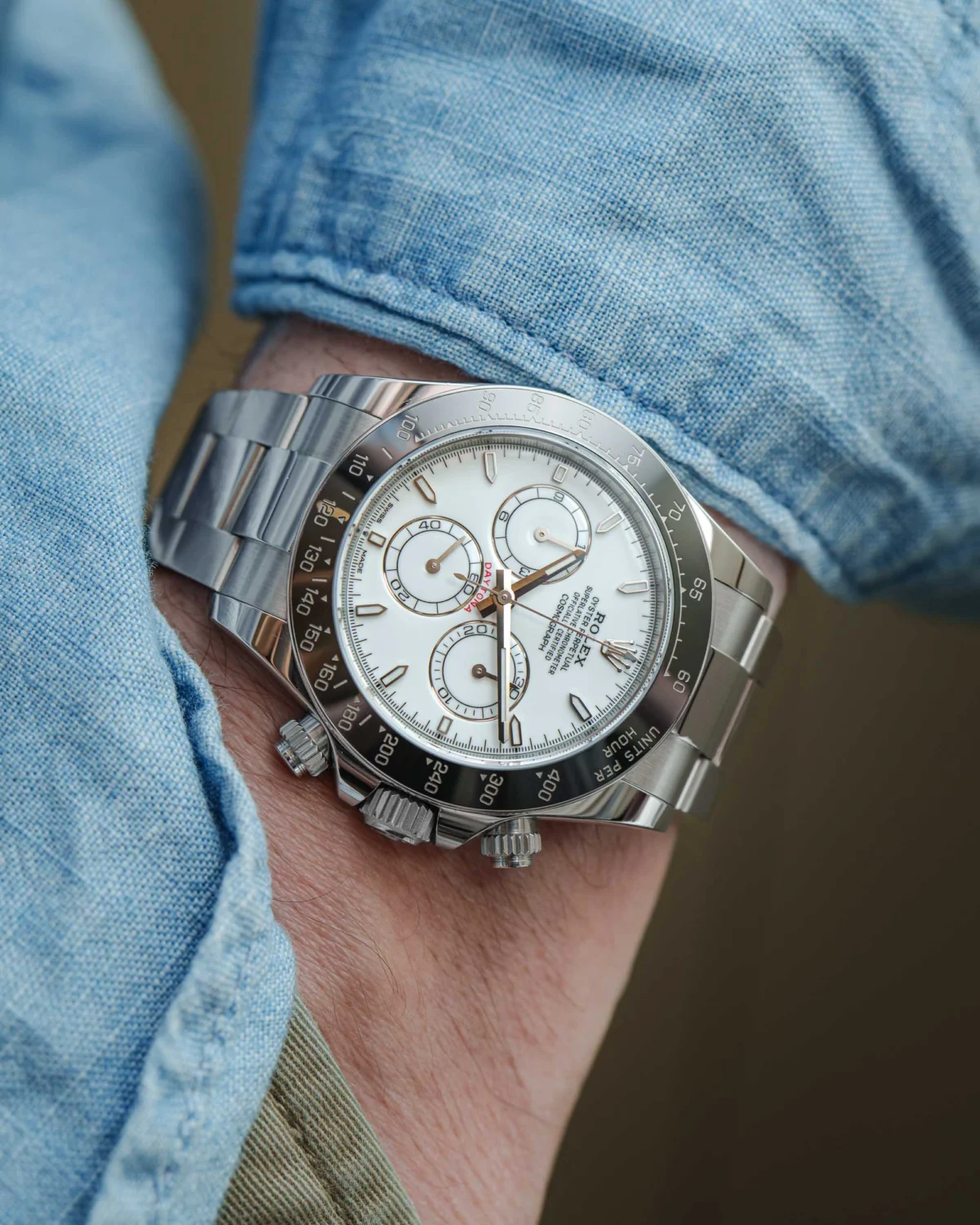
A primary talking point is the incorporation of "Rolesium" into the case design. This term, previously exclusive to Rolex’s Yacht-Master collection, denotes a specific combination of Oystersteel (Rolex’s proprietary 904L stainless steel) and platinum. In the 126502, Rolex has utilized platinum for the thin band encircling the bezel and for the caseback ring. The main 40mm case body remains constructed from 904L stainless steel, a material known for its exceptional corrosion resistance and polishability. This strategic use of platinum adds a subtle heft and a distinct visual accent, differentiating it from standard steel Daytonas without the substantial weight of a full platinum case. The price point reflects this material choice, with the 126502 retailing at $57,800 USD.
Refined Ceramic Bezel
The bezel of the 126502 features an updated construction and aesthetic. Instead of the standard black Cerachrom insert found on many Daytona models, this iteration utilizes a new ceramic composite composed of zirconia and tungsten carbide. This material is purported to offer enhanced scratch resistance. Visually, the bezel insert presents an anthracite hue, a shade lighter than the conventional black, and exhibits a subtle metallic luster that is more apparent in person than in static images. Furthermore, the engraved markings on the bezel have been refined. The numerals are now vertically aligned, improving readability, and the engravings themselves are filled with platinum using a PVD process. This attention to detail, while perhaps not critical for the watch’s primary function as a chronograph for most users, adds a layer of technical sophistication.

The Enamel Dial: A Matter of Precision
Perhaps the most discussed feature of the Rolex Cosmograph Daytona 126502 is its white enamel dial. While initial reports and Rolex’s own communications may have alluded to "Grand Feu" enamel, a closer examination reveals a more nuanced approach. True Grand Feu enamel involves fusing powdered glass directly onto a metal base at extremely high temperatures, a process demanding multiple firings and meticulous control to prevent cracking, often resulting in a 40-50% failure rate. This traditional method, prized for its depth and luminosity, is found in high-end timepieces from various brands.
The dial of the 126502, while undeniably beautiful and possessing the characteristic milky sheen of enamel, is achieved through a different technique. Rolex has employed a process where powdered glass is fused to ceramic bases for the main dial and the three sub-dials. These ceramic components are then fired and subsequently affixed to a brass plate. This method, often referred to as a glaze, is less demanding than true Grand Feu enamel as ceramic is more heat-resistant and the glass is not directly fused to metal. While it yields a visually similar, highly desirable finish, it represents a more accessible and less technically complex manufacturing process. Despite the terminology debate, the dial’s aesthetic appeal is undeniable, featuring the classic sunken sub-registers and the iconic red "DAYTONA" inscription.

Open Caseback and Caliber 4130
The 126502 marks a significant moment as it is only the third Daytona model to feature an open caseback, following the full platinum production model and limited Le Mans editions. This allows enthusiasts to admire the intricate workings of the Rolex caliber 4130 automatic chronograph movement. This movement, widely regarded as a benchmark for automatic chronographs, incorporates Rolex’s proprietary technologies such as the Chronergy escapement, Parachrom hairspring, and Paraflex shock absorbers. The display caseback showcases a skeletonized yellow gold rotor and carefully decorated plates, with a deliberate detail being the positioning of the red "DAYTONA" text on the movement to mirror its counterpart on the dial.
Market Reaction and Implications
The introduction of the Rolex Cosmograph Daytona 126502 has predictably elicited a strong reaction from the watch enthusiast community. The "off-catalog" status suggests limited production, further amplifying its desirability and likely contributing to a significant premium on the secondary market. This strategy by Rolex, focusing on subtle yet impactful updates to its most iconic models, consistently generates immense demand, often exceeding supply.

The substantial price difference between the standard steel Daytona and the 126502, approximately $49,000 USD, raises questions about value proposition for some observers. While the platinum elements and the refined enamel dial contribute to the cost, the decision to employ a glaze rather than true Grand Feu enamel, coupled with the advanced manufacturing techniques already present in standard steel Daytonas, prompts discussions about the pricing logic. However, in the realm of Rolex, perceived value and brand prestige often transcend purely material cost.
The implications of this release are multifaceted. It demonstrates Rolex’s ongoing commitment to refining its core offerings, showcasing advancements in materials and finishing techniques. The open caseback, a feature historically reserved for specific lines, suggests a potential broader application in future models, offering collectors a more intimate view of Rolex’s horological prowess. The updated bezel design and materials also hint at future aesthetic directions for the Daytona.

The Enduring Allure of the Daytona
Despite the critical examination of its specific features and pricing, the Rolex Cosmograph Daytona 126502 remains an undeniably accomplished timepiece. Its historical significance, iconic design, and robust functionality are undisputed. The practical considerations, such as the screw-down pushers, are well-documented and often accepted as part of the Daytona’s character.
The 126502 serves as a testament to Rolex’s masterful ability to cultivate desire through meticulous evolution and strategic marketing. It excites collectors about incremental changes, showcasing innovations that may gradually filter into more accessible models. Ultimately, the true "wizardry" of Rolex lies in its capacity to generate such profound enthusiasm for a watch that, for the vast majority of enthusiasts, will remain an aspiration rather than an acquisition. The off-catalog Rolex Cosmograph Daytona 126502, priced at $57,800 USD, is a prime example of this enduring phenomenon. For further details, interested parties are directed to the official Rolex website.