









The allure of shimmer and sparkle is making a triumphant return, echoing the iconic aesthetics of the early 2000s. From the futuristic visions painted by Britney Spears in her "Oops!… I Did It Again" music video to the ubiquitous sparkle that defined a generation, body glitter and gemstone adornments are once again taking center stage. This trend is not confined to music videos; it’s manifesting on red carpets, social media, and in the burgeoning beauty collections of influential figures. Stars like Zara Larsson, Tyla, and Sabrina Carpenter are embracing the glitterati, while the cultural phenomenon that is HBO’s "Euphoria" has placed body glitter in a prominent spotlight, arguably deserving of its own IMDB credit.
Donni Davy, the lead makeup artist behind "Euphoria" and founder of Half Magic Beauty, offers a compelling theory for this resurgence. "We’ve been in a ‘clean girl’ makeup trend for a while now," Davy explains. "And whenever something has been popular for a long time, there’s a tendency to go in the other direction. It makes sense that glitter and shimmer are coming back, and I’m here for it." This cyclical nature of fashion and beauty trends suggests a natural pivot away from minimalism towards maximalism, with glitter serving as a potent symbol of celebratory self-expression.
.jpg)
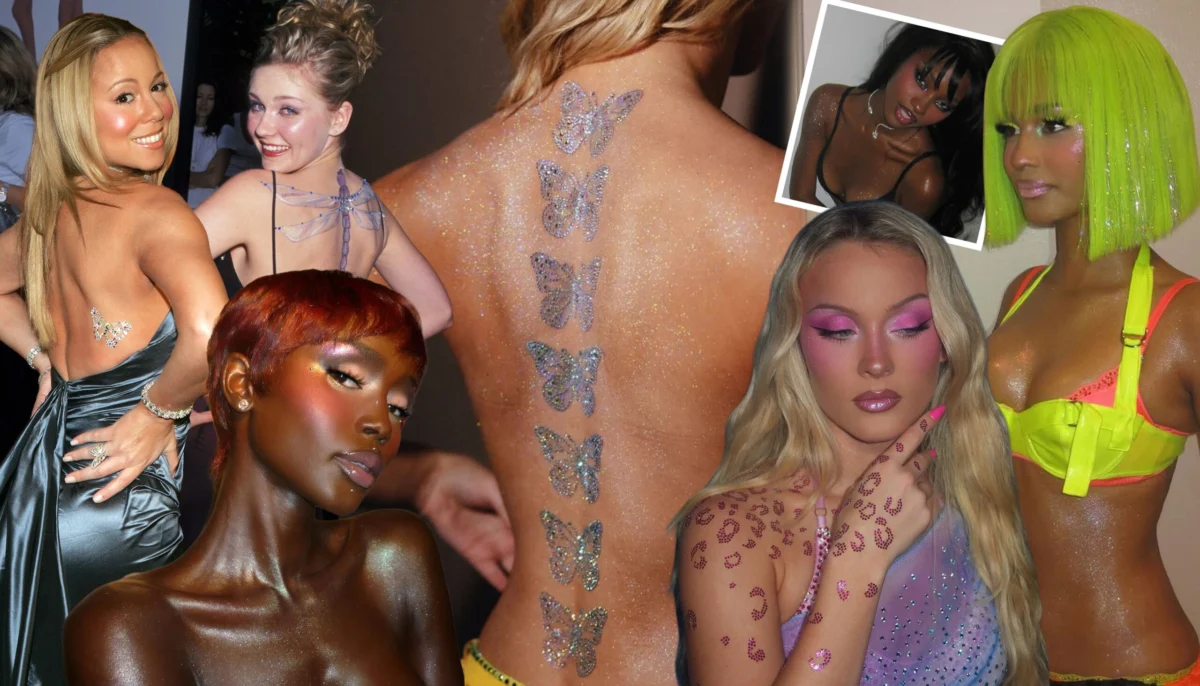
Beyond loose glitter, the trend extends to crystal-coated adhesive body stickers, a staple of millennial proms, which are experiencing a significant revival. Zara Larsson was recently seen sporting intricate butterfly "tattoos" on her back, a testament to the enduring appeal of these adhesive embellishments. Lucas Stowe, the performance-wear designer and artist behind Larsson’s look, notes that the current interest is bridging generational gaps. "Gen Alpha and Gen Z are seeing these things as new," Stowe observes, drawing parallels to the fascination with Lisa Frank stickers. "I remember loving them. For [my generation], that was so exciting and new. It’s funny to [witness] Gen Z-ers seeing them through new eyes. To us, it’s nostalgia." This phenomenon highlights how Y2K aesthetics, once dismissed by some as fleeting trends, are now being rediscovered and reinterpreted by new generations, imbuing them with fresh cultural significance.
A Deep Dive into the Glitterati: Historical Context and Evolution
The history of glitter as a cosmetic and adornment is more nuanced than a simple Y2K trend. Its origins can be traced back to 1934, when machinist Henry Ruschmann of Bernardsville, New Jersey, developed an early form of glitter for industrial coatings by processing Mylar film and metallic powder. However, it was in the late 1990s and early 2000s that glitter truly cemented its status as a pop culture accessory, becoming synonymous with the era’s burgeoning music scene and televised music video culture, particularly on platforms like MTV’s TRL.

Charlie Riddle, makeup artist and Stila’s global beauty director and head of artistry, recalls this period vividly. "Think back to the days of Britney and Christina," Riddle says. "They were all about being glowy, yet almost futuristic. People were using glitter on the arms, chest, legs, anywhere that could catch the light." This era saw glitter applied with abandon, transforming skin into a canvas of shimmering light.
Complementing the loose glitter, rhinestone adhesives, reminiscent of Mariah Carey’s iconic butterfly adornment around 2001, also played a pivotal role. Ngozi Edeme, a makeup artist, reflects on this trend: "All the baddest video vixens had some of the body art we see today, from bedazzled tramp stamps to belly button rings." This period was characterized by an unapologetic embrace of adornment, a stark contrast to the more subdued beauty trends that would later emerge.
The personal connection to this era’s beauty is profound for many. The author recalls a personal history steeped in body glitter, where even school uniforms were accessorized with a liberal application. Brands like Bath & Body Works’ Art Stuff range and Jessica Simpson’s edible body powders from Dessert Beauty served as early introductions to more sophisticated formulations like Benefit’s Kitten Sparkling Body Shimmer and Urban Decay’s Cocoa Body Powder, which offered not just shimmer but also sensory experiences like chocolate flavoring. Wende Zomnir, founder of Urban Decay, which was later acquired by L’Oréal Paris, notes the cultural context of glitter’s rise: "Body glitter blew up back then because it was a natural extension of the moment: girl-led rock bands, brands like Urban Decay shaking up the makeup landscape; permission was given."

The impact of these Y2K-inspired adornments was far-reaching, influencing both music videos and red carpet appearances. Stars like Kirsten Dunst and Salma Hayek embraced body art, with Hayek famously sporting butterfly designs at the 1998 MTV Video Music Awards, potentially hand-painted before the widespread availability of adhesive stickers. At the 1999 premiere of "Drop Dead Gorgeous," Dunst opted for a dragonfly design embellished with rhinestones. Makeup artist Molly R. Stern recalls the DIY approach of the time: "We were getting all of our supplies from the art store back then. If we could stick it on our face or body, we did." These elaborate designs often served as the focal point of an ensemble, with color schemes meticulously matched to eye makeup or attire.
The "more is more" philosophy permeated the application of body glitter and shimmer during this period. Lori Taylor Davis, global pro lead artist at Smashbox, describes the look: "Think, collarbones glazed in shimmer oils, shoulders dusted in sparkle, and tiny rhinestones framing the eyes made luminous skin a statement. It wasn’t subtle; it was seen. It was about glow, and catching the light from every angle." This approach extended to all visible skin, from décolletage to legs, seamlessly integrating with the era’s fashion trends, including low-rise jeans and revealing cutouts.
By the mid- to late-2000s, while the broader trend shifted towards more subtle shimmer, artists like Mylah Morales kept the glitter flame alive with performers like Kesha, ushering the aesthetic into its "indie-sleaze" phase. Morales explains the inspiration: "With Kesha, the inspiration is always rooted in rock-and-roll glamour and a ‘more is more’ philosophy. We looked at ’70s disco-era icons and glam-rock legends, but modernized it. The goal was to make the glitter look like it was radiating from her skin rather than just sitting on top of it. We wanted her to look like a celestial creature caught in a strobe light." This approach demonstrated how body adornments could be an integral part of a holistic aesthetic, blurring the lines between makeup, fashion, and performance.

The Modern Renaissance: Innovation and Refinement
The current revival of body glitter and gemstone adornments is not merely a nostalgic rehashing of past trends. Contemporary formulations boast significant advancements in texture, wearability, and safety. Donni Davy notes, "Glitter has gotten more sparkly and the textures are less chunky. It’s more refined, and the colors are also more sophisticated."
Cosmetic chemists Victoria Lu and Gloria Fu of Chemist Confessions highlight the evolution of formulas. "Back in the ’90s and early 2000s, body glitter formulas were usually simple, large plastic glitter particles suspended in basic gels or oils, with more focus on visual impact," Lu explains. "The concept is fun, but the actual formula and material were less than ideal with goopy, greasy textures." Fu adds, "Today, you can find better base systems like lightweight gels, dry-touch oils, even serum-like textures, and more skin care-inspired products with better comfort and wearability. There’s also more awareness around the glitter material itself to improve eye safety, general skin irritation, and glitter’s overall environmental impact." This focus on advanced formulations and sustainable materials signifies a more conscious and sophisticated approach to embellishment.

Mastering the Shimmer: Application Techniques for 2026
Achieving a flawless glitter or gemstone look in 2026 requires a strategic approach to application. Experts emphasize the importance of skin preparation to ensure longevity and prevent transfer. "You want to keep the skin slightly tacky," Davy advises. "A slightly dewy or tacky base will help the glitter stick better."
Lori Taylor Davis recommends a layered application process. "If the skin isn’t prepped, glitter can look patchy instead of luminous," she states. "I build in layers, starting with a base for hydration, then adding a tack layer like a balm, mixing medium, or adhesive where needed." This multi-step process ensures that the glitter adheres evenly and maintains its vibrancy throughout the day or night.

A crucial distinction in modern glitter application is the use of body-safe cosmetics over craft glitter. Linnea Sumner, a special effects and beauty makeup artist at New York City’s Kimara Ahnert Studio, stresses this point: "Craft glitter can have sharp edges not suitable for skin. Even if you don’t feel the sharp edges putting it on, you’ll definitely feel it taking it off, especially around your eyes." Using a brush to press, rather than swipe, the glitter into place is also recommended for optimal adhesion.
Strategic placement is key to maximizing the visual impact of glitter and gemstones. Davis suggests thinking like a sculptor, focusing on high points like collarbones, shoulders, and cheekbones, which naturally catch the light. Following the body’s natural contours can create an elongating effect. Asymmetry is also encouraged to add an element of edginess to the look. A final mist of a robust setting spray, such as those from Kryolan, Mehron, Ben Nye, or high-hold beauty brands like One/Size or Skindinavia Bridal, is essential to create a barrier and lock the embellishments in place.
Adhering to Artistry: The Application of Body Stickers and Gems

Unlike glitter, which benefits from a slightly tacky base, body stickers and individual rhinestones require a clean, dry surface for optimal adhesion. Lucas Stowe advises against using spray tan or body oil in the application area and recommends cleaning the skin with rubbing alcohol beforehand. Stowe’s creative process often begins with digital renderings, drawing inspiration from diverse sources like Cher, "The Rocky Horror Picture Show," drag culture, and Lisa Frank. The adhesive on these stickers is engineered for extended wear, even through demanding performances.
For beginners, Stowe suggests starting with smaller stickers on flat areas of the body, avoiding friction points where clothing might cause them to peel. For curved areas or to enhance security, he recommends using eyelash glue as a supplementary adhesive, or for affixing additional rhinestones around a design.
For those creating custom rhinestone designs, Edeme suggests mapping out the pattern with a white pencil on dry, alcohol-cleaned skin. Laying out the rhinestones and adhesive on a plate, then using a rhinestone picker tool or tweezers, facilitates precise placement. Sumner recommends Duo Brush-On Clear Adhesive for its brush applicator, advising to apply the glue to the skin rather than the gem itself to prevent sticky fingers.

Ultimately, the application of body stickers and gemstones is an invitation for personal expression. "Have fun with it and let the design reflect your personality," Edeme encourages. "Explore animal prints, flower designs, or even tattoo designs." The versatility of these adornments allows for a wide range of creative interpretations, from intricate freehand designs to bold graphic statements, ensuring that each application is as unique as the individual wearing it.
The Cultural and Commercial Impact of the Glitter Revival
The resurgence of body glitter and gemstone adornments is more than a fleeting beauty trend; it represents a broader cultural shift towards unapologetic self-expression and a playful embrace of nostalgia. The Y2K era, once characterized by its distinctive aesthetic, is being re-examined through a contemporary lens, with new generations finding inspiration in its bold and uninhibited spirit.

This revival has significant commercial implications, driving demand for innovative glitter formulations, adhesive embellishments, and specialized application tools. Brands are responding by launching new collections and reintroducing beloved products, tapping into the growing market for maximalist beauty. The increased awareness around sustainable and body-safe glitter also signifies a maturation of the market, catering to a more discerning consumer.
As this trend continues to gain momentum, it promises to redefine beauty standards, encouraging individuals to embrace their sparkle and adorn themselves with confidence and creativity. The future, it seems, is indeed bright, shimmering, and delightfully glittery.